
Nikola Tesla Articles
Thomas A. Edison, Mankind's Benefactor
Impressions of the Great Inventor Who Proposes to Cheapen Building of Houses
Famous Genius, Who Has Enriched Nearly Every Field of Human Endeavor, Toils For Days Without Sleep or Food — A Persistent Worker With Quite a Vein of Dry Fun. Joke Played on a Quaker
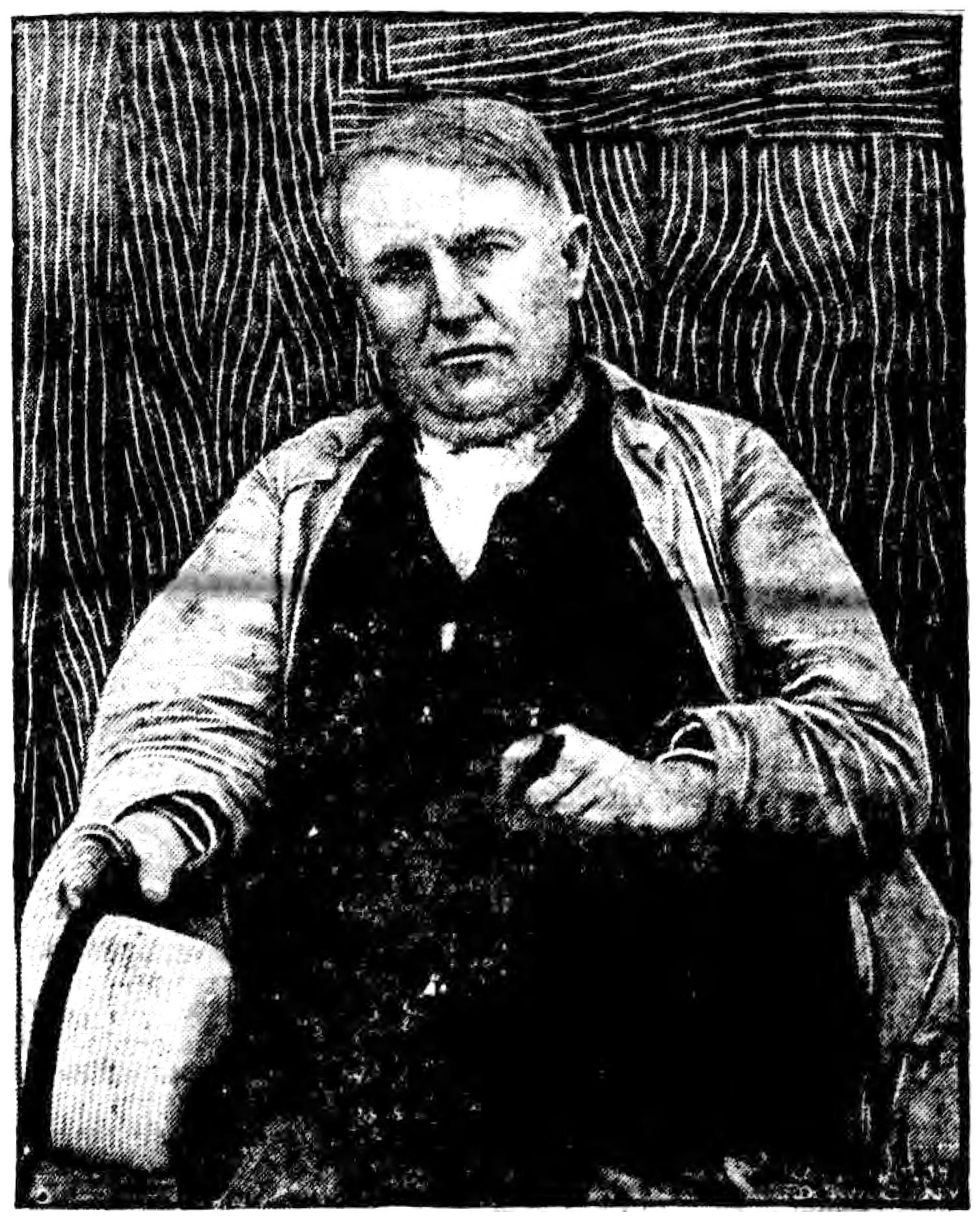
WHEN in some future age the world looks back at the really great figures of the nineteenth and twentieth centuries it is not impossible that the perspective of time will make Thomas A. Edison appear the largest of the group. His activities have been so multifarious and his inventions have been so startling, so numerous, and have so covered every field of human activity that it is impossible for us to take in the real dimensions of the man or to measure the widespread effect of his work on the progress of the world.
Among his inventions may be mentioned the automatic repeater in telegraphy, the quadruplex telegraph, the printing telegraph, the carbon telegraph transmitter, the megaphone, the phonograph, the kinetoscope, the mimeograph and the incandescent light system. His patents run into the thousands. There is scarcely a field of human endeavor that has not been enriched by them. Now he proposes to revolutionize the architecture of the world by the erection of concrete houses made in a few hours by the pumping of the concrete into molds. By this means the great inventor believes that within a few years it will be possible for practically every man to own his home, as these concrete structures can be reared at a cost so much less than is now needed for brick, frame or stone houses as to be a trifle in comparison. Already he has brought light, music and entertainment to the poor, and now if he can give to each toiler that greatest of all blessings, a home, no benefactor of the human race will have wrought more powerfully for the happiness and prosperity of the race than this man, who, starting as a poor boy himself, has done so much to transform the face of the world.
Works Days Without Food or Sleep.
Perhaps the greatest secret of Thomas A. Edison’s power is concentration. For hours, aye, for days at a time, he will shut himself in his dark room and without sleep or food will devote himself to the working out of some intricate chemical or mechanical problem. His own mental world is so complete within itself that he can live in it and become unconscious of all the world outside. This is not only true of him in his laboratory, but in all the other affairs of life, even in his reading. It is said of him that he scarcely ever reads a book unless it is called to his attention by his wife or some friend. Mrs. Edison tells one story that illustrates this peculiarity. Noticing one night that her husband was becoming abstracted over some problem, she asked him if he had read “The Count of Monte Cristo.” He said he never had and asked if it was good. On being assured on this point he said:
“All right. I guess I’ll read it now.”
The problem was laid aside, and the world was forgotten till that book was finished. When the last word had been devoured Edison glanced at his watch and found it was 5 in the morning. He thought it too late to go to bed, so he went to his workshop and toiled on for twelve hours without food or sleep. A man who has as much concentration as that is bound to win out.
Persistence is another of the Edisonian traits. In his invention of the incandescent light he made failure after failure in his efforts to discover the proper material. Never daunted, he at last struck upon the thing seemingly by accident. It is said by inventors that nine-tenths of the great discoveries are made in just that way. “Accidents,” we call them, yet that much abused word may be only a cloak to hide our ignorance, so little do we know of the secret springs that move the universe. In the divine nomenclature they may have a more intelligible and appreciative name. It is hard to think of an “accident” in a system so perfectly adjusted as that of nature. Moreover, it is a comforting thought that after a man has tried to solve a problem for months and even years one of these “accidents” happens along, clears up his difficulties and makes his pathway open and plain to the goal of success.
His Venture In Journalism.
Thomas Alva Edison was born in Ohio nearly sixty years ago. He received little schooling except the instruction given him by his mother. At the age of twelve he was a newsboy on the Grand Trunk railroad. It was here that he ventured into journalism. Gathering together a handful of type and a very small and very old job press, he printed a diminutive paper called the Grand Trunk Herald. The railroad men gave him an old smoking car for an office, and after a time he had a circulation of 500. Edison not only edited the little sheet, but set it up, printed it, circulated it and solicited the “ads,” and subscriptions. In a word, he was the whole editorial, business and mechanical staff.
The careers of men often turn on events so trifling that the world again calls them “accidents.” With such a start as the Grand Trunk Herald it would seem that fate had cut out Thomas A. Edison to be a shining light as an editor. But the lad’s mind was so keen for investigation that he tried some mechanical experiments in his smoking car office, and as a result he had a disastrous fire that burned up his newspaper outfit. He then studied telegraphy, became an expert operator and worked on the key in various places in the United States and Canada. In these days he was called “Crazy Tom.” Almost every great man is called crazy by people who do not understand him because he is so different from themselves. Edison slept about as little then as now, spent all the time out of office hours working on inventions and often arrived at the office late through his preoccupation over some big problem. He spent all his money for tools and apparatus and patronized the free lunch counters when he wanted anything to eat. As for clothes, he seemed unconscious of what he had on and for the most part went rather shabby in order that he might have more money for experiments. Yet there is one record of his having spent $30 for a new suit. The next day he was experimenting in the workshop with a bottle of sulphuric acid. Suddenly it exploded, and acid covered him from head to foot. That new suit was ruined. “What I get for putting so much money in a suit,” was Edison’s only comment.
At another time he tried to make some gun cotton, but muttered that it was no good and placed it on the back of an old stove. Several months later when fire was started in the stove there was an explosion. “It was good, wasn’t it?” said Edison sententiously.
Cared Little For Money.
This sort of thing went on till Edison made his first leap into fame by inventing the stock ticker. This brought him in $40,000, and he was so unused to handling money that he did not know how to get the check cashed. Edison never did care very much for money, though he has plenty of it now. It is one of the anomalies of life that a penniless boy should invent the stock ticker that is now the rich man’s office pet throughout the land.
After that he invented pretty much everything. The few things he overlooked he still has time for. At one time he said he intended to contrive a cradle that would be rocked by lung power — that is, by the baby’s cry. The harder the little sinner squalled the faster the cradle would rock.
The great inventor has quite a vein of dry fun. He is also a practical joker upon occasion. A genius can do things with impunity for which other people would be put in jail.
Phonograph Joke on a Quaker.
At one time Edison hid some phonographs about the guest chamber of his house. One night a Quaker was visiting him and was awakened from his slumber by hearing a metallic voice swearing horribly. He turned on the lights and looked carefully, but could find no one. Every time he dropped asleep the thing was repeated. Finally, when he could stand it no longer, he called Mr. Edison and said the house must be haunted by a tribe of the most blasphemous ghosts that had ever broken loose from the nether regions. Edison was the picture of innocence and helped his guest search for the source of the profanity, but without success. Finally he explained that it must be the phonographs that broke forth at rather unexpected times. That may be a joke, but homicide has been committed on less provocation.
To a youthful friend who once applied to him for advice Edison tersely said:
“Young man, the best advice I can give you is never look at the clock.”
To a persistent lightning rod agent who once asked him if he approved of lightning rods the great inventor replied:
“It depends upon the building.”
“But is it any good in any case? Would you advise their use on churches, for instance?” ventured the rod man.
“Well,” replied Edison, with a twinkle, “they might be of use on churches. It does look as though Providence were a bit absentminded at times.”
When in New York one day Mr. Edison remarked to a friend on leaving:
“I want to go back to the quietude of my own workshop. I can’t stand New York. You are too glaring and noisy over here, one of the chief reasons being that you are using so many of my contrivances.”
Everybody has called Edison a wizard, and for that reason I refrain. Most wizards are fakirs, and Thomas A. Edison is genuine.
Loves Imaginative Authors.
Strange as it may seem, this most practical of the world’s inventors loves such imaginative authors as Edgar Allan Poe and Jules Verne. It is also said that he is a spiritualist and that he ascribes many of his discoveries to spiritual agencies. Certain it is that he was for many years a member of the Theosophical society of New York.
Edison is an inveterate smoker and is so absentminded he never seems to know how many cigars he does burn. Once he complained to his tobacconist of the rapidity with which his cigars disappeared and could not believe he smoked them all himself. The dealer agreed to make some “faked cigars.”
“I’ll fix ’em with horse hair and hard rubber,” said he. “Then you’ll find there will not be so many missing.”
Several weeks later Mr. Edison saw the tobacconist again and said:
“Look here! I thought you were going to fix me some faked cigars.”
“Why, I did!” exclaimed the other in hurt surprise. “Don’t you remember the box with a green label — cigars tied with yellow ribbon?”
Edison smiled reflectively. “I smoked those cigars myself,” he said.
A guest once noticed that Mr. Edison lighted a great many matches to keep his cigars going and placed the burned matches back in the box with the unlighted ones. He explained the habit by waving the stub of his cigar at Mrs. Edison and saying:
“She won’t let me drop ’em ’round.”
Trainer of Electricians.
Thomas A. Edison has not only brought great material results to the world, but has done the more important work of training men. Among the list of those who have graduated from his college of hard work are such noted scientists as Nikola Tesla and A. E. Kennelly, president of the Institute of Electrical Engineers. Other noted electricians that were trained by Edison are Charles Batchelor, the late John Kruesi and S. B. Bergman, who has become the largest manufacturer of electrical apparatus in the United States. Frank J. Sprague, editor of the Sprague electric system, and the late Frank MacGowen, the explorer, were also Edison pupils.
It is thus seen that Mr. Edison has not only invented or improved practically all the things that have to do with men, even to the houses they live in, but that he has contrived to invent or improve quite a number of very bright men themselves.
J. A. EDGERTON.
Reprints
- Thomas A. Edison, Mankind's Benefactor (reprint)Rome Sentinel — September 24th, 1906