Nikola Tesla Articles
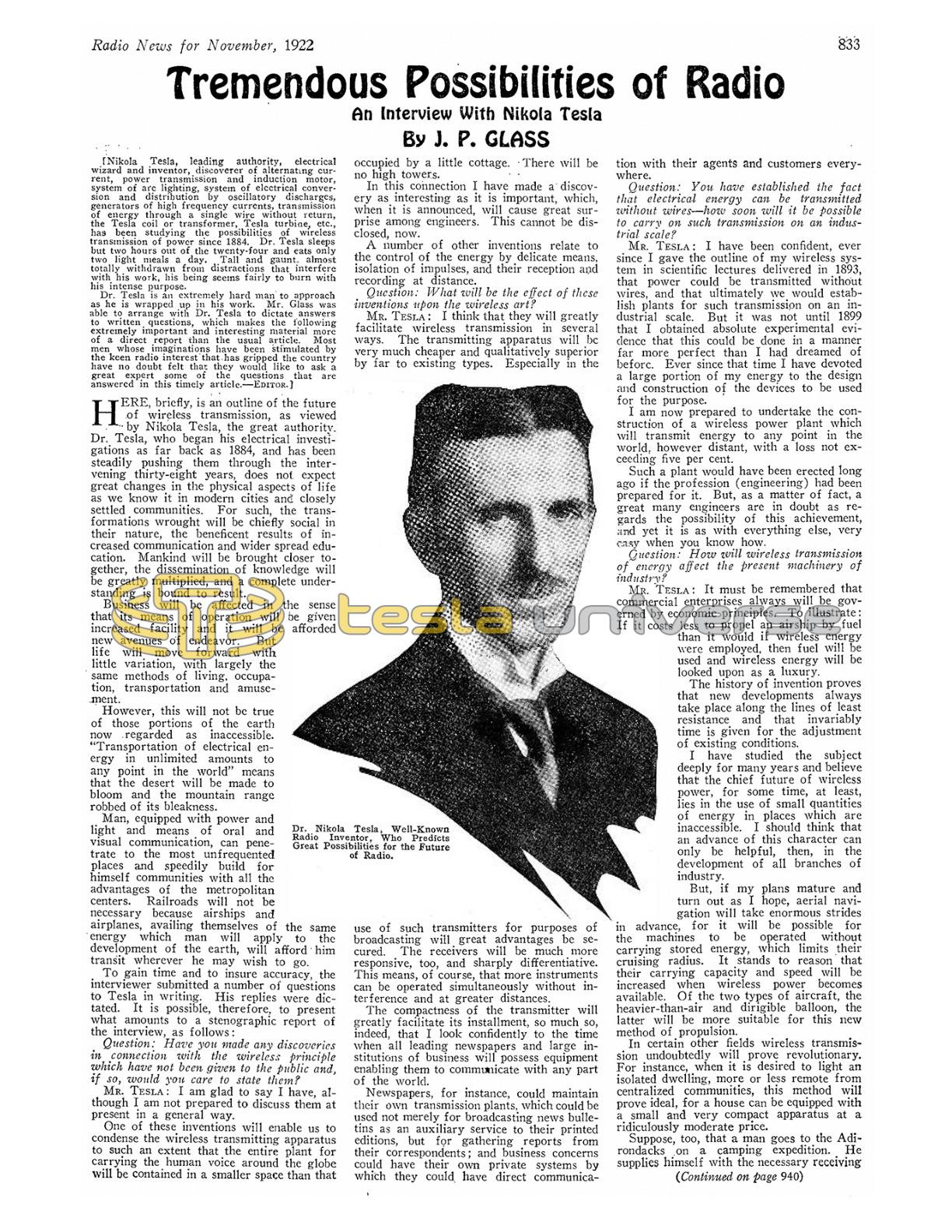
Tremendous Possibilities of Radio
An Interview With Nikola Tesla
By J. P. GLASS
Nikola Tesla, leading authority, electrical wizard and inventor, discoverer of alternating current, power transmission and induction motor, system of arc lighting, system of electrical conversion and distribution by oscillatory discharges, generators of high frequency currents, transmission of energy through a single wire without return, the Tesla coil or transformer, Tesla turbine, etc., has been studying the possibilities of wireless transmission of power since 1884. Dr. Tesla sleeps but two hours out of the twenty-four and eats only two light meals a day. Tall and gaunt, almost totally withdrawn from distractions that interfere with his work, his being seems fairly to burn with his intense purpose.
Dr. Tesla is an extremely hard man to approach as he is wrapped up in his work. Mr. Glass was able to arrange with Dr. Tesla to dictate answers to written questions, which makes the following extremely important and interesting material more of a direct report than the usual article. Most men whose imaginations have been stimulated by the keen radio interest that has gripped the country have no doubt felt that they would like to ask a great expert some of the questions that are answered in this timely article. — EDITOR.]
Here, briefly, is an outline of the future of wireless transmission, as viewed by Nikola Tesla, the great authority. Dr. Tesla, who began his electrical investigations as far back as 1884, and has been steadily pushing them through the intervening thirty-eight years, does not expect great changes in the physical aspects of life as we know it in modern cities and closely settled communities. For such, the transformations wrought will be chiefly social in their nature, the beneficent results of increased communication and wider spread education. Mankind will be brought closer together, the dissemination of knowledge will be greatly multiplied, and a complete understanding is bound to result.
Business will be affected in the sense that its means of operation will be given increased facility and it will be afforded new avenues of endeavor. But life will move forward with little variation, with largely the same methods of living, occupation, transportation and amusement.
However, this will not be true of those portions of the earth now regarded as inaccessible. "Transportation of electrical energy in unlimited amounts to any point in the world" means that the desert will be made to bloom and the mountain range robbed of its bleakness.
Man, equipped with power and light and means of oral and visual communication, can penetrate to the most unfrequented places and speedily build for himself communities with all the advantages of the metropolitan centers. Railroads will not be necessary because airships and airplanes, availing themselves of the same energy which man will apply to the development of the earth, will afford him transit wherever he may wish to go.
To gain time and to insure accuracy, the interviewer submitted a number of questions to Tesla in writing. His replies were dictated. It is possible, therefore, to present what amounts to a stenographic report of the interview, as follows:
Question: Have you made any discoveries in connection with the wireless principle which have not been given to the public and, if so, would you care to state them?
MR. TESLA: I am glad to say I have, although I am not prepared to discuss them at present in a general way.
One of these inventions will enable us to condense the wireless transmitting apparatus to such an extent that the entire plant for carrying the human voice around the globe will be contained in a smaller space than that occupied by a little cottage. There will be no high towers.
In this connection I have made a discovery as interesting as it is important, which, when it is announced, will cause great surprise among engineers. This cannot be disclosed, now.
A number of other inventions relate to the control of the energy by delicate means, isolation of impulses, and their reception and recording at distance.
Question: What will be the effect of these inventions upon the wireless art?
MR. TESLA: I think that they will greatly facilitate wireless transmission in several ways. The transmitting apparatus will be very much cheaper and qualitatively superior by far to existing types. Especially in the use of such transmitters for purposes of broadcasting will great advantages be secured. The receivers will be much more responsive, too, and sharply differentiative. This means, of course, that more instruments can be operated simultaneously without interference and at greater distances.
The compactness of the transmitter will greatly facilitate its installment, so much so, indeed, that I look confidently to the time when all leading newspapers and large institutions of business will possess equipment enabling them to communicate with any part of the world.
Newspapers, for instance, could maintain their own transmission plants, which could be used not merely for broadcasting news bulletins as an auxiliary service to their printed editions, but for gathering reports from their correspondents; and business concerns could have their own private systems by which they could have direct communication with their agents and customers everywhere.
Question: You have established the fact that electrical energy can be transmitted without wires — how soon will it be possible to carry on such transmission on an industrial scale?
MR. TESLA: I have been confident, ever since I gave the outline of my wireless system in scientific lectures delivered in 1893, that power could be transmitted without wires, and that ultimately we would establish plants for such transmission on an industrial scale. But it was not until 1899 that I obtained absolute experimental evidence that this could be done in a manner far more perfect than I had dreamed of before. Ever since that time I have devoted a large portion of my energy to the design and construction of the devices to be used for the purpose.
I am now prepared to undertake the construction of a wireless power plant which will transmit energy to any point in the world, however distant, with a loss not exceeding five per cent.
Such a plant would have been erected long ago if the profession (engineering) had been prepared for it. But, as a matter of fact, a great many engineers are in doubt as regards the possibility of this achievement, and yet it is as with everything else, very easy when you know how.
Question: How will wireless transmission of energy affect the present machinery of industry?
MR. TESLA: It must be remembered that commercial enterprises always will be governed by economic principles. To illustrate: If it costs less to propel an airship by fuel than it would if wireless energy were employed, then fuel will be used and wireless energy will be looked upon as a luxury.
The history of invention proves that new developments always take place along the lines of least resistance and that invariably time is given for the adjustment of existing conditions.
I have studied the subject deeply for many years and believe that the chief future of wireless power, for some time, at least, lies in the use of small quantities of energy in places which are inaccessible. I should think that an advance of this character can only be helpful, then, in the development of all branches of industry.
But, if my plans mature and turn out as I hope, aerial navigation will take enormous strides in advance, for it will be possible for the machines to be operated without carrying stored energy, which limits their cruising radius. It stands to reason that their carrying capacity and speed will be increased when wireless power becomes available. Of the two types of aircraft, the heavier-than-air and dirigible balloon, the latter will be more suitable for this new method of propulsion.
In certain other fields wireless transmission undoubtedly will prove revolutionary. For instance, when it is desired to light an isolated dwelling, more or less remote from centralized communities, this method will prove ideal, for a house can be equipped with a small and very compact apparatus at a ridiculously moderate price.
Suppose, too, that a man goes to the Adirondacks on a camping expedition. He supplies himself with the necessary receiving apparatus, which he can carry in his kit with ease, and before he departs arranges with the power plant owners for service; then when he reaches his destination, no matter how wild and inaccessible it may be, he can be supplied with all the light and power which he may need.
I am looking with the greatest confidence to an application of the wireless principle for purposes of lighting on a vast scale, but this will not interfere with the lighting of cities and populated districts from central plants.
The new art will be of small effect, in itself, on the cost of production. There is an idea in the popular mind that wireless power will be had for nothing, but this is far from being so. The primary energy has to be provided, either from a waterfall or by burning fuel.
To sum up, I have always visualized the wireless art as being applied to fields not supplied by present systems. These will endure for a long time, until conditions economically demand the substitution of a new system.
Question: When wireless transmission of energy becomes an industrial fact, will not the larger part of the present system of fuel transportation become obsolete? Will not practically all power then be produced close to, or in, the mine and oil fields and at water power stations?
MR. TESLA: The engineering world at present is developing the so-called super-power system, which I have advocated for twenty years. It will be the means of furnishing energy more economically and over greatly increased areas. Wireless transmission would not seriously interfere with it.
Of course, there are innumerable places where power transmitted without wires would be of relatively greater value and in commercial enterprises this consideration would govern the installation of receivers.
As to the present system of hauling fuel to great distances: Engineers are centering their efforts on reduction of this waste, that being precisely one of the objects of the super-power system. But, while plants operating with wires must be favorably placed, a wireless plant can be located without reference to natural advantages. This is important.
There is a strong tendency now to erect power plants close to the coal and oil fields and the sources of water supply. Industry will be greatly benefited when this idea is carried out on an extensive scale.
Question: Will not wireless transmission of energy result in time in the moving of practically all means of transportation with electrical energy from central power stations?
MR. TESLA: No, I do not expect that such will be the case, for the transportation systems now used present certain important practical advantages which cannot be disregarded.
Question: Will not automobiles, for instance, be operated merely by the operative "cutting in" on electrical energy supplied by wireless from power stations?
MR. TESLA: I fear we shall not live to see the wireless system in general use for this purpose. It is difficult to propel an automobile by the new method for reasons with which experts are familiar. Success can be much more easily achieved in the case of airships.
In time to come it is possible that some form of automobile may be perfected that will enable this propulsion of such vehicles to be effected by power drawn from the ambient medium.
Question: Will the transmission of large amounts of electrical energy by wireless constitute any sort of menace to life and property?
MR. TESLA: None whatever. We live on a globe which is charged to a pressure of two billion volts and we do not feel it at all, although it is possible that we may be affected by this immense pressure in some way or other. Lightning discharges usually occur under a tension of 1,500,000,000 volts and yet the powerful oscillations set up are insensible. Wireless transmission will be effected by electric currents of much smaller force than this. Far from being a menace, the new art will enhance in innumerable ways the safety of life and property.
Question: Getting back to the wireless transmission of sound, will it be possible to develop voice detectors that, at a distance, say, of four or five hundred feet, will amplify sounds so they can be heard plainly?
MR. TESLA: Of course it will. The human ear, though an organ much inferior to the eye, is wonderful just the same. It may be of interest for me to state that at a certain period in my life, when I suffered from hyper-excitation of the nerves, I could hear distinctly a fly walking on a table at a distance of several feet, and when he alighted I heard a strong thud.
In my experiments at my wireless plant at Colorado Springs in 1899 I could easily hear with the unaided ear thunder claps at a distance of 550 miles, although my assistants could not hear beyond 150 miles.
I believe it possible to perceive the sound of a strong explosion at a distance of 12,000 miles. If this theory is correct, it explains the extraordinary behavior of many persons afflicted with nervous diseases.
There are amplifiers of various kinds by which a sound can be multiplied a billionfold. There is virtually no limit in this direction.
Question: In one of your articles you declared you believed it possible to precipitate rainfall by means of wireless energy. Is there a probability of this being an early materialization?
MR. TESLA: That is an idea on which I have labored since 1892, when I accidentally observed that a stroke of lightning caused a copious downpour. Twenty years ago I had advanced so far in the design of the means for accomplishing this purpose that I made every effort to carry out the idea on a large scale.
But I found my plans were received with skepticism. We undoubtedly will accomplish this wonder some day and then will come the lords and masters of life on this planet. We will be able, then, to obtain any amount of power almost without effort and produce lakes and rivers where all was barren before. All the work will be done by the sun; man will merely press the button.
Hitherto the interview had concerned itself solely with the utilitarian aspects of the wireless principle. At this point the following question was propounded:
The development of water power and of the wireless transmission of electrical energy produced by water power would indicate that in the far distant day when coal and oil are exhausted those countries having large quantities of water power will become exporters of electrical energy to less fortunately situated countries. Does not this mean new political adjustments and division? Or will wireless telephony, hastening the day of world peace and international progress, long before that time prepare mankind, through increased intercourse and education, for the cooperative use of natural resources?
The scientist's reply was a proper finale.
I have always considered the wireless art the greatest advance of all ages. That is why it has been the chief object of attainment in my life.
We will never overcome international friction and wars by pacts and agreements, however solemn, nor will we by this means abolish the barriers that separate the nations from one another and are an impediment to general progress. There is only one way of achieving this great end and that is by annihilating distance. The wireless art will accomplish this in every aspect.
Of particular importance as means for insuring peaceful relations between nations and communities will be wireless telephony and picture transmission. The latter is crude and imperfect, but carries the convincing power of a record. The time is not distant when we will have wireless television, which is immensely more difficult to accomplish and correspondingly far reaching in its effects on human life. No such apparatus is in existence, now, but the preliminary steps necessary to the successful solution of this great problem already have been made.
The combined use of the wireless telephone and the apparatus for television will put human beings in intimate aural and visual contact though thousands of miles may separate them. So to speak, a man will be able to lean out of his window in New York and talk to his "neighbor," similarly placed in Paris.
The consequences of such an achievement are inestimable when considered in relation to our social and political progress.
[Copyright, 1922, Thompson Feature Service, Inc.]