Nikola Tesla Articles
Turn on Your Niagara
ELEVATORS IN NEW YORK MAY BE RUN BY NIAGARA POWER.
The Great Work of the Niagara Power Company and the Changes Electricity Will Produce.
The waters of the four greatest lakes of North America and of the world turbulently descend, in rapids and falls, a height of over three hundred feet, in a distance of about eight miles. Only less wonderful than the falls, falling a height of 167 feet, are the rapids above and the rapids and whirlpool below.
Here is all the waterflow from a dozen States and half Canada struggling for a front seat at the biggest show on earth, and hurrying away through a chasm that looks as narrow as a canal when you gaze at it from above. It is a stream which never shrinks or swells.
In this descent of many waters is a force that could drive twice the machinery of the American continent if there were means of applying the one to the other. Talk of taming that power! And yet part of the great stream is already harnessed, and more is to be put to work. But there’ll never be the day when the falls will be one whit less grand than now. Man may cut and carve again, steal 5,000 horse-power here and 10,000 there; there will always be plenty left.
It is an old story to apply the force of falling water to machinery near at hand. What now awaits development on a large scale is to convey this force to long distances. Shall this force reach Albany, distant 330 miles? Shall it reach New York, distant 500 miles?
To convey electricity to Buffalo, distant twenty miles, will prove an easy task, for it has already been carried as far in Europe. An electric plant transmits electricity from Tivoli to Rome, the same distance, and lights the seven-hilled city of immortal fame. In Germany there are longer currents, and from the Falls of Lauffen, Switzerland, a current is carried to Frankfort, a distance of 112 miles, with a loss of only 24 per cent.
Work is to commence in June with the generation of electricity to the extent of 15,000 horse power, when the Cataract Construction Company is to turn over to the Niagara Falls Power Company the plant it has been under contract to produce. That Power Company is a company of powers in finance, too. William K. Vanderbilt, Chauncey M. Depew, J. Pierpont Morgan, D. O. Mills, Morris K. Jessup, Charles Lanier, Isaac N. Seligman, Edward D. Adams, Edward Winslow, Hamilton McK. Twombly, Francis Lynde Stetson, Edward A. Wickes, William B. Rankine and George H. Kent have been in it. Mr. Stetson is the president.
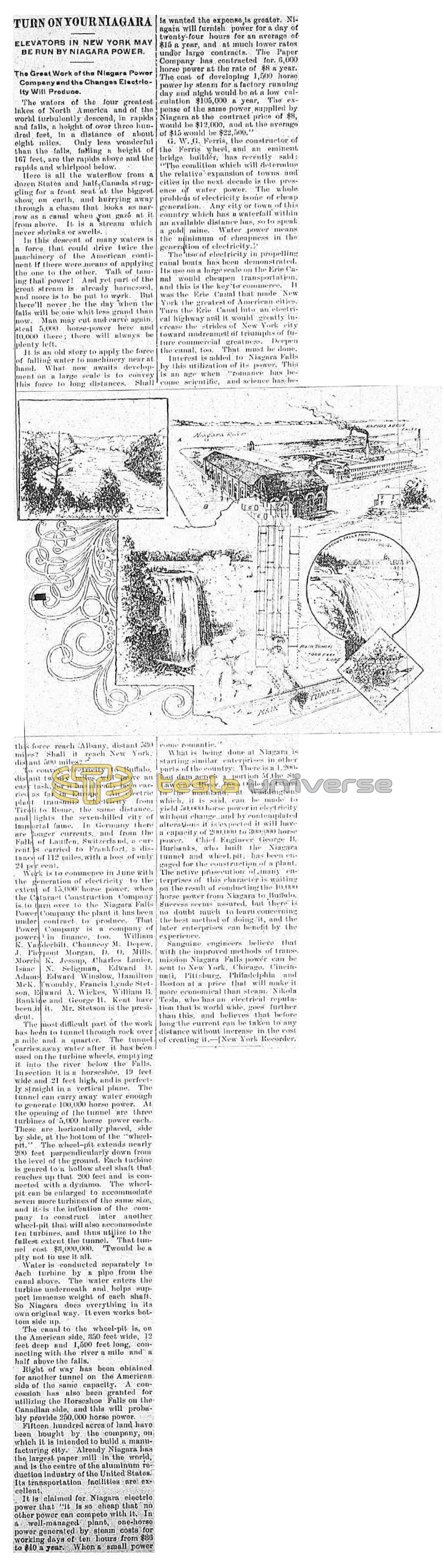
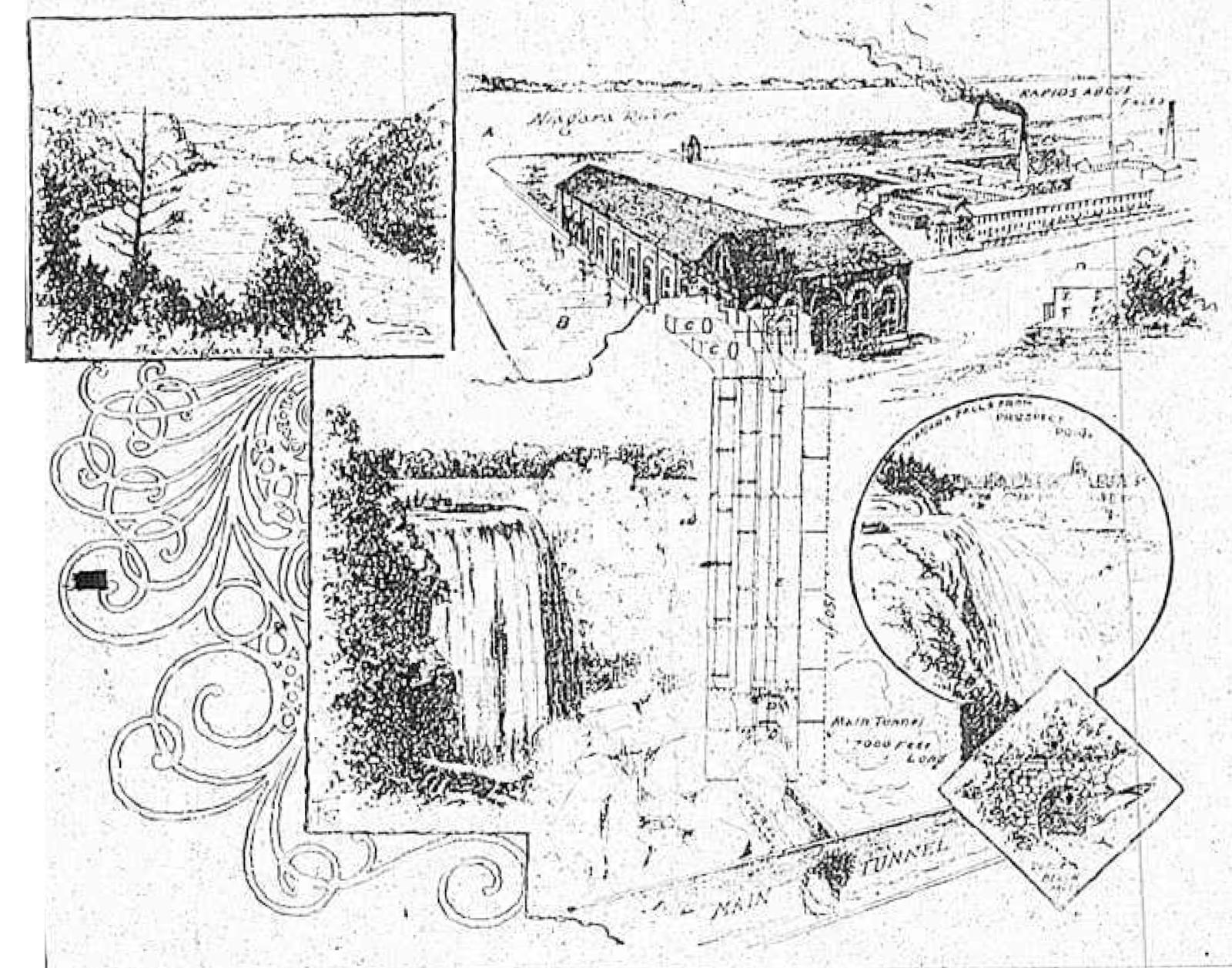
The most difficult part of the work has been to tunnel through rock over a mile and a quarter. The tunnel carries away water after it has been used on the turbine wheels, emptying it into the river below the Falls. In section it is a horseshoe, 19 feet wide and 21 feet high, and is perfectly straight in a vertical plane. The tunnel can carry away water enough to generate 100,000 horse power. At the opening of the tunnel are three turbines of 5,000 horse power each. These are horizontally placed, side by side, at the bottom of the “wheel-pit.” The wheel-pit extends nearly 200 feet perpendicularly down from the level of the ground. Each turbine is geared to a hollow steel shaft that reaches up that 200 feet and is connected with a dynamo. The wheel-pit can be enlarged to accommodate seven more turbines of the same size, and it is the intention of the company to construct later another wheel-pit that will also accommodate ten turbines, and thus utilize to the fullest extent the tunnel. That tunnel cost $1,000,000. ’Twould be a pity not to use it all.
Water is conducted separately to each turbine by a pipe from the canal above. The water enters the turbine underneath and helps support immense weight of each shaft. So Niagara does everything in its own original way. It even works bottom side up.
The canal to the wheel-pit is, on the American side, 250 feet wide, 12 feet deep and 1,500 feet long, connecting with the river a mile and a half above the falls.
Right of way has been obtained for another tunnel on the American side of the same capacity. A concession has also been granted for utilizing the Horseshoe Falls on the Canadian side, and this will probably provide 250,000 horse power.
Fifteen hundred acres of land have been bought by the company, on which it is intended to build a manufacturing city. Already Niagara has the largest paper mill in the world, and is the centre of the aluminum reduction industry of the United States. Its transportation facilities are excellent.
It is claimed for Niagara electric power that “It is so cheap that no other power can compete with it. In a well-managed plant, one-horse power generated by steam costs for working days of ten hours from $30 to $40 a year. When a small power is wanted the expense is greater. Niagara will furnish power for a day of twenty-four hours for an average of $15 a year, and at much lower rates under large contracts. The Paper Company has contracted for 6,000 horse power at the rate of $8 a year. The cost of developing 1,500 horse power by steam for a factory running day and night would be at a low calculation $105,000 a year. The expense of the same power supplied by Niagara at the contract price of $8, would be $12,000, and at the average of $15 would be $22,500.”
G. W. G. Ferris, the constructor of the Ferris wheel, and an eminent bridge builder, has recently said: “The condition which will determine the relative expansion of towns and cities in the next decade is the presence of water power. The whole problem of electricity is one of cheap generation. Any city or town of this country which has a waterfall within an available distance has, so to speak, a gold mine. Water power means the minimum of cheapness in the generation of electricity.”
The use of electricity in propelling canal boats has been demonstrated. Its use on a large scale on the Erie Canal would cheapen transportation, and this is the key to commerce. It was the Erie Canal that made New York the greatest of American cities. Turn the Erie Canal into an electrical highway and it would greatly increase the strides of New York city toward undreamed of triumphs of future commercial greatness. Deepen the canal, too. That must be done.
Interest is added to Niagara Falls by this utilization of its power. This is an age when “romance has become scientific, and science has become romantic.”
What is being done at Niagara is starting similar enterprises in other parts of the country. There is a 1,200-foot dam across a portion of the St. Lawrence River, from Ogden’s Island to the mainland, at Waddington, which, it is said, can be made to yield 50,000 horse power in electricity without change, and by contemplated alterations it is expected it will have a capacity of 200,000 to 300,000 horse power. Chief Engineer George B. Burbanks, who built the Niagara tunnel and wheel-pit, has been engaged for the construction of a plant. The active prosecution of many enterprises of this character is waiting on the result of conducting the 10,000 horse power from Niagara to Buffalo. Success seems assured, but there is no doubt much to learn concerning the best method of doing it, and the later enterprises can benefit by the experience.
Sanguine engineers believe that with the improved methods of transmission Niagara Falls power can be sent to New York, Chicago, Cincinnati, Pittsburg, Philadelphia and Boston at a price that will make it more economical than steam. Nikola Tesla, who has an electrical reputation that is world wide, goes further than this, and believes that before long the current can be taken to any distance without increase in the cost of creating it. — New York Recorder.