
Nikola Tesla Articles
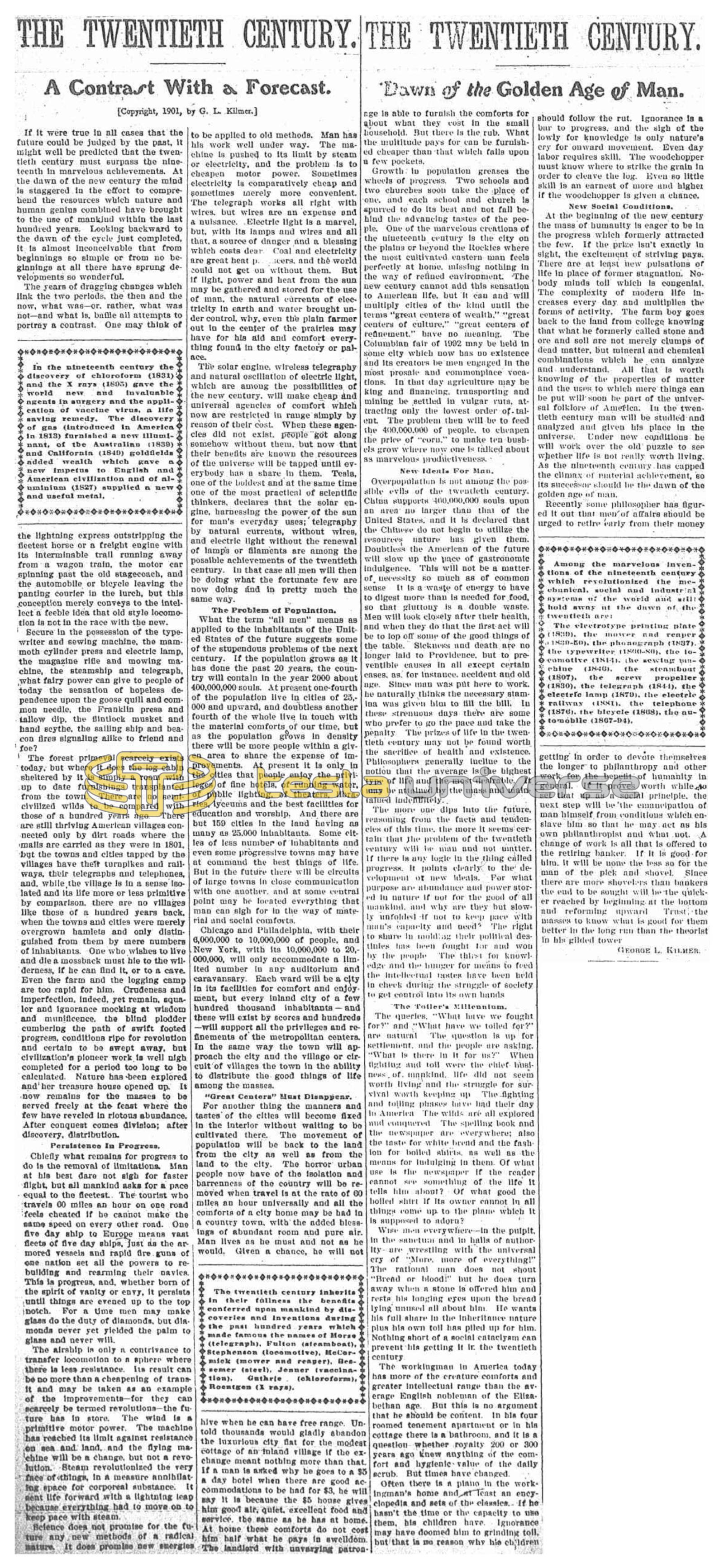
The Twentieth Century
A Contrast With a Forecast.
Dawn of the Golden Age of Man.
[Copyright, 1901, by G. L. Kilmer.]
If it were true in all cases that the future could be judged by the past, it might well be predicted that the twentieth century must surpass the nineteenth in marvelous achievements. At the dawn of the new century the mind is staggered in the effort to comprehend the resources which nature and human genius combined have brought to the use of mankind within the last hundred years. Looking backward to the dawn of the cycle just completed, it is almost inconceivable that from beginnings so simple or from no beginnings at all there have sprung developments so wonderful.
The years of dragging changes which link the two periods, the then and the now, what was — or, rather, what was not — and what is, baffle all attempts to portray a contrast. One may think of the lightning express outstripping the fleetest horse or a freight engine with its interminable trail running away from a wagon train, the motor car spinning past the old stagecoach, and the automobile or bicycle leaving the panting courier in the lurch, but this conception merely conveys to the intellect a feeble idea that old style locomotion is not in the race with the new.
In the nineteenth century the discovery of chloroform (1831) and the X rays (1895) gave the world new and invaluable agents in surgery, and the application of vaccine virus, a life saving remedy. The discovery of gas (introduced in America in 1813) furnished a new illuminant, of the Australian (1830) and California (1849) goldfields added wealth which gave a new impetus to English and American civilization, and of aluminium (1827) supplied a new and useful metal.
Secure in the possession of the typewriter and sewing machine, the mammoth cylinder press and electric lamp, the magazine rifle and mowing machine, the steamship and telegraph, what fairy power can give to people of today the sensation of hopeless dependence upon the goose quill and common needle, the Franklin press and tallow dip, the flintlock musket and hand scythe, the sailing ship and beacon fires signaling alike to friend and foe?
The forest primeval scarcely exists today, but where it does the log cabin sheltered by it is simply a room with up to date furnishings transplanted from the town. There are no semicivilized wilds to be compared with those of a hundred years ago. There are still thriving American villages connected only by dirt roads where the mails are carried as they were in 1801, but the towns and cities tapped by the villages have their turnpikes and railways, their telegraphs and telephones, and, while the village is in a sense isolated and its life more or less primitive by comparison, there are no villages like those of a hundred years back, when the towns and cities were merely overgrown hamlets and only distinguished from them by mere numbers of inhabitants. One who wishes to live and die a mossback must hie to the wilderness, if he can find it, or to a cave. Even the farm and the logging camp are too rapid for him. Crudeness and imperfection, indeed, yet remain, squalor and ignorance mocking at wisdom and munificence, the blind plodder cumbering the path of swift footed progress, conditions ripe for revolution and certain to be swept away, but civilization’s pioneer work is well nigh completed for a period too long to be calculated. Nature has been explored and her treasure house opened up. It now remains for the masses to be served freely at the feast where the few have reveled in riotous abundance. After conquest comes division; after discovery, distribution.
Persistence In Progress.
Chiefly what remains for progress to do is the removal of limitations. Man at his best dare not sigh for faster flight, but all mankind asks for a pace equal to the fleetest. The tourist who travels 60 miles an hour on one road feels cheated if he cannot make the same speed on every other road. One five day ship to Europe means vast fleets of five day ships, just as the armored vessels and rapid fire guns of one nation set all the powers to rebuilding and rearming their navies. This is progress, and, whether born of the spirit of vanity or envy, it persists until things are evened up to the top notch. For a time men may make glass do the duty of diamonds, but diamonds never yet yielded the palm to glass and never will.
The airship is only a contrivance to transfer locomotion to a sphere where there is less resistance. Its result can be no more than a cheapening of transit and may be taken as an example of the improvements — for they can scarcely be termed revolutions — the future has in store. The wind is a primitive motor power. The machine has reached its limit against resistance on sea and land, and the flying machine will be a change, but not a revolution. Steam revolutionized the very face of things, in a measure annihilating space for corporal substance. It sent life forward with a lightning leap because everything had to move on to keep pace with steam.
Science does not promise for the future any new methods of a radical sort. It does promise new energies to be applied to old methods. Man has his work well under way. The machine is pushed to its limit by steam or electricity, and the problem is to cheapen motor power. Sometimes electricity is comparatively cheap and sometimes merely more convenient. The telegraph works all right with wires, but wires are an expense and a nuisance. Electric light is a marvel, but, with its lamps and wires and all that, a source of danger and a blessing which costs dear. Coal and electricity are great heat producers, and the world could not get on without them. But if light, power and heat from the sun may be gathered and stored for the use of man, the natural currents of electricity in earth and water brought under control, why, even the plain farmer out in the center of the prairies may have for his aid and comfort everything found in the city factory or palace.
The solar engine, wireless telegraphy and natural oscillation of electric light, which are among the possibilities of the new century, will make cheap and universal agencies of comfort which now are restricted in range simply by reason of their cost. When these agencies did not exist, people got along somehow without them, but now that their benefits are known the resources of the universe will be tapped until everybody has a share in them. Tesla, one of the boldest and at the same time one of the most practical of scientific thinkers, declares that the solar engine, harnessing the power of the sun for man’s everyday uses; telegraphy by natural currents, without wires, and electric light without the renewal of lamps or filaments are among the possible achievements of the twentieth century. In that case all men will then be doing what the fortunate few are now doing and in pretty much the same way.
The Problem of Population.
What the term “all men” means as applied to the inhabitants of the United States of the future suggests some of the stupendous problems of the next century. If the population grows as it has done the past 20 years, the country will contain in the year 2000 about 400,000,000 souls. At present one-fourth of the population live in cities of 25,000 and upward, and doubtless another fourth of the whole live in touch with the material comforts of our time, but as the population grows in density there will be more people within a given area to share the expense of improvements. At present it is only in the cities that people enjoy the privileges of fine hotels, of running water, of public lighting, of theaters, libraries, lyceums and the best facilities for education and worship. And there are but 159 cities in the land having as many as 25,000 inhabitants. Some cities of less number of inhabitants and even some progressive towns may have at command the best things of life. But in the future there will be circuits of large towns in close communication with one another, and at some central point may be located everything that man can sigh for in the way of material and social comforts.
Chicago and Philadelphia, with their 6,000,000 to 10,000,000 of people, and New York, with its 10,000,000 to 20,000,000, will only accommodate a limited number in any auditorium and caravansary. Each ward will be a city in its facilities for comfort and enjoyment, but every inland city of a few hundred thousand inhabitants—and these will exist by scores and hundreds — will support all the privileges and requirements of the metropolitan centers. In the same way the town will approach the city and the village or circuit of villages the town in the ability to distribute the good things of life among the masses.
“Great Centers” Must Disappear.
For another thing the manners and tastes of the cities will become fixed and the interior without waiting to be cultivated there. The movement of population will be back to the land from the city as well as from the land to the city. The horror urban people now have of the isolation and barrenness of the country will be removed when travel is at the rate of 60 miles an hour universally and all the comforts of a city home may be had in a country town, with the added blessings of abundant room and pure air. Man lives as he must and not as he would. Given a chance, he will not hive when he can have free range. Untold thousands would gladly abandon the luxurious city flat for the modest cottage of an inland village if the exchange meant nothing more than that. If a man is asked why he goes to a $5 a day hotel when there are good accommodations to be had for $3, he will say it is because the $5 house gives him good air, quiet, excellent food and service, the same as he has at home. At home these comforts do not cost him half what he pays in swelldom. The landlord with unvarying patronage is able to furnish the comforts for about what they cost in the small household. But there is the rub. What the multitude pays for can be furnished cheaper than that which falls upon a few persons.
The twentieth century inherits in their fullness the benefits conferred upon mankind by discoveries and inventions during the past hundred years which made famous the names of Morse (telegraph), Fulton (steamboat), Stephenson (locomotive), McCormick (mower and reaper), Bessemer (steel), Jenner (vaccination), Guthrie (chloroform), Roentgen (X rays).
Growth in population greases the wheels of progress. Two schools and two churches soon take the place of one, and each school and church is spurred to do its best and not fall behind the advancing tastes of the people. One of the marvelous creations of the nineteenth century is the city on the plains or beyond the Rockies where the most cultivated eastern man feels perfectly at home, missing nothing in the way of refined environment. The new century cannot add this sensation to American life, but it can and will multiply cities of the kind until the terms “great centers of wealth,” “great centers of culture,” “great centers of refinement,” have no meaning. The Columbian fair of 1892 may be held in some city which now has no existence, and its creators be men engaged in the most prosaic and commonplace vocations. In that day agriculture may be king, and finance, transportation and mining be settled in vulgar ruts, attracting only the lowest order of talent. The problem then will be to feed the 400,000,000 of people, to cheapen the price of “corn,” to make ten bushels grow where now one is talked about as marvelous productiveness.
New Ideals For Men.
Overpopulation is not among the possible evils of the twentieth century. China supports 400,000,000 souls upon an area no larger than that of the United States, and it is declared that the Chinese do not begin to utilize the resources nature has given them. Doubtless the American of the future will slow up the pace of gastronomic indulgence. This will not be a matter of necessity so much as of common sense. It is a waste of energy to have to digest more than is needed for food, so that gluttony is a double waste. Men will look closely after their health, and when they do that the first act will be to lop off some of the good things of the table. Sickness and death are no longer laid to Providence, but to preventible causes in all except certain cases, as, for instance, accident and old age. Since man was put here to work, he naturally thinks the necessary stamina was given him to fill the bill. In these strenuous days there are some who prefer to go the pace and take the penalty. The prizes of life in the twentieth century may not be found worth the sacrifice of health and existence. Philosophers generally incline to the notion that the average is the wisest type of life and the most desirable. It may be attained by the mass and maintained indefinitely.
The more one dips into the future, reasoning from the facts and tendencies of this time, the more it seems certain that the problem of the twentieth century will be man and not matter. If there is any break in the rising calling of progress, it points clearly to the development of new ideals. For what purpose are abundance and power stored if not to be used for the good of mankind, and why are they but slowly unfolded if not to keep pace with man’s capacity and need? The right to share in molding their political destinies has been fought for and won by the people. The thirst for knowledge and the hunger for means to feed the intellectual tastes have been held in check, but the struggle of society to get control into its own hands
The Toiler’s Millennium.
The queries, “What have we fought for?” and “What have we toiled for?” are natural. The question is up for settlement, and the people are asking, “What is there in it for us?” When fighting and toil were the chief business of mankind, life did not seem worth living and the struggle for survival worth keeping up. The fighting and toiling phases have had their day in America. The wilds are all explored and conquered. The spelling book and the newspaper are everywhere; also the taste for white bread and the fashion for boiled shirts, as well as the means for indulging in them. Of what use is the newspaper if the reader cannot see something of the life it tells him about? Or what good the newspaper if its owner cannot let all things come up to the plane which it is supposed to adorn?
Wise men everywhere — in the pulpit, in the sanctum and in halls of authority — are wrestling with the universal cry of “More, more of everything!” The rational man does not shout “Bread or blood!” but he does turn away when a stone is offered him and vests his longing eyes upon the bread lying unused all about him. He wants his full share in the inheritance nature and even toil has piled up for him. Nothing short of a social cataclysm can prevent his getting it in the twentieth century.
Among the marvelous inventions of the nineteenth century which revolutionized the mechanical, social and industrial systems of the world and will hold sway at the dawn of the twentieth are:
The electrotype printing plate (1829), the mower and reaper (1830-39), the phonograph (1877), the typewriter (1866-68), the locomotive (1814), the sewing machine (1846), the bicycle (1869), the automobile (1897-98), the screw propeller (1839), the telegraph (1844), the electric lamp (1879), the electric railway (1884), the telephone (1876).
The workingman in America today has more of the creature comforts and greater intellectual range than the average English nobleman of the Elizabethan age. But this is no argument that he should be content. Suppose our roomed tenement apartment or in his cottage there is a bathroom, and it is a question whether royalty 200 or 300 years ago knew anything of the comfort and hygienic value of the daily scrub. But times have changed.
Often there is a piano in the workingman’s home and at least an encyclopedia and sets of the classics. If he hasn’t the time or the capacity to use them, his children have. Ignorance may have doomed him to grinding toil, but that is no reason why his children should follow the rut. Ignorance is a bar to progress, and the sigh of the lowly for knowledge is only nature’s cry for onward movement. Even day labor requires skill. The woodchopper must know where to strike the grain in order to cleave the log. Even so little skill is an earnest of more and higher if the woodchopper is given a chance.
New Social Conditions.
At the beginning of the new century the mass of humanity is eager to be in the progress which formerly attracted the few. If the prize isn’t exactly in sight, the excitement of striving pays. There are at least new pulsations of life in place of former stagnation. Nobody minds toil which is congenial. The complexity of modern life increases every day and multiplies the forms of activity. The farm boy goes back to the land from college knowing that what he formerly called stone and ore and soil are not merely lumps of dead matter, but mineral and chemical combinations which he can analyze and understand. All that is worth knowing of the properties of matter and the uses to which mere things can be put will soon be part of the universal folklore of America. In the twentieth century man will be studied and analyzed and given his place in the universe. Under new conditions he will work over the old puzzle to see whether life is not really worth living.
As the nineteenth century has capped the climax of material achievement, so its successor should be the dawn of the golden age of man.
Recently some philosopher has figured it out that men of affairs should be urged to retire early from their money getting in order to devote themselves the longer to philanthropy and other work for the benefit of humanity in general. If it proves worth while to set that up as a social standard, the next step will be the emancipation of man himself from conditions which enslave him so that he may act as his own philanthropist and what not. A change of work is all that is offered to the retiring banker. If it is good for him, it will be none the less so for the man of the pick and shovel. Since there are more shovelers than bankers the end to be sought will be the quicker reached by beginning at the bottom and reforming upward. Trust the masses to know what is good for them better in the long run than the theorist in his gilded tower.
GEORGE L. KILMER.
Reprints
- The Twentieth Century (reprint)Ogdensburg News — January 3rd, 1901