
Nikola Tesla Articles
Wastefulness of War
Nikola Tesla Considers it the Greatest Obstacle to Human Progress.
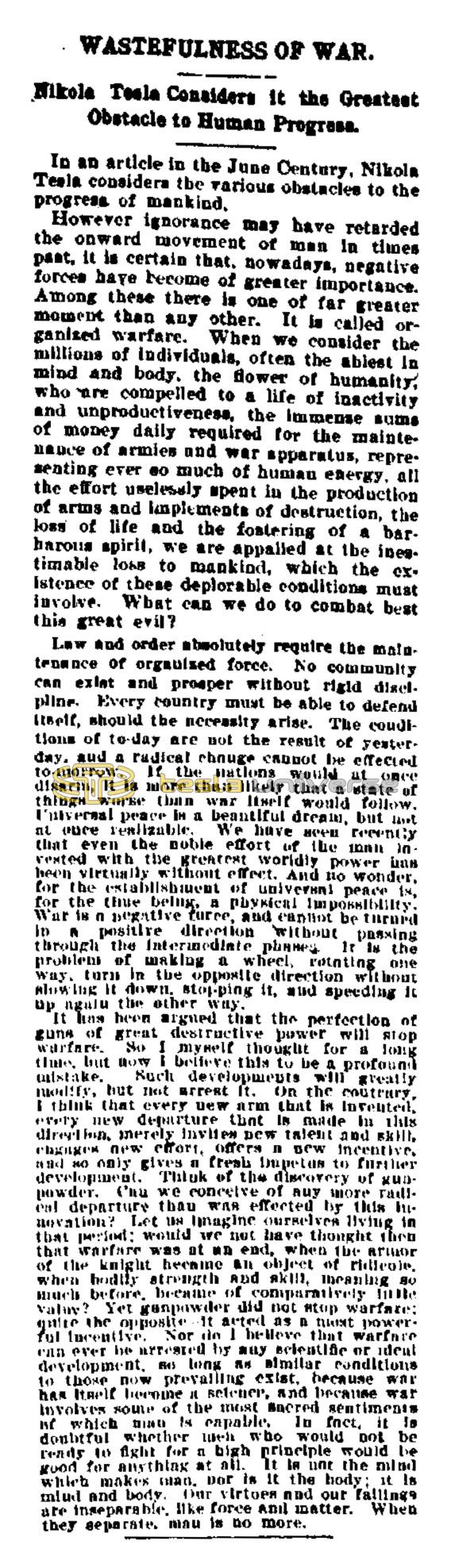
In an article in Century, Nikola Tesla considers the various obstacles to the progress of mankind.
"However ignorance may have retarded the onward movement of map in times past, it is certain that, nowadays, negative forces have become of greater importance. Among these there is one of far greater moment than any other. It is called organized warfare. When we consider the millions of individuals, often the ablest in mind and body, the flower of humanity, who are compelled to a life of inactivity and unproductiveness, the immense sums of money daily required for the maintenance of armies and war apparatus, representing ever SO much of human energy, all the effort uselessly spent in the production of arms and implements of destruction, the loss of life and the fostering of a barbarous spirit, we are appalled at the inestimable loss to mankind, which the existence of these deplorable conditions must involve. What can we do to combat best this great evil?
"Law and order absolutely require the maintenance of organized force. No community can exist and prosper without rigid discipline. Every country must be able to defend itself, should the necessity arise. The conditions of to-day are not the result of yesterday, and a radical change cannot be effected to-morrow. If the nations would at once disarm, it is more than likely that a state of things worse than war itself would follow. Universal peace is a beautiful dream, but not at once realizable. We have seen recently that even the noble effort of the man invested with the greatest worldly power has been virtually without effect. And no wonder, for the establishment of universal peace is, for the time being, a physical impossibility. War is a negative force, and cannot be turned in a positive direction without passing through the intermediate phases. It is the problem of making a wheel, rotating one way, turn in the opposite direction without slowing it down, stopping it, and speeding it up again the other way.
"It has been argued that the perfection of guns of great destructive power will stop warfare. So I myself thought for a long time, but now I believe this to be a profound mistake. Such developments will greatly modify, but not arrest it. On the contrary. I think that every new arm that is invented, every new departure that is made in this direction, merely invites new talent and skill, engages new effort, offers a new incentive, and so only gives a fresh impetus to further development. Think of the discovery of gunpowder. Can we conceive of any more radical departure than was effected by this innovation? Let us imagine ourselves living in that period: would we not have thought then that warfare was at an end, when the armor of the knight became an object of ridicule; when bodily strength and skill, meaning so much before, became of comparatively little value? Yet gunpowder did not stop warfare; quite the opposite — it acted as a most powerful incentive. Nor do I believe that warfare can be arrested by any scientific or ideal development, so long as similar conditions to those now prevailing exist, because war has itself become a science, and because war involves some of the most sacred sentiments of which man is capable. In fact, it is doubtful whether men who would not be ready to fight for a high principle would be good for anything at all. It is not the mind which makes man, nor is it the body; it is mind and body. Our virtues and our failings are inseparable, like force and matter. When they separate, man is no more."
Reprints
- Wastefulness of War (reprint)Dobbs Ferry Register — July 6th, 1900