Nikola Tesla Articles
American Electrical Engineers Memorialize Late Nikola Tesla
Yugoslavs Also Hail Famed Inventor On Occasion Of Centennial Of Birth
By ADAM SUDETIC, Member Lodge 519
DETROIT — Some three months prior to the Oct. 1, 1956, Tesla Centennial Celebration in Chicago, I received a copy of the official program entitled: “American Institute of Electrical Engineers Fall General Meeting”.
This program was mailed to me by my friend Mr. Leland I. Anderson, founder of The Tesla Society. In it I found, among other things, that Professor Samuel G. Hibben was to lecture on the subject: —
“Tesla’s contributions to today’s Arc and Vapor Illuminants”.
I was also informed that Dr. Hibben’s would illustrate his lecture by way of demonstration. This lecture, in itself, was highly interesting, and so I decided to attend.
Report In Newspapers
Before boarding the train in Detroit, I bought two Chicago newspapers, expecting to find some news or announcements bearing upon the events that were going to take place. In its Sunday edition, the "Chicago Sun-Times", September 30, on page 54, carried the following headline: “Electrical Wizard — Tesla to be Honored here”. Among other things, it said:
“It was Tesla who gave the world alternating current, which enabled long-distance transmission of electrical power to give us our present electrical system.”
“Other accomplishments of the electrical engineer included constant speed motor (the principle is used in the electric clock), neon and cold-light fluorescent lamps, radio control of remote objects and methods of wireless power transmission.”
Meeting Mr. Anderson
Upon my arrival at the great Morrison Hotel, the first and most important thing for me to do was to meet Mr. Anderson.
This is a gentleman with whom I got acquainted through correspondence, but had never had an opportunity to meet, an enthusiast and admirer of our own compatriot, the late, great Dr. Nikola Tesla.
When I found in which room he was staying I called him and was lucky to find him in his room. As soon as I identified myself he told me to “come-up”.
Meeting him I was pleasantly surprised to find him to be a couple of decades younger than I thought he would be. And when I told him what a terrible mistake I had made, he just smiled.
Registration And Exhibits
Mr. Anderson took me to Mezzanine to register in order that I might be able to attend this great gathering of Electrical Engineers and Scientists.
I was given a badge with my name, city and state typed on it. With this identification I could have attended all the lectures, demonstrations and meetings, but unfortunately I did not have time for it.
To commemorate the 100th Anniversary of the birth of the genius Tesla, there were several exhibits displayed in the Mezzanine: There was a beautiful Tesla bust made by young Yugoslav sculptor Stevan Segvich, a student at the Chicago Art Institute; a lovely replica of Tesla’s famous Tower made by L. I. Anderson, which certainly required a great deal of time and patience to make; a greatly enlarged picture of “Cascade of Electrical Explosion”, which was 22 feet long when Tesla produced it in his laboratory in Colorado Springs, Colorado; an enlarged picture of the Boat which Tesla built and operated through his wireless system; two of Tesla’s original motors loaned by the Ford Museum of Dearborn, Michigan; the original “Agreement” between Tesla and his friend George Westinghouse, consisting of three typewritten sheets; and a beautiful photo of Tesla and a book published by Westinghouse in 1893, containing original patents and their descriptions, loaned by Westinghouse Electric corporation.
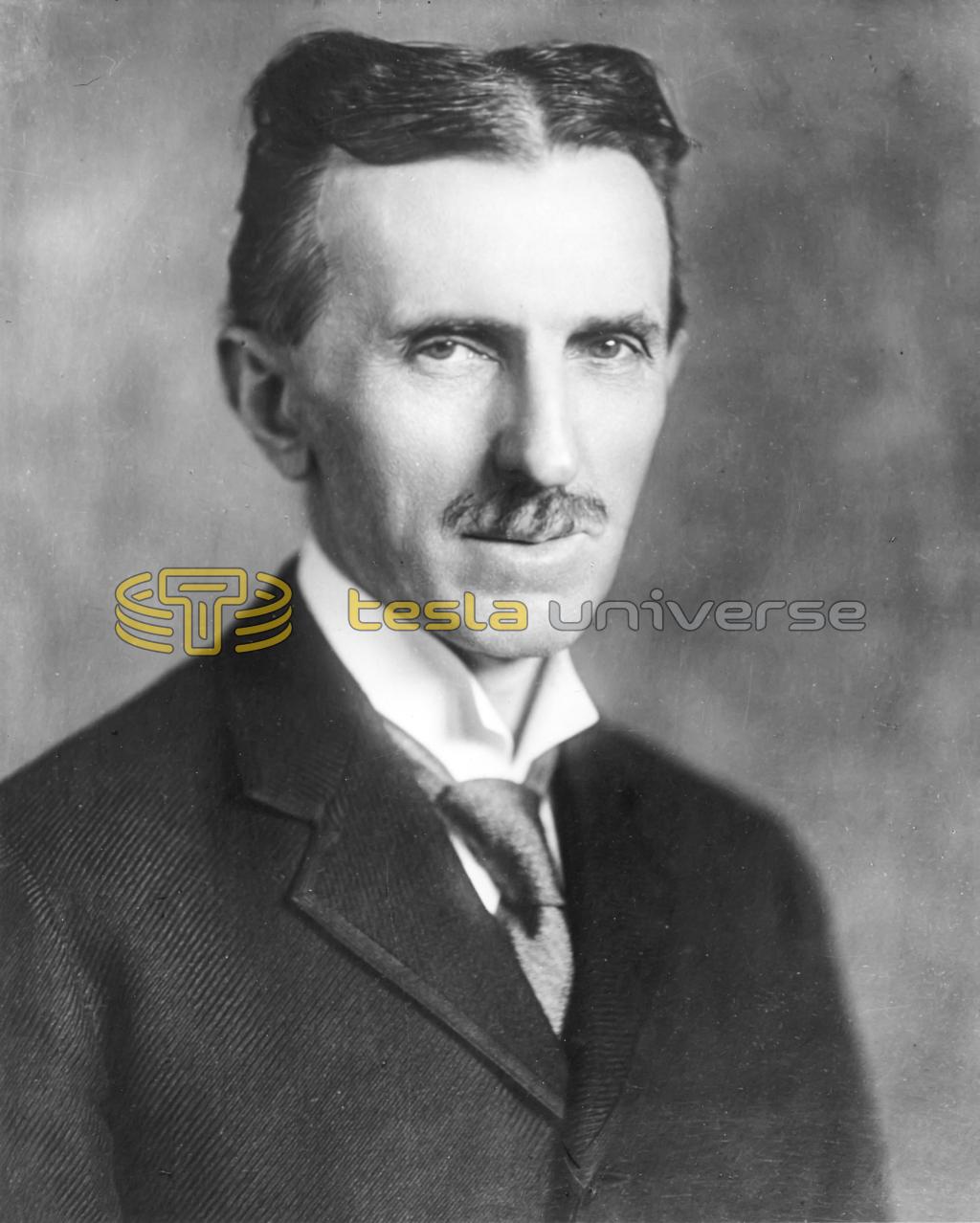
And to top it all there was a large and beautiful picture of Tesla, which was moved from place to place wherever an important event took place.
The Tesla Luncheon
This luncheon was sponsored in co-operation with the American Institute of Electrical Engineers by the Tesla Society. It was held in the Madison Room from 12 noon to 2:00 p.m.
Toastmaster at the luncheon was Mr. Anderson, who introduced the speakers. One of them was Mr. Elmer Gertz, who was graduated from a technological school but turned to law and writing. His subject was: “The Personality of Nikola Tesla”.
Mr. Gertz is a wonderful speaker, one who does not raise his voice, a sort of university professor lecturing to students. Since this is also the centennial of the famous Irish play writer George Bernard Shaw (born on July 26, 1856, in Dublin), Mr. Gertz’ speech was a kind of comparative study of two great men in their respective fields. It was very interesting and educational.
Testimonial A Success
The other speaker at the luncheon was Mr. W. W. Wilhelm, whose subject was: “My experience with Tesla”.
Mr. Wilhelm told us that he worked with Tesla during World War I in Chicago, in 1916, at which time Tesla worked for our government. The nature of work was — turbine.
Mr. Wilhelm, who was Tesla’s assistant at that time, described Tesla as a “kind man to the workers”. It was nice and pleasant to work with him and for him. He never swore nor cursed.
Since the question of religiousness comes up now and then, Mr. Wilhelm said he could not tell us much about that, but went on and told us the following story:
“When Orthodox Christmas came along on January 6th, there was a heavy snowdrift in Chicago. Only few people managed to come to work. Tesla’s auto got stuck in the snow and could not proceed to the shop. He called me to come to him, and when I came, Tesla gave me a big basket full of fruits, candies, etc., plus one box of cigars, and told me to take that to the shop and give it to the workers, which I did.”
His story was very interesting. After four decades, Mr. Wilhelm still recalled all those happy moments he had spent with the great Tesla, and he spoke of them with dignity and pride.
Best Still To Come
Whenever something is really interesting to a person, the time passes too fast; it certainly passed fast with our luncheon and the two speeches we heard.
— From the Madison Room we moved as fast as we could to the adjoining Cotillion Room. Here something was going to happen that I will not easily forget. Fortunately, only the front row was reserved for the chairmen of the various committees, and I got a seat in the second row, next to the stage.
As soon as we were seated, Mr. W. M. Ballinger, Chairman of the Officers, opened the meeting and introduced the chairmen. He warned us not to applaud each chairman individually, but to reserve this for the end. We obliged.
The Welcome Address was to be delivered by the Honorable Richard J. Daly, Mayor of Chicago, but he was unable to attend and the address was read by his Commissioner of Buildings. It was well prepared and delivered. In it were included many events which took place in Chicago many, many years ago, particularly the World’s Fair in 1893.
Response to this address was made by Mr. M. S. Coover, the President of the American Institute of Electrical Engineers. By the way, the Chicago branch was founded in 1893.
Celebration In Yugoslavia
In Yugoslavia extensive preparations were made to honor Dr. Nikola Tesla and to celebrate the centennial of his birth.
The scientific circles throughout the world were informed about it far in advance. Delegates were selected and sent to Yugoslavia to take part in this extraordinary event.
The American Institute of Electrical Engineers delegate was Mr. R. C. Sogge, who made a lengthy report at this official session. Mr. Sogge read a long list of names of the delegates and the countries they represented.
He told his audience how well they were received by a group of professors in Belgrade and how they were treated nicely wherever they went. He had kind words and praise for the Yugoslav people, and for the educational circles for their hospitality. They were taken on tour to some of the more industrial centers.
On the occasion of this Tesla Centennial Celebration in Yugoslavia, a large volume book was published in the English language. Mr. Sogge got a copy which was intended for the A.I.E.E. and which he presented to the Society for its files.
Lecture And Demonstration
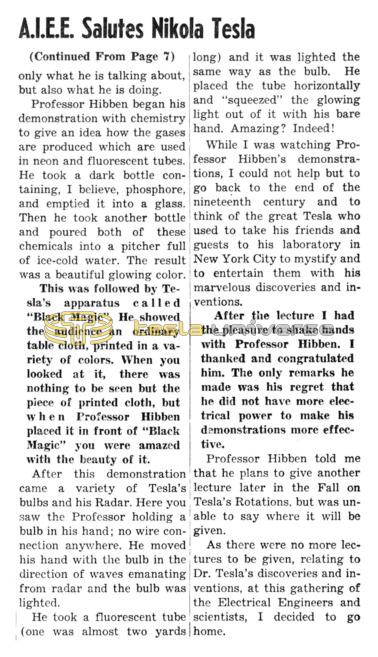
Following Mr. Sogge’s report, Professor Samuel G. Hibben was introduced to the audience. He is an elderly gentleman who knows not only what he is talking about, but also what he is doing.
Professor Hibben began his demonstration with chemistry to give an idea how the gases are produced which are used in neon and fluorescent tubes. He took a dark bottle containing, I believe, phosphore, and emptied it into a glass. Then he took another bottle and poured both of these chemicals into a pitcher full of ice-cold water. The result was a beautiful glowing color.
This was followed by Tesla’s apparatus called “Black Magic.” He showed the audience an ordinary table cloth, printed in a variety of colors. When you looked at it, there was nothing to be seen but the piece of printed cloth, but when Professor Hibben placed it in front of “Black Magic” you were amazed with the beauty of it.
After this demonstration came a variety of Tesla’s bulbs and his Radar. Here you saw the Professor holding a bulb in his hand; no wire connection anywhere. He moved his hand with the bulb in the direction of waves emanating from radar and the bulb was lighted.
He took a fluorescent tube (one was almost two yards long) and it was lighted the same way as the bulb. He placed the tube horizontally and “squeezed” the glowing light out of it with his bare hand. Amazing? Indeed!
While I was watching Professor Hibben’s demonstrations, I could not help but to go back to the end of the nineteenth century and to think of the great Tesla who used to take his friends and guests to his laboratory in New York City to mystify and to entertain them with his marvelous discoveries and inventions.
After the lecture I had the pleasure to shake hands with Professor Hibben. I thanked and congratulated him. The only remarks he made was his regret that he did not have more electrical power to make his demonstrations more effective.
Professor Hibben told me that he plans to give another lecture later in the Fall on Tesla’s Rotations, but was unable to say where it will be given.
As there were no more lectures to be given, relating to Dr. Tesla’s discoveries and inventions, at this gathering of the Electrical Engineers and scientists, I decided to go home.