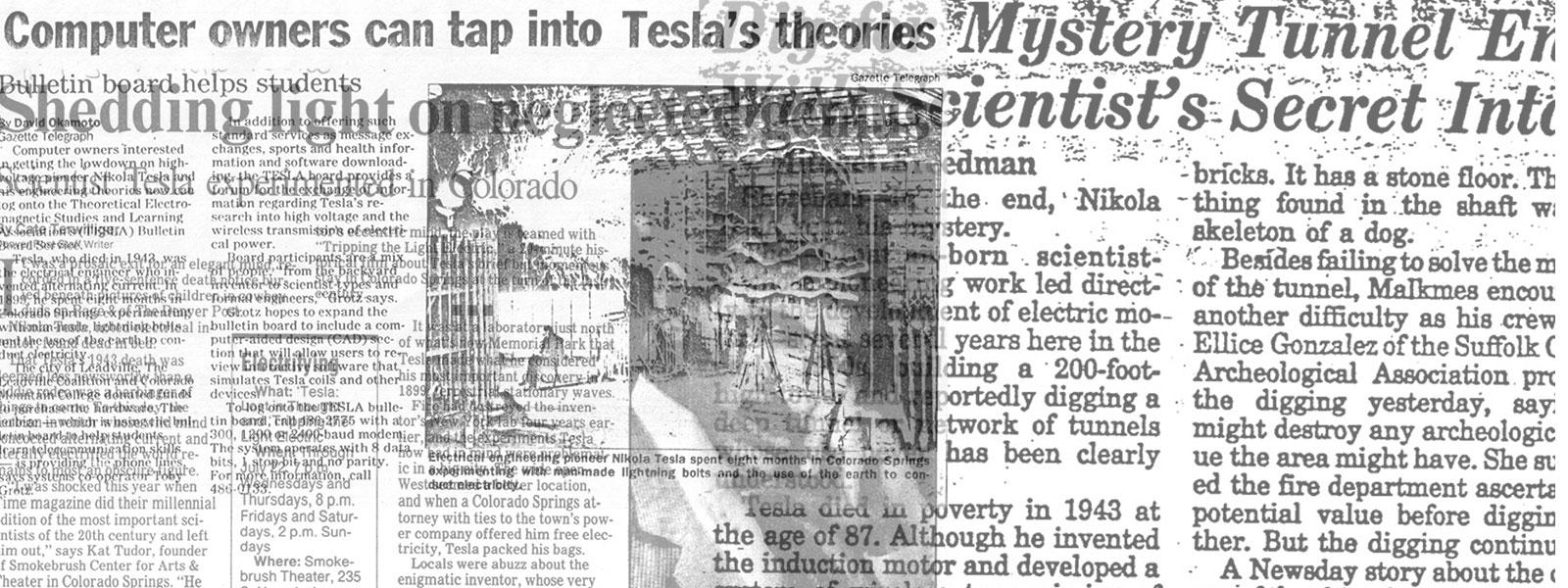
Nikola Tesla Articles
Death of Westinghouse
INVENTOR OF AIRBRAKE AND AN INDUSTRIAL LEADER
He Did Much to Advance Electrical and Mechanical Knowledge, and Scores of Useful Devices Were Developed Under His Control — Gave Aid to Other Inventors in Shops.
Funeral services for George Westinghouse, inventor of the airbrake, will be held at the Fifth Avenue Presbyterian Church to-morrow at 2 P. M. The burial will be at Woodlawn Cemetery. Mr. Westinghouse died of chronic heart disease, which manifested itself about fifteen months ago. His death occurred yesterday afternoon at his apartment in the Langham, Central Park West. The attending physician was Dr. William H. Van den Burg.
George Westinghouse was born at Central Bridge, Schoharie County, N. Y., on October 6, 1846, the son of George and Emeline Vedder Westinghouse. The father’s ancestors had come from Germany, and had settled in Massachusetts and Vermont before the American Revolution; the mother was of Dutch-English origin. When George Westinghouse, the younger, was ten years of age, the family moved to Schenectady; the father was interested in the founding of the Schenectady Agricultural works, and was himself of an inventive turn.
In that city the boy attended the public schools. The hours not spent in classrooms were commonly passed in interested experimentation and observation in his father’s establishment. At the age of fifteen he had put together a type of rotary engine, and it was not long after this that he stood successfully the examination for the position of assistant engineer in the navy.
AS ENGINEER IN THE NAVY.
His practical studies were interrupted by the outbreak of the Civil war, for he enlisted in the Twelfth New York National Guard, in June, receiving his discharge at the expiration of thirty days. The following November he joined the Sixteenth New York Cavalry, serving a year, and being discharged as a full corporal. A month later he was appointed third assistant engineer in the navy. Mr. Westinghouse believed that he could be of more value to his country by serving as a naval engineer, in which position he could best utilize his talents. He was assigned to the United States steamship Muscota, and from this vessel was transferred successively to the Star and Stripes and to the Potomac flotilla. He served until the close of the war, and received an honorable discharge on the 1st of August, 1865. The Government wished him to continue his services in the navy, but he desired to take up again his studies. Entering Union College at Schenectady he pursued the classical courses of study to the close of his second year.
The circumstances under which Westinghouse came to leave Schenectady and to begin his later career illustrate the traits that won him success. He was returning from a visit to Albany when the train was delayed by the derailing of a freight train ahead. The young man watched the efforts to get the cars back on the track with disgust, and showed the workmen that what they needed was a rerailing frog.
He returned home, made some frogs, and, with two other men, who furnished $5,000, started his first factory to manufacture the invention. He held the patents in his own name, however. When the device was fairly on the market the partners demanded that he make over the patents to them. Westinghouse refused, and the partners seized the business, which, without the young inventor, soon failed. Westinghouse went to Pittsburgh, where he became a salesman for Alexander & Woods, a steel casting company. This firm took up the rerailing frog and made it a success.
WORKING ON HIS TRAIN BRAKE.
The idea of the air brake came to Westinghouse in this same year. In one of his trips between Schenectady and Troy he witnessed a bad train wreck — a head-on collision on a straight track. The danger had been seen by the engineers in good time, but the hand brakes could not be set soon enough to avert the disaster. Westinghouse began to seek a device by which the brakes could be controlled from the engine cab.
First he tried automatic brakes attached to the couplers, and then steam, but none was of practical value. Then he read of the use of compressed air in driving the drills that were cutting the Mont Cenis tunnel out of solid rock, and he knew that success was his.
It was difficult to get a trial of his invention, but finally Ralph Bagley guaranteed the payment of the foundry bill for the first apparatus, which was installed on the Steubenville accommodation train. It received its initial trial unexpectedly. As the train rounded a curve the engineer saw a wagon wedged between the tracks some distance dead ahead. The advertised time for the trial of the airbrakes had not arrived. It was too late to stop the train by hand brakes. The skeptical engineer turned on the air in desperation. The passengers were thrown out of their seats by the shock, but a wreck was averted.
They tell a story of Westinghouse and Commodore Vanderbilt, whom the young inventor tried to interest in the air-brake. He got an audience with Commodore Vanderbilt, and explained his device to him. He believed in his invention and was convinced that the New York Central should have all cars equipped at once. Commodore Vanderbilt asked:
“Do you mean to tell me that you can stop a railway train by wind?”
“Well, yes, inasmuch as air is wind, I suppose that you are right,” replied Westinghouse.
“I have no time to waste with fools,” was the answer, and the interview was ended.
The crude device of the brake, as far as Westinghouse had then carried it, by means of an old Worthington pump, was soon perfected and adopted on the Panhandle. The Pennsylvania took it up, and all the railways followed.
The test of the brake was in 1868, when Mr. Westinghouse was just a few months more than twenty-two years of age. The possibility of using compressed air for railroad brakes, and a company was organized to manufacture the apparatus. A small shop was opened in Pittsburgh, with less than 100 workmen, a patent for the air brake—the first received by Mr. Westinghouse — having been issued on April 13, 1869.
The following year Mr. Westinghouse went abroad to exploit his invention. He sought to improve his apparatus, and in the course of time he brought out the “triple valve,” which enables the brakes to be applied simultaneously on a long train and sets them fast if a car breaks away.
His success with the air brake induced Mr. Westinghouse to apply compressed air for the operation of railroad switches and signals, and he also made use of electricity in the same connection, having become interested in the latter science.
IMPROVEMENT OF THE AIR-BRAKE.
The improvement of the air-brake by Westinghouse’s invention of the triple valve was almost as important as the original invention of the device. This reduced the time for full application of the brakes on a ten-car train from twenty-five to eight seconds; or, to express it in distance, it reduced by 1,000 feet the distance in which a train going at forty miles an hour could be stopped. Again, Westinghouse’s genius solved the problem of applying air-brakes on long and heavily loaded freight trains. In a string of fifty cars the full force of the brakes could be applied to the rear cars in less than eighteen seconds; and this, at a rate of speed, meant consequences scarcely less disastrous than a collision. Trains melted and cars crushed and drawers, as the famous Burlington brake trials of 1886 and 1887.
Competing companies experimented for nine months with fifty-car strings, and then the mechanical engineers asked for another year to study the problem. Electric power used to operate the brakes, it was found, could work satisfactorily, but such mechanism was unsuited to heavy railway work. Mr. Westinghouse studied the problem and, in the summer of 1887, made modifications in the triple valve which allowed the full application throughout a train of 50 coaches. He had solved the matter; and, in October and November, his demonstration train made a triumphal tour of the country. Railroad men were amazed when they saw a loaded freight train one-third of a mile long, running at forty miles an hour, stopped smoothly in 540 feet.
The brilliant fight which Westinghouse made in the electrical field was characteristic of his foresight and of his staying power. As soon as he had organized, Westinghouse had sent to Europe came home and reported that he had secured an option on an appliance whereby alternating currents of high potentiality could be transformed into currents of practicable voltage. Experiments in this direction were being made by the Gaulard and Gibbs system. The Westinghouse Company listened to the report, cabled to Europe to bind the option, and, within two weeks, had started the engineer for Europe to close the transaction. That brought about the introduction of the alternating current in this country, and with it the possibility of carrying electricity over considerable distances, so that it might do its work far away from the point of generation.
LIGHTING THE WORLD’S FAIR
This led Mr. Westinghouse to acquire the control of some important electrical patents covering the use of alternating currents, and to form the Westinghouse Electric and Manufacturing Co., for the manufacture of electrical machinery. No but a man of Mr. Westinghouse’s determined courage could ever have developed the use of the alternating current as he did. It was opposed by older electrical companies, which did everything in their power to prevent its introduction, and even Edison was against its adoption.
In the lighting of the World’s Fair at Chicago in 1893 the characteristics of Westinghouse as inventor, mechanic, and man of affairs were admirably displayed. He took the contract for lighting the fair at a price one million dollars less than had been offered by other companies. They, in the effort to crush him, endeavored to persuade the exposition authorities that he could not secure adequate bonds for performance of the contract. He himself then gave private bonds equal to the amount of the contract. After the contract was taken, injunctions were obtained to prevent his manufacture of the lamps, as well as the air pump for exhausting the bulbs, which was at that time supposed to be the best. Mr. Westinghouse then invented another form of lamp, known as the “stopper pattern,” and invented and built machines for the accurate grinding of the stoppers and the necks of the bulbs. He also developed a special form of air-pump to secure the exhaustion. The one million dollars over and distributed to the stockholders when the fair was closed was just the amount that Mr. Westinghouse saved these stockholders by taking the contract for the lighting. This was the largest installation of alternating-current apparatus which had been made up to that time. His next great feat with alternating-current generators was the Niagara installation of the ten tremendous dynamos, which was by far the greatest electrical installation ever made. He also designed and installed the plants for the elevated and subway roads in New York, and for the Metropolitan Railway of London.
It would be unprofitable to enumerate the various devices controlled by Mr. Westinghouse. Many of them, the inventions of other men, were developed under his supervision, for no important step was taken in his shops before he was consulted. He aided Nikola Tesla in developing the discovery of the principle of the rotary magnetic field, and he assigned many of his engineers to the work of perfecting the Nernst lamp so that it might be made a commercial article. Stillwell and Lamme conducted their experiments in the wonderful laboratories and testing plants of the Westinghouse concern; and he, personally, spent royally in the encouragement of research. He assisted in the development of the Cooper Hewitt lamp. Another invention in which he saw commercial possibilities was the Parsons steam turbine, and he acquired the right to introduce the engine in this country soon after it began to attract attention in England. Gas engines were produced under the eye of the head of the Westinghouse Companies, and he began to manufacture them long before gas became the factor it is to-day in commercial enterprises.
DEVELOPING USES OF GAS.
It is not so well known that Mr. Westinghouse developed the use of natural gas so that it might serve conveniently large areas quite remote from the immediate gas fields. The most important feature in the use of the gas (its piping from the gas wells) is due almost entirely to him, and the Philadelphia Company in Pittsburgh was created by him.
The troubles of the Westinghouse Electric Company in the financial disturbance of 1907 were largely due to Westinghouse’s aggressive characteristics. As one of his associates put it, Westinghouse could put a brake on every railroad car in the country, but could not brake himself when he saw danger ahead; so, on October 23, financial circles here and in Pittsburgh got a shock when it was announced that, owing to the embarrassment of the Investment Security Company, the Pittsburgh Stock Exchange would close. This affected a number of the Westinghouse interests.
The severe decline in Westinghouse Electric and Manufacturing second preferred from 54⅛ to 26 had foreshadowed some important developments. It had been known for several months that the electric company was in need of funds. Operations of the company for that year had been on a scale never before equalled; and the failure of the stockholders to take up the $5,000,000 new stock at $75 per share a few months before naturally disarranged the plans of the management for financing its requirements. It had been expected to pay off maturing loans with the proceeds, and the exigencies of the situation in New York prevented the company from making loans that would carry it over a period of several months. The situation became acute and a receivership was sought.
After a receivership which lasted fourteen months, the company was reorganized in December, 1908, and restored to the management of its directors. In the reorganization, however, certain changes were made in the security issues, and the bondholders’ committee, which brought about the reorganization, chose Robert Mather to enter the company as their direct representative.
WESTINGHOUSE NOT A WALL STREET MAN.
Then on July 29, 1910, after having for more than a quarter century ruled with almost absolute power the Westinghouse Electric and Manufacturing Company, Westinghouse was ousted by the directors from his place as president. Friction between the president and the board of directors, extending over a period of more than two years, and culminating in an open break between Robert Mather and Mr. Westinghouse, led to the action of the directors.
Unlike many men of great wealth, Mr. Westinghouse did not accumulate his fortune through stock manipulation or by participation in syndicates. He was inventor, manufacturer, trader, adding one by one to his enterprises, expanding them, sending their products through the ordinary channels of trade, and widening his markets until they covered every civilized country. His genius as an inventor, combined with his knowledge of mechanical processes and a mastery of varied phases of engineering, enabled him to become the actual head of his great works, while his business sense, so to speak, led him to direct the currents of commerce. Finding that Europe needed much of his apparatus, he organized companies in France, England, Russia, and Germany to supply the demand, and when Canada showed signs of increasing commercial activity a Westinghouse plant was built in that country.
TYPE OF HONEST BUSINESS MAN.
Work was apparently his chief recreation. He was a type, too, of the ruggedly honest man of business. Once, it is related, a dissatisfied customer came to Mr. Westinghouse and complained about an ill-advised purchase of incandescent lamps.
“Did you know that these lamps were not suited to that man’s business when you sold them to him?” asked Mr. Westinghouse of the employee who was responsible for the sale.
“Yes,” was the hesitating reply.
“That is not the way to build up a business,” said Mr. Westinghouse, and he dismissed the subordinate at once.
His associates say that their chief had a saving sense of humor, coupled with a remarkable memory.
“He seemed to make a mental photograph of every happening,” said one of them, “and he could always bring out the correct negative when it was needed. In recalling a discussion that took place, say ten years before, he could tell the name of the man with whom he had conversed.”
When engaged in New York in his duties of organizer, financier, or active manager, Mr. Westinghouse was frequently called up on the long-distance telephone for orders.
“And if orders were received over the telephone to space a certain connection one-thirty-second of an inch,” one of his engineers remarked, “and he should find a month or two later that it actually measured one-sixteenth, he would ask in an instant why the change was made.”
“He had an extraordinary capacity for design,” said an engineer who knew Mr. Westinghouse’s methods. Then the engineer went on to tell how Mr. Westinghouse would sit at a billiard table with an electric light shining in his eyes, and make his own drawings without a measuring rule, working out the proportions as the plans developed, and finding the weight of metal to a nicety.
“You can actually use the calipers on those drawings, they are so true to scale,” added the engineer.
WORKING OUT A DESIGN
When Mr. Westinghouse sent his drawings to the shop he might give orders to 80 or 100 men to work out the design. And when it was completed he would make the necessary alterations if any were required to add to the effectiveness of his creation. Neither time nor money counted in the Westinghouse shops when the “old man,” as he was called, had initiated a certain line of experiment. When he thought a design to be founded on correct principles, he worked at it until all mechanical obstacles were overcome. Engineers might throw up their hands, but not Mr. Westinghouse. It took four years of costly experiments to produce the 4,000-horse-power locomotive which was designed to haul heavily loaded trains through the Pennsylvania tunnel under the Hudson River. Some of the contrivances for this machine were utilized in the operation of a miniature locomotive in the back yard of the Westinghouse home in Pittsburgh as far back as 1891, which goes to show how the inventor was able to make use of old ideas.
Not the least significant incident in Mr. Westinghouse’s career was the fact that he was the first great employer of labor in America to institute the Saturday half-holiday for employees.
HIS HONORS AND OFFICES
Mr. Westinghouse’s connections abroad brought him into relations with many of the foremost men of science and industrial leaders there. He was a friend of Lord Kelvin, and was decorated with the French Legion of Honor, the Royal Italian Order of the Crown, and the Order of Leopold. He held the honorary degree of LL.D. from Union College, and he was an honorary member of the American Society of Mechanical Engineers and the American Association for the Advancement of Science. He was also one of the three Ryan trustees of the Equitable Life Insurance Society, and was continued in this office after J. Pierpont Morgan had taken control of the society.
Before Mr. Westinghouse’s ousting from the presidency of the Westinghouse Electric and Manufacturing Company, in 1910, he held the offices of president and director in sixteen companies, including the Canadian Westinghouse Company, Limited, the Cooper Hewitt Electric Company, Nernst Lamp Company, Pittsburgh Motor Company, Security Investment Company, Société Italiana Westinghouse, Paris Société Anonyme Westinghouse, St. Petersburg Société Electrique Westinghouse de Russie, Paris; Union Switch and Signal Company, Westinghouse Air Brake Company, Westinghouse Brake Company, Limited, of London; Westinghouse Cooper Hewitt Company, Limited, of London; Westinghouse Electric and Manufacturing Company, Westinghouse Lamp Company, Westinghouse Machine Company. He was also chairman of the board of directors of the British Westinghouse Electric and Manufacturing Company, Limited, of London; the Société Anonyme Westinghouse, Paris; Westinghouse Electric Company, Limited, of London, and director of the Consolidated Car Heating Company, the Electric Power Securities Company of Niagara Falls, Electric Properties Company, Traction and Power Securities Company, Limited, of London; Westinghouse, Church, Kerr & Co., Westinghouse Foundry Company, Westinghouse Metal Filament Lamp Company, and the Westinghouse Metallfaden Glühlampen-Fabrik, G. m. b. H., of Vienna. After his deposition from the presidency of the Westinghouse Electric and Manufacturing Company, Mr. Westinghouse resigned from his offices in several of the other companies allied with this concern.
In August, 1867, Mr. Westinghouse married Marguerite Erskine Walker, who survives him. They had one child, George Westinghouse, Jr., who lives near Lenox, Mass. The latter married Miss Violet Brocklebank, the daughter of Sir Thomas and Lady Brocklebank, of Irton Hall, Cumberland, England.
25,000 MEN SUSPEND WORK
PITTSBURGH, March 13. — Twenty-five thousand men suspended work to-day in the Turtle Creek valley, out of respect to the late George Westinghouse. He was a factor in the industries of that section, which were to-day ordered closed until after Mr. Westinghouse’s funeral.
