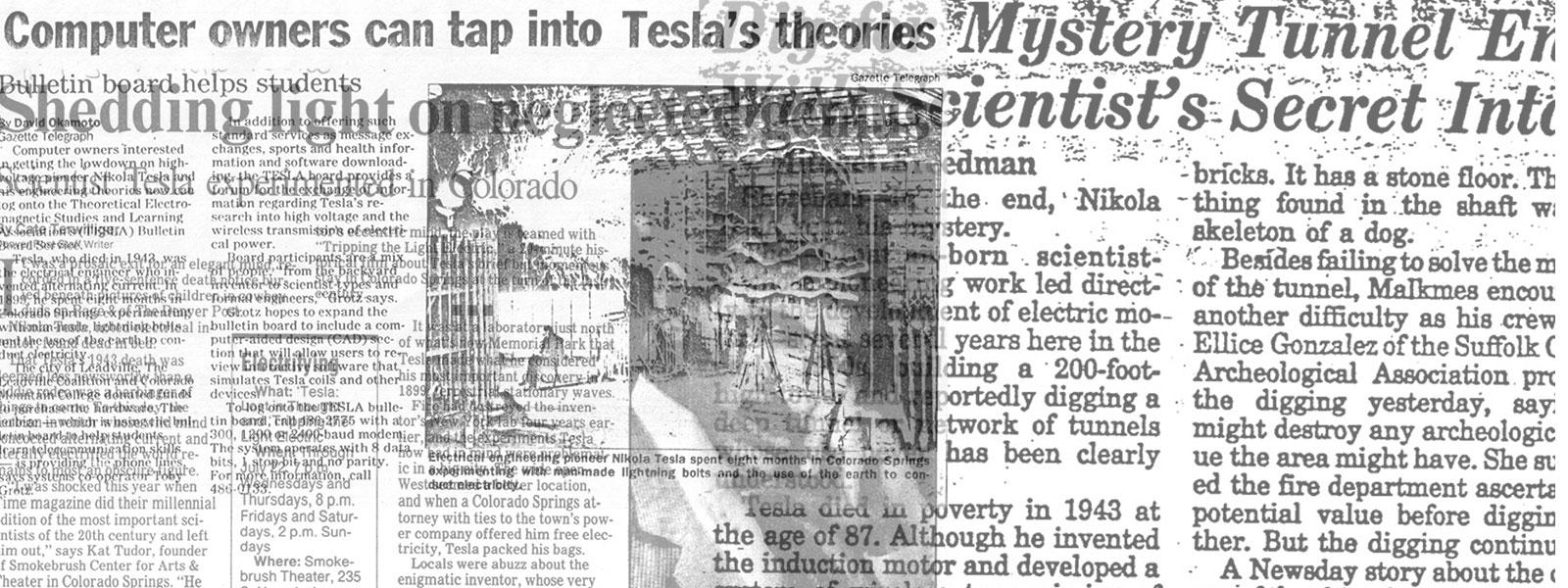
Nikola Tesla Articles
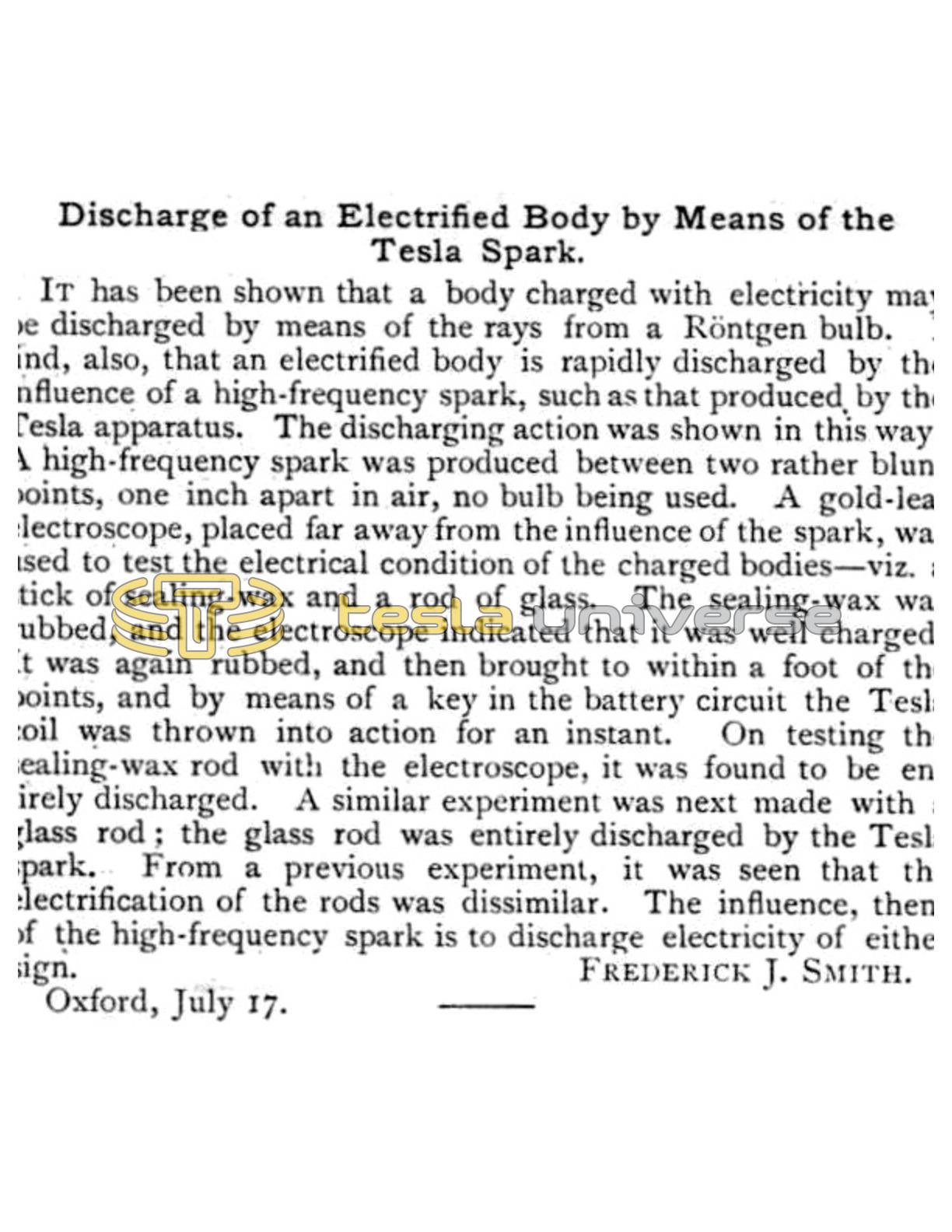
Discharge of an Electrified Body by Means of the Tesla Spark
It has been shown that a body charged with electricity may be discharged by means of the rays from a Röntgen bulb. I find, also, that an electrified body is rapidly discharged by the influence of a high-frequency spark, such as that produced by the Tesla apparatus. The discharging action was shown in this way. A high-frequency spark was produced between two rather blunt points, one inch apart in air, no bulb being used. A gold-leaf electroscope, placed far away from the influence of the spark, was used to test the electrical condition of the charged bodies — viz. a stick of sealing-wax and a rod of glass. The sealing-wax was rubbed, and the electroscope indicated that it was well charged. It was again rubbed, and then brought to within a foot of the points, and by means of a key in the battery circuit the Tesla coil was thrown into action for an instant. On testing the sealing-wax rod with the electroscope, it was found to be entirely discharged. A similar experiment was next made with a glass rod; the glass rod was entirely discharged by the Tesla spark. From a previous experiment, it was seen that the electrification of the rods was dissimilar. The influence, then, of the high-frequency spark is to discharge electricity of either sign.
FREDERICK J. SMITH.
Oxford, July 17.
Reprints
- Discharge of an Electrified Body by Means of the Tesla Spark (reprint)Electrical Engineer — August 19th, 1896