Nikola Tesla Articles
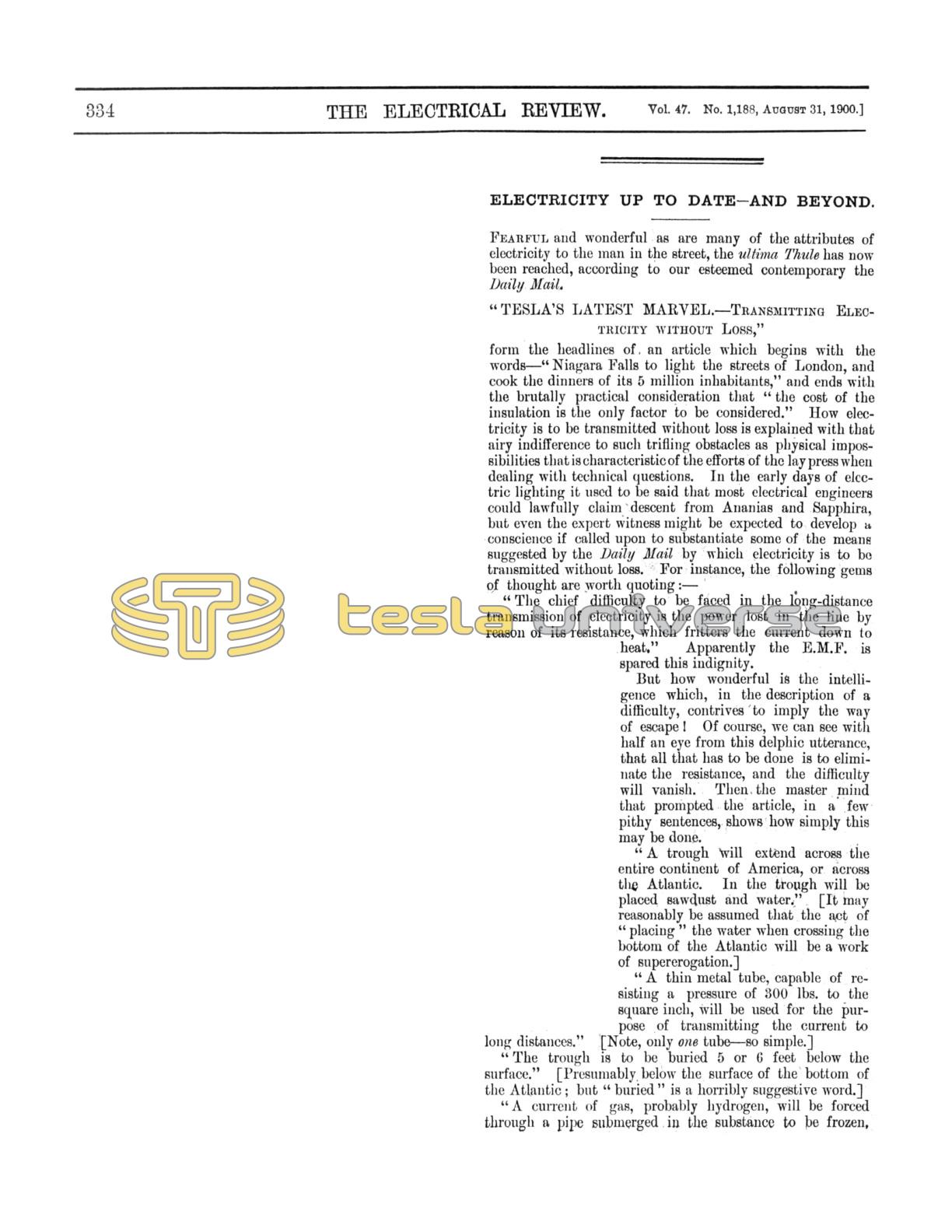
Electricity Up To Date - And Beyond
Fearful and wonderful as are many of the attributes of electricity to the man in the street, the ultima Thule has now been reached, according to our esteemed contemporary the Daily Mail.
"TESLA'S LATEST MARVEL. — TRANSMITTING ELECTRICITY WITHOUT LOSS,"
form the headlines of an article which begins with the words — "Niagara Falls to light the streets of London, and cook the dinners of its 5 million inhabitants," and ends with the brutally practical consideration that "the cost of the insulation is the only factor to be considered." How electricity is to be transmitted without loss is explained with that airy indifference to such trifling obstacles as physical impossibilities that is characteristic of the efforts of the lay press when dealing with technical questions. In the early days of electric lighting it used to be said that most electrical engineers could lawfully claim descent from Ananias and Sapphira, but even the expert witness might be expected to develop a conscience if called upon to substantiate some of the means suggested by the Daily Mail by which electricity is to be transmitted without loss. For instance, the following gems of thought are worth quoting:—
"The chief difficulty to be faced in the long-distance transmission of electricity is the power lost in the line by reason of its resistance, which fritters the current down to heat." Apparently the E.M.F. is spared this indignity.
But how wonderful is the intelligence which, in the description of a difficulty, contrives to imply the way of escape! Of course, we can see with half an eye from this delphic utterance, that all that has to be done is to eliminate the resistance, and the difficulty will vanish. Then the master mind that prompted the article, in a few pithy sentences, shows how simply this may be done.
"A trough will extend across the entire continent of America, or across the Atlantic. In the trough will be placed sawdust and water." [It may reasonably be assumed that the act of "placing" the water when crossing the bottom of the Atlantic will be a work of supererogation.]
"A thin metal tube, capable of resisting a pressure of 300 lbs. to the square inch, will be used for the purpose of transmitting the current to long distances." [Note, only one tube — so simple.]
"The trough is to be buried 5 or 6 feet below the surface." [Presumably below the surface of the bottom of the Atlantic; but “buried” is a horribly suggestive word.]
"A current of gas, probably hydrogen, will be forced through a pipe submerged in the substance to be frozen. The hydrogen will be reduced to — 200° C., which will suffice to freeze the material, and neutralise the heat generated by the passage of the electricity."
The italics are ours. Why is any heat generated? Transmission without loss means conductors without resistance, hence absence of heat. But if heat be generated, the neutralisation comes a day after the fair, as far as any saving is concerned. It would be better, if we might hazard a suggestion, to neutralise the resistance.
Nothing is said about the cost of producing the “gas at — 200° C.,” or the quantity that will be required, nor is the somewhat delicate subject touched upon of labour troubles which might ensue if workmen were asked to break up and make good the bottom of the Atlantic under a pressure of anything from 2 tons per square inch upwards. What would the fish say to a cold streak at the bottom of their home? They might strike, and be joined by horses and birds out of sympathy. The possible prospect of fish refusing to be caught, horses refusing to move, and birds declining to fly, ought surely to awaken some sense of responsibility in Mr. Tesla's breast!
But we have not exhausted the possibilities of this system.
Mr. Tesla is stated to believe that his new system of insulation is “indispensable to telephone and telegraph companies.” The inclusion of each telephone wire in a trough filled with sawdust and water, and reduced to — 200° C., opens up some pleasing prospects on the overhead system.
Mr. Tesla is stated to believe, further, that no electricity will be wasted in transmission, and that “water-power converted into electricity will be carried thousands of miles.” Query, in a trough?
The Daily Mail, in concluding, points out that, “by Mr. Tesla's invention, there is now practically no limit to the distance to which electricity may be conveyed.”
The Daily Mail has spoken. We have, therefore, reached finality, and we may imagine interplanetary space mapped out, in the near future, into districts by troughs of sawdust and water at — 200° C., and agencies appointed in each of the more important planets for the supply of electricity on sale or return. Why not? it would be just as easy as to “trough” the bottom of the Atlantic.