Nikola Tesla Articles
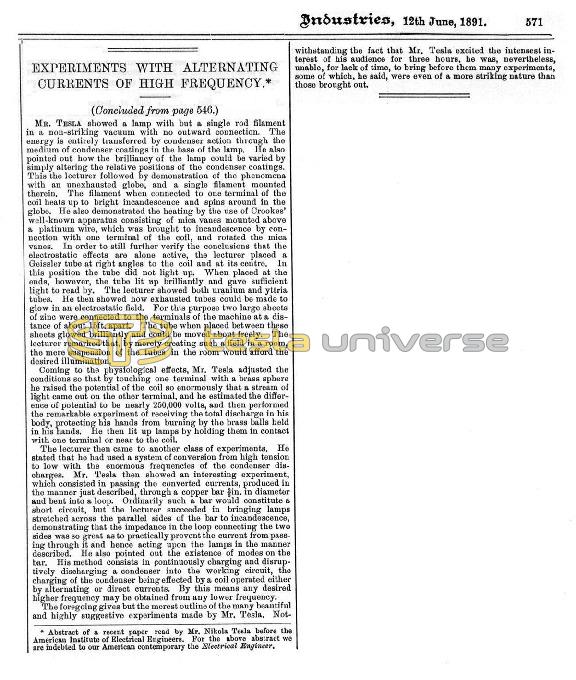
Experiments with Alternating Currents of High Frequency - Lecture Abstract - Part 2
(Concluded from page 546.)
Mr. Tesla showed a lamp with but a single rod filament in a non-striking vacuum with no outward connection. The energy is entirely transferred by condenser action through the medium of condenser coatings in the base of the lamp. He also pointed out how the brilliancy of the lamp could be varied by simply altering the relative positions of the condenser coatings. This the lecturer followed by demonstration of the phenomena with an unexhausted globe, and single filament mounted therein. The filament when connected to one terminal of the coil heats up to bright incandescence and spins around in the globe. He also demonstrated the heating by the use of Crookes' well-known apparatus consisting of mica vanes mounted above a platinum wire, which was brought to incandescence by connection with one terminal of the coil, and rotated the mica vanes. In order to still further verify the conclusions that the electrostatic effects are alone active, the lecturer placed a Geissler tube at right angles to the coil and at its centre. In this position the tube did not light up. When placed at the ends, however, the tube lit up brilliantly and gave sufficient light to read by. The lecturer showed both uranium and yttria tubes. He then showed how exhausted tubes could be made to glow in an electrostatic field. For this purpose two large sheets of zinc were connected to the terminals of the machine at a distance of about 15ft. apart. The tube when placed between these sheets glowed brilliantly and could be moved about freely. The lecturer remarked that, by merely creating such a field in a room, the mere suspension of the tubes in the room would afford the desired illumination.
Coming to the physiological effects, Mr. Tesla adjusted the conditions so that by touching one terminal with a brass sphere he raised the potential of the coil so enormously that a stream of light came out on the other terminal, and he estimated the difference of potential to be nearly 250,000 volts, and then performed the remarkable experiment of receiving the total discharge in his body, protecting his hands from burning by the brass balls held in his hands. He then lit up lamps by holding them in contact with one terminal or near to the coil.
The lecturer then came to another class of experiments. He stated that he had used a system of conversion from high tension to low with the enormous frequencies of the condenser discharges. Mr. Tesla then showed an interesting experiment, which consisted in passing the converted currents, produced in the manner just described, through a copper bar ⅜in. in diameter and bent into a loop. Ordinarily such a bar would constitute a short circuit, but the lecturer succeeded in bringing lamps stretched across the parallel sides of the bar to incandescence, demonstrating that the impedance in the loop connecting the two sides was so great as to practically prevent the current from passing through it and hence acting upon the lamps in the manner described. He also pointed out the existence of modes on the bar. His method consists in continuously charging and disruptively discharging a condenser into the working circuit, the charging of the condenser being effected by a coil operated either by alternating or direct currents. By this means any desired higher frequency may be obtained from any lower frequency.
The foregoing gives but the merest outline of the many beautiful and highly suggestive experiments made by Mr. Tesla. Notwithstanding the fact that Mr. Tesla excited the intensest interest of his audience for three hours, he was, nevertheless, unable, for lack of time, to bring before them many experiments, some of which, he said, were even of a more striking nature than those brought out.
*Abstract of a recent paper read by Mr. Nikola Tesla before the American Institute of Electrical Engineers. For the above abstract we are indebted to our American contemporary the Electrical Engineer.