Nikola Tesla Articles
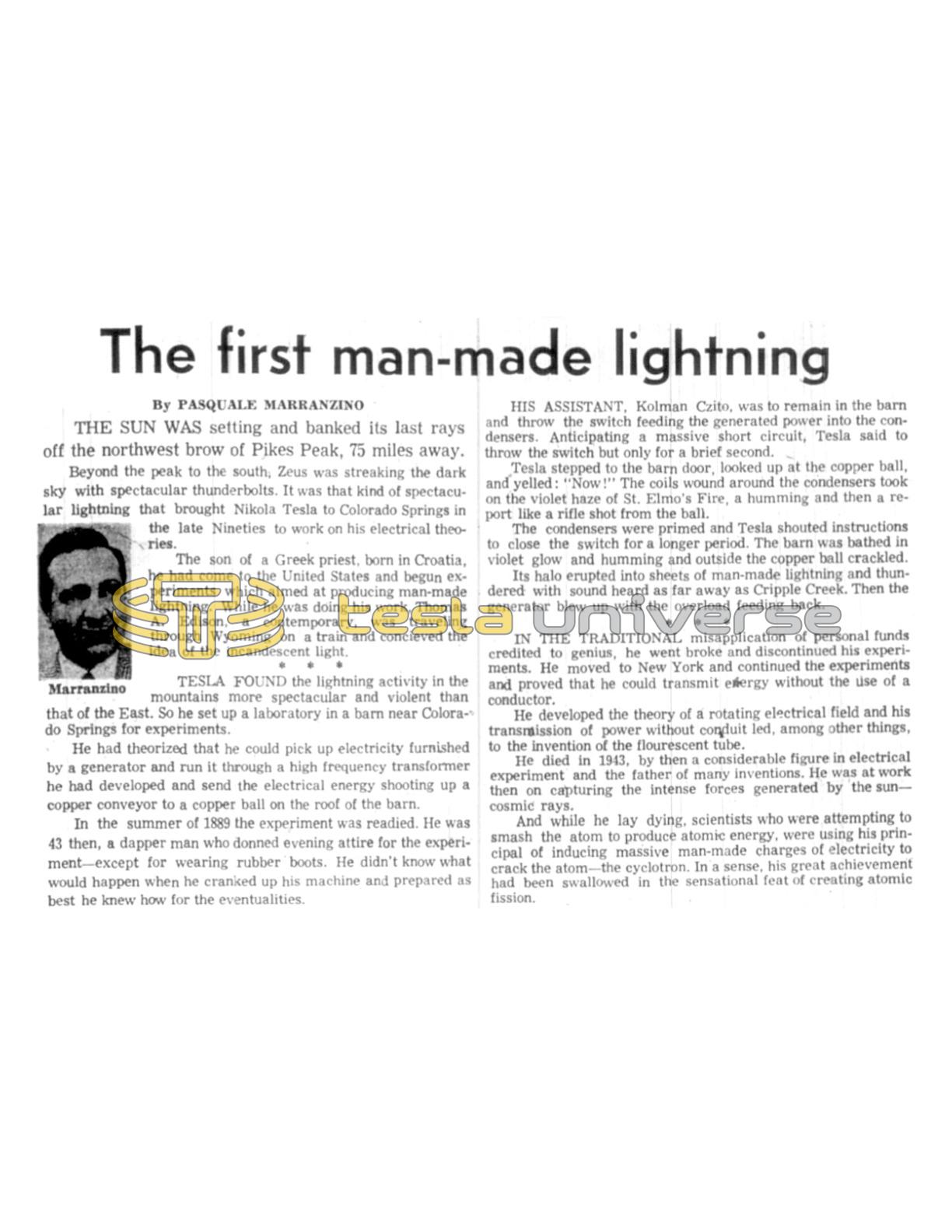
The First Man-Made Lightning
By PASQUALE MARRANZINO
The sun was setting and banked its last rays off the northwest brow of Pikes Peak, 75 miles away.
Beyond the peak to the south, Zeus was streaking the dark sky with spectacular thunderbolts. It was that kind of spectacular lightning that brought Nikola Tesla to Colorado Springs in the late Nineties to work on his electrical theories.
The son of a Greek priest, born in Croatia, he had come to the United States and begun experiments which aimed at producing man-made lightning. While he was doing his work, Thomas A. Edison, a contemporary, was traveling through Wyoming on a train and concieved the idea of the incandescent light.
Tesla found the lightning activity in the mountains more spectacular and violent than that of the East. So he set up a laboratory in a barn near Colorado Springs for experiments.
He had theorized that he could pick up electricity furnished by a generator and run it through a high frequency transformer he had developed and send the electrical energy shooting up a copper conveyor to a copper ball on the roof of the barn.
In the summer of 1889 the experiment was readied. He was 43 then, a dapper man who donned evening attire for the experiment — except for wearing rubber boots. He didn't know what would happen when he cranked up his machine and prepared as best he knew how for the eventualities.
His assistant, Kolman Czito, was to remain in the barn and throw the switch feeding the generated power into the condensers. Anticipating a massive short circuit, Tesla said to throw the switch but only for a brief second.
Tesla stepped to the barn door, looked up at the copper ball, and yelled: "Now!" The coils wound around the condensers took on the violet haze of St. Elmo's Fire, a humming and then a report like a rifle shot from the ball.
The condensers were primed and Tesla shouted instructions to close the switch for a longer period. The barn was bathed in violet glow and humming and outside the copper ball crackled.
Its halo erupted into sheets of man-made lightning and thundered with sound heard as far away as Cripple Creek. Then the generator blew up with the overload feeding back.
In the traditional misapplication of personal funds credited to genius, he went broke and discontinued his experiments. He moved to New York and continued the experiments and proved that he could transmit energy without the use of a conductor.
He developed the theory of a rotating electrical field and his transmission of power without conduit led, among other things, to the invention of the fluorescent tube.
He died in 1943, by then a considerable figure in electrical experiment and the father of many inventions. He was at work then on capturing the intense forces generated by the sun — cosmic rays.
And while he lay dying, scientists who were attempting to smash the atom to produce atomic energy, were using his principal of inducing massive man-made charges of electricity to crack the atom — the cyclotron. In a sense, his great achievement had been swallowed in the sensational feat of creating atomic fission.