Nikola Tesla Articles
Helicopters and Safety Planes
New Advances in the Field of Aeronautics Relate to Making Flying Safer and Toward the Development of Vertically Rising Machines.
The world is looking forward to new developments in aircraft, and possibly even getting more than it expects in the way of radical departures from present styles. Aviation enthusiasts believe that the only solution to the problem of popular flying is the development and successful demonstration of vertical flying machines. These machines will have to be able to rise from a limited tract of land and come to rest in the same space. In addition, they will have to proceed at a speed of approximately sixty miles an hour and be absolutely safe, even in the event that the engines should stop.
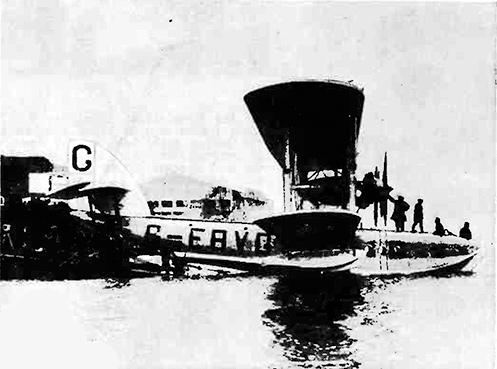
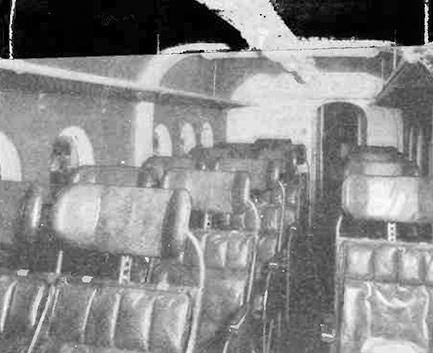
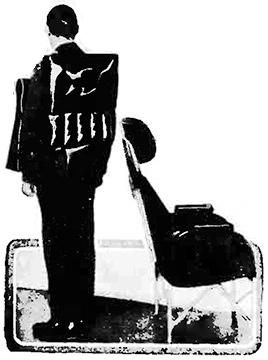
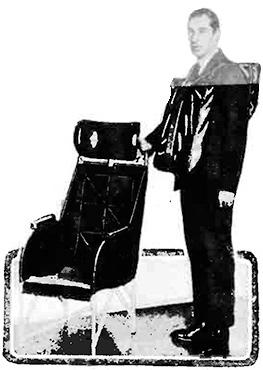
The photographs here show the world's largest seaplane liner. It is equipped with three 485 horsepower Jupiter engines, and is made entirely of metal. It is completely equipped with every convenience for the passengers, including dining and culinary service. The seats are air-filled, and comfortably hold the life belt and parachutes for a forced departure from the plane. The photographs on either side show one of the seats and the equipment strapped to a passenger. The immensity of this plane can be estimated by comparing with the men standing on the vessel.
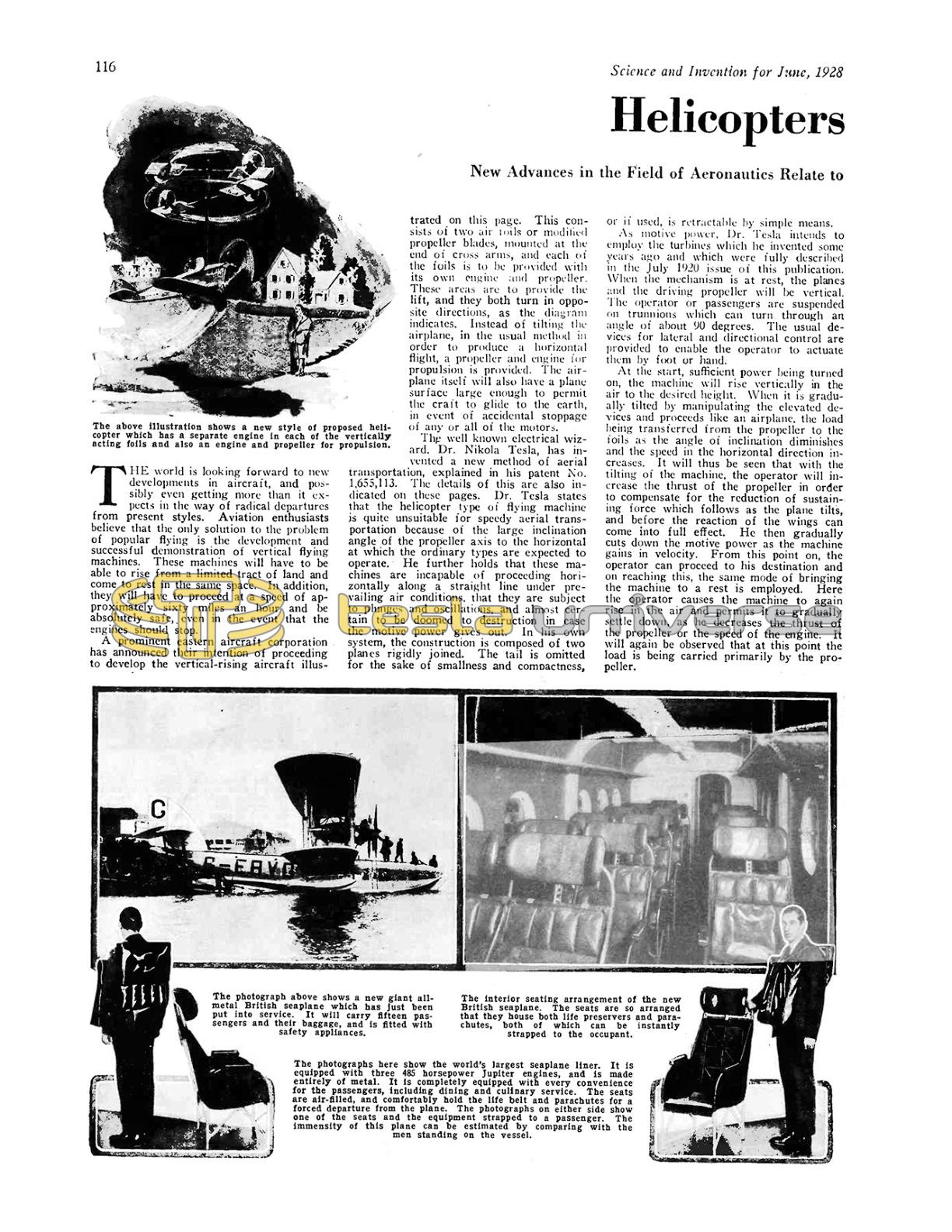
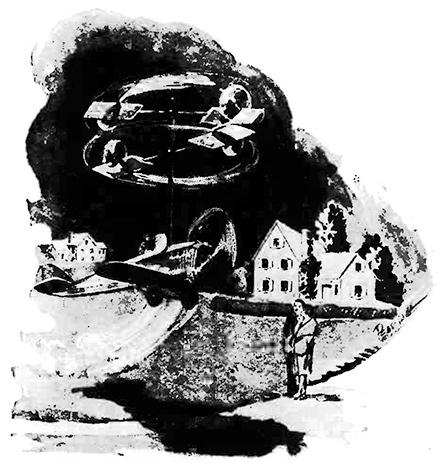
A prominent eastern aircraft corporation has announced their intention of proceeding to develop the vertical-rising aircraft illustrated on this page. This consists of two air foils or modified propeller blades, mounted at the end of cross arms, and each of the foils is to be provided with its own engine and propeller. These areas are to provide the lift, and they both turn in opposite directions, as the diagram indicates. Instead of tilting the airplane, in the usual method in order to produce a horizontal flight, a propeller and engine for propulsion is provided. The airplane itself will also have a plane surface large enough to permit the craft to glide to the earth, in event of accidental stoppage of any or all of the motors.
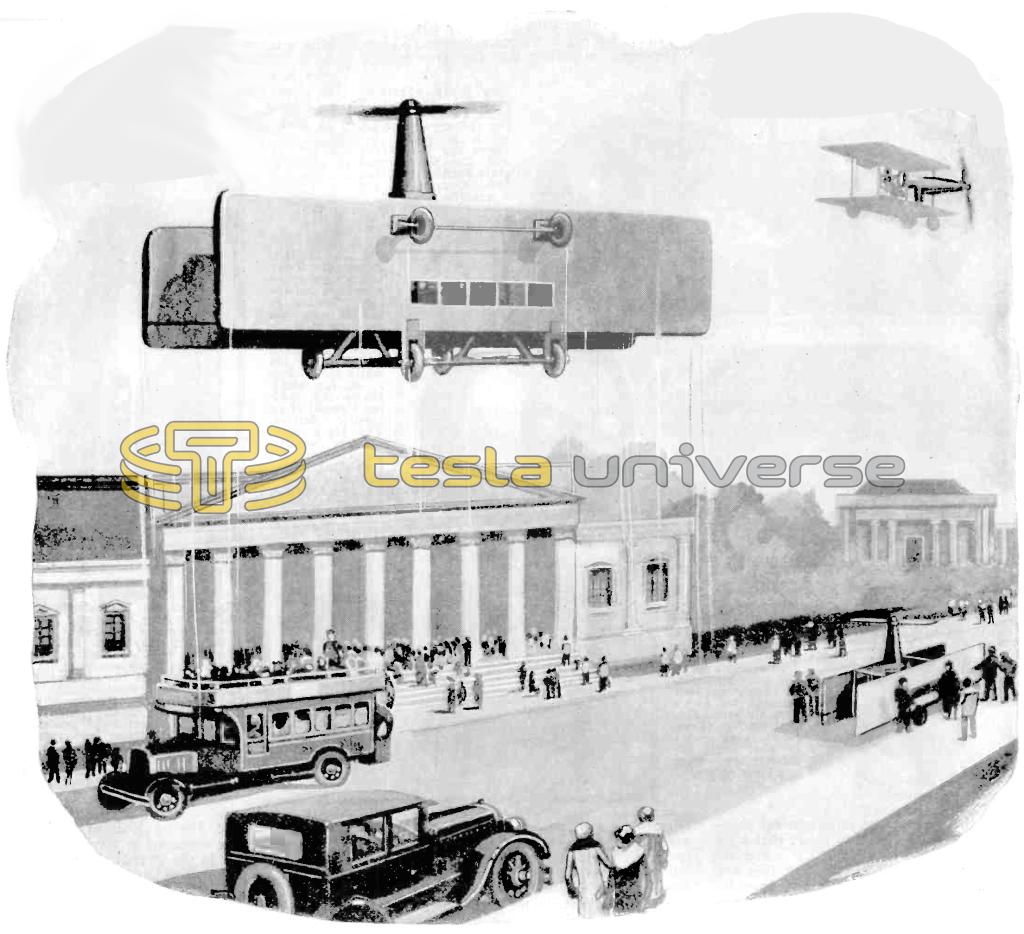
The well known electrical wizard, Dr. Nikola Tesla, has invented a new method of aerial transportation, explained in his patent No. 1,655,113. The details of this are also indicated on these pages. Dr. Tesla states that the helicopter type of flying machine is quite unsuitable for speedy aerial transportation because of the large inclination angle of the propeller axis to the horizontal at which the ordinary types are expected to operate. He further holds that these machines are incapable of proceeding horizontally along a straight line under prevailing air conditions, that they are subject to plunges and oscillations, and almost certain to be doomed to destruction in case the motive power gives out. In his own system, the construction is composed of two planes rigidly joined. The tail is omitted for the sake of smallness and compactness, or if used, is retractable by simple means.
As motive power, Dr. Tesla intends to employ the turbines which he invented some years ago and which were fully described in the July 1920 issue of this publication. When the mechanism is at rest, the planes and the driving propeller will be vertical. The operator or passengers are suspended on trunnions which can turn through an angle of about 90 degrees. The usual devices for lateral and directional control are provided to enable the operator to actuate them by foot or hand.
At the start, sufficient power being turned on, the machine will rise vertically in the air to the desired height. When it is gradually tilted by manipulating the elevated devices and proceeds like an airplane, the load being transferred from the propeller to the foils as the angle of inclination diminishes and the speed in the horizontal direction increases. It will thus be seen that with the tilting of the machine, the operator will increase the thrust of the propeller in order to compensate for the reduction of sustaining force which follows as the plane tilts, and before the reaction of the wings can come into full effect. He then gradually cuts down the motive power as the machine gains in velocity. From this point on, the operator can proceed to his destination and on reaching this, the same mode of bringing the machine to a rest is employed. Here the operator causes the machine to again rise in the air and permits it to gradually settle down, as he decreases the thrust of the propeller or the speed of the engine. It will again be observed that at this point the load is being carried primarily by the propeller.
It will be observed that any type of a gasoline engine could be employed in a helicopter of this nature, but Dr. Tesla recommends the use of his gasoline turbine because of its lightness and because it lends itself to this kind of work, for which the modern types of engines might be unsuited. His own turbine is capable of carrying a great overload and of running without danger of excessive speeds so that during the starting and landing operations, the necessary power can be developed by the motors. At the same time there is always a surplus of power which can be employed if the operator desires to greatly increase his forward speed. The illustrations on this page show the machine as it would appear at rest, with the propeller in a vertical position and the same plane in horizontal flight. No tail is here indicated, but if one were to be employed, it would as mentioned before, be quickly retractable.
And in London, developments along the line of passenger aircraft are rapidly proceeding, with every safety appliance imaginable being included and everything being done to accommodate the passengers. In these large planes the seats are now fully equipped with both parachutes and life preservers, so that in the event the passengers have to leave the plane because of an emergency, they can step out of it, even while it is in flight and negotiate a perfectly safe landing. These planes are all-metal built.
The ability of metal planes in carrying out successful long distance flights is exemplified by the German plane the "Bremen," the first to cross the Atlantic from east to west. The flight was from Dublin, Ireland to Greenely Island, Canada, with Baron von Huenefeld, Herman Koehl, and James Fitzmaurice.