Plans
Suggestions for Producing High-Frequency Currents and Some of Their Phenomena - Part 2
(Concluded.)
Editor note: See part one here.
BY EDWIN F. NORTHRUP AND ELLIOTT WOODS.
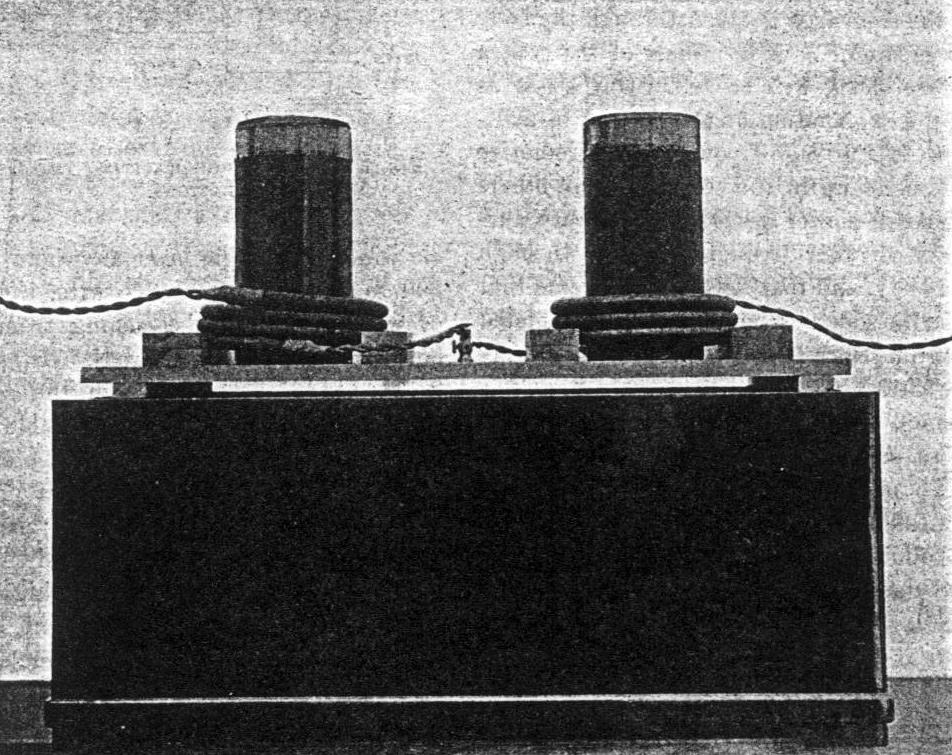
Two views, reproduced from photographs, of two coils constructed on the general lines described above are illustrated in Figs. 5 and 6. The coil shown in Fig. 5 gave a very good twenty-inch discharge. The terminals in the picture, Fig. 5, are shown twenty and one-quarter inches apart, from which standard of reference the reader can determine the other dimensions of the apparatus. The coils shown in Figs. 5 and 6 had their secondaries wound on glass jars which set on the inside of larger glass jars around which the primary coils are wound. The construction as indicated in Fig. 3 would, however, if followed, have been somewhat more efficient. The primary turns, as indicated above, should preferably be made of copper strip, as the high-frequency currents in the primary coils are chiefly confined to the surface of the conductor and by using copper ribbon instead of round wire as actually used, it is possible to surround a larger portion of the secondary windings without increasing the number of primary turns.
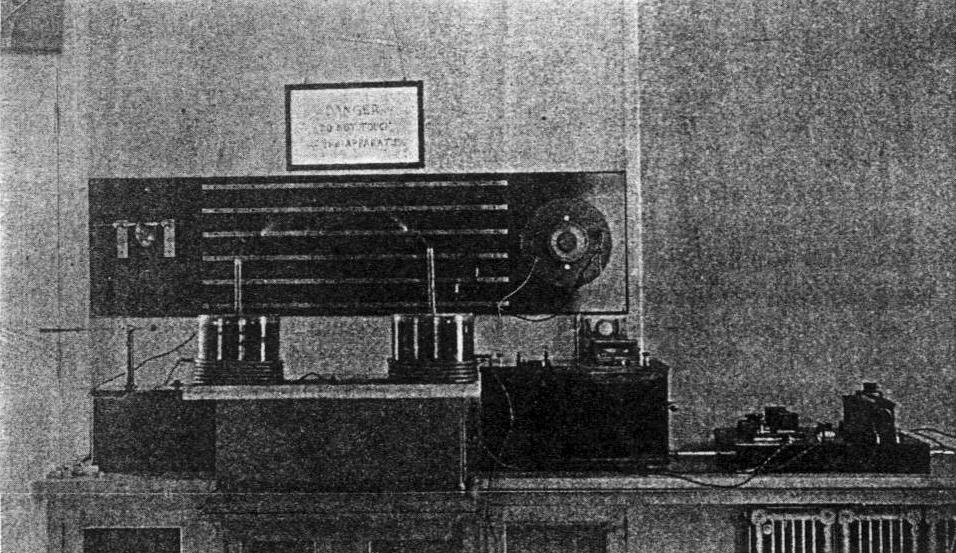
Experiments with the coils illustrated in Figs. 5 and 6 showed that for obtaining the maximum length of discharge a certain number of primary turns were required. For the coil shown in Fig. 6 four turns on each half seemed to give the best result. The efficiency of the high-frequency coil in regard to length and volume of discharge is greatly increased when the leads to the primary windings, or, in other words, the connecting wires in the circuit in which the electricity oscillates, are kept as short as possible. The discharge from a high-frequency coil will vary in volume, as well as in length, very greatly, according to the form of construction of the apparatus and the power which is put into it. A coil such as has been described above, when the transformer is taking about twenty amperes at 110 volts and 7,200 alternations per minute, should give a discharge of sufficient volume to bring the filament of a 110-volt sixteen-candle-power lamp to a bright red when passed through it. We have seen as many as ten incandescent lamps brought nearly to candle-power when joined in series and the discharge from a high-frequency coil, capable of giving eight inches, passed through all of them. Observations taken on a wattmeter which measured the true power put into the apparatus apparently showed that the apparatus was taking less power than would be required with ordinary currents to light ten lamps to two-thirds candlepower, as they actually were lighted from the high-frequency discharge which was passed through them. To all appearances the filaments were brought to incandescence by true conduction currents. As far as the indications went, a considerably larger number than ten lamps could have been lighted in the same way and to the same brilliancy; as one lamp, when the current was passed through it alone, was lighted no more brilliantly than when passed through ten in series, and an air-gap, in series with the lamps over which the discharge passed, very slightly, if at all, diminished their glow. The explanation of this apparent paradox, that more energy was displayed in the lamps than was actually put into the apparatus, as measured by a wattmeter measuring true watts, can not be satisfactorily given by the writers. No opportunity has been presented to investigate the matter experimentally so as to reach a certain conclusion. We consider any explanation based upon theory as of little value and a study of the interesting phenomenon above described is suggested as being well worth the trouble. Any high-frequency discharge which is not of sufficient volume to light up lamps, when passed directly through their filaments, may be considered poor as to what may easily be obtained by proper construction.
Many experiments were tried by the writers with the high-frequency apparatus shown in Figs. 5 and 6. None of the experiments was strictly new, having been described by Tesla and other writers, and only a brief mention will be made of some experiments which indicate strikingly the properties of high-frequency currents, which show phenomena totally unlike direct currents and those of moderate frequency. Thus, presenting a piece of metal held in the hand to one terminal of the high-frequency coil draws a discharge from the terminal into the body, even though the body be insulated by a stool with glass legs. Simple and common as is this observation to those familiar with high-frequency currents, it would be inexplicable to one who does not appreciate that electricity always flows in a closed circuit, and that the circuit, according to Maxwell's theory, is, for high-frequency currents, as perfectly closed through the dielectric medium as it is through a wire for ordinary currents. The experiment as described can be performed without any disagreeable sensations, but, contrary to the common notion, if the discharge is taken through the body by grasping both terminals of the coil, a severe shock will be felt. Our guess as to the explanation of this is that in addition to the high-frequency electromotive forces set up in the coil, there are others of much slower period which cause currents of lower frequency to pass through the body, and that it is these currents that give the shock. When the body is insulated and one terminal is touched, it is only the currents which have a very high frequency that can pass into the body and these produce little or no sensation.
To obtain from a high-frequency coil a most brilliant display of light, proceed as follows: take a large piece of plate glass and fasten a piece of tin-foil about as big as a dollar on each side of the glass near its centre. Connect to each piece of tin-foil a terminal of the coil. When the coil is in operation, even if it is a very large one, the discharge will not puncture the glass, but will spread out in fiery streamers on each side of the glass like the roots of a tree, covering a wide area and producing a most beautiful effect, especially when seen in the dark.
All kinds of vacuum tubes, including electric light bulbs, can be made to glow brightly by being held in the hand and approached to one terminal of the coil. Vacuum tubes will generally glow if suspended between two metal sheets which are connected to the terminals of the coil. Many other experiments along the same line, which attracted such lively attention when first exhibited in a striking manner by Tesla, can be performed with a coil constructed like those described above.
A very beautiful display of light and a high-frequency discharge of considerable length can very easily and inexpensively be obtained by constructing an air-insulated coil made as follows: Describe on the top of an old wooden table two concentric circles, the inner one about three feet in diameter and the outer one about four and one-half feet in diameter. On the circumference of each circle bore fifteen or twenty evenly spaced holes. In each hole insert a rod about three feet long, of hard, dry wood, glass or fibre. Around the upright rods of the inside circle wind in a single layer anywhere from 500 to 1,000 turns of fine wire, the coil of wire thus formed reaching from the bottom to the top of the rods. Bring the bottom terminal up through the centre of the coil, fastening it to a suitable support above the coil. Wind around the outside circle of upright rods, eight or ten turns of heavier wire, say No. 12; making the outside turns the primary and the inside turns the secondary of a high-frequency coil, the other parts of the high-frequency apparatus being the same as we have described above, a high-frequency discharge of a foot or more in length may be obtained. If the terminals of the secondary are separated, so that the discharge can not pass, the wire coils formed as above will appear, when viewed in a darkened room, like a huge, brilliantly glowing cylinder of purplish light. One of the writers once entertained a small audience of ladies and gentlemen for an hour and a half with a display of a large variety of light effects obtained with a high-frequency apparatus, and we know of no more pleasing entertainment than can be furnished with properly selected experiments performed with a high-frequency apparatus of large power.
The high-frequency currents of low potential which pass through the primary circuit only may be made to yield in a simple manner many striking effects of induction and impedance. Thus an impressive but simple experiment is performed as follows: a single turn of heavy wire is made to complete the condenser circuit. Another single turn of heavy wire is connected near its ends by a suitable mounting upon which a small lamp socket is placed, containing a lamp of about six candle-power. The mounting of the lamp is so arranged that it can be used as a handle. When the condenser current is flowing through a single turn of wire and this is approached with the turn holding the small lamp, the latter will light up when the turns are at some little distance and can readily be made to give its full candle-power. One of Tesla's experiments is easily performed with great success as follows: a one-quarter-inch brass rod ten feet long is bent at its centre so as to form a narrow arch, the vertical sides of which are about ten inches apart. Suitable slides are made to work on these rods and upon these slides electric lamp sockets are placed. As we performed the experiment, a sixteen-candle-power lamp was placed in one socket near the bottom of the arch. Near the centre of the arch a ten-candle-power lamp was placed. Near the top an eight-candle-power lamp. When the current is taken from the condenser and passed through the arch, the phenomena of impedance are strikingly shown by these lamps. The lower lamp lights up nearly to full candle-power. The middle one remains dark, and the upper one, if care is not taken, will quickly burn out.
These simple experiments, and a great many others which space will not permit us to describe, can be performed by any one and the appliances for them can generally be made with very little trouble.
So many of these experiments come to the mind of one working with high-frequency currents, and go to show in a most convincing manner how influential are the effects of capacity, impedance and molecular bombardment, that it seems to us that the physical laboratory of any school or college is not complete unless supplied with apparatus for the production of high-frequency phenomena.
As the spectacular features of high-frequency currents increase with the length and volume of the discharge which is obtained, it is of interest to many persons to strive to obtain the most powerful apparatus which can be built. The largest apparatus, for which the writers have specifications, gives a discharge of thirty-two inches.
It is probable, however, that an apparatus could be constructed which would give a discharge of considerably greater length and volume sufficient to bring sixteen-candle-power lamps to incandescence. The experience of the writers would indicate that the form of construction shown in diagrams 1 and 3 is that which is best adapted to obtaining the longest possible discharge lengths with greatest safety in insulation, and with apparatus constructed in the smallest compass. Whatever the length of discharge one wishes to obtain, the apparatus should be proportioned as above described. Roughly speaking, the length and diameter of each half of the secondary coil should be the same. For each inch of secondary winding of one-half of the secondary coil, two inches of discharge can be obtained. A good oil to use for the insulation is a clear thin paraffin oil, and its dielectric strength can be reckoned as at least ten times that of air for high-frequency potentials. As shown in a previous article by one of the writers, the dielectric strength of oil is greater for high-frequency potentials than for low-frequency potentials. If the above considerations hold beyond the range over which the writers have experimented, one ought to be able to obtain a discharge five feet in length with a coil, each half of which has a secondary winding about thirty inches high and about thirty inches in diameter at its base, and about twenty-two to twenty-four inches at its top. Of course, the greater the discharge length with a discharge having a given thickness, which one wishes to obtain, the greater must be the capacity of the transformer which charges the condenser. Our experiments indicated that the primary of the transformer required about one ampere at 110 volts pressure for each inch of high-frequency discharge, which had sufficient volume to light an incandescent lamp of sixteen candle-power. If great discharge lengths are sought, the condenser should be arranged to withstand a potential that will disrupt a parallel gap of at least one and one-half to two inches. The most feasible way to obtain a condenser of this strength and of sufficient capacity is to construct four condensers like the one described above, and join two pairs in series. It may here be remarked that to double the dielectric strength of a condenser and maintain its capacity unchanged, its volume must be increased four times. It is better to make several condensers and join them together in the combinations required for the capacity and dielectric strength sought, than to make one large condenser. In the former case, various capacities can be obtained for experimental purposes, and breakdowns are much more easily repaired. The commercial uses of a powerful high-frequency coil are not very obvious at the present time. A coil, however, giving a six-inch discharge is very useful for the production of X-rays, chiefly where these are to be used for therapeutic purposes and where sharpness of definition is not essential. A coil of moderate power will excite a large tube to its fullest capacity, which will very brilliantly light fluorescent screens. It is possible that the physiological effects produced by charging the body of an insulated person from one terminal of a powerful coil may have certain beneficial effects.
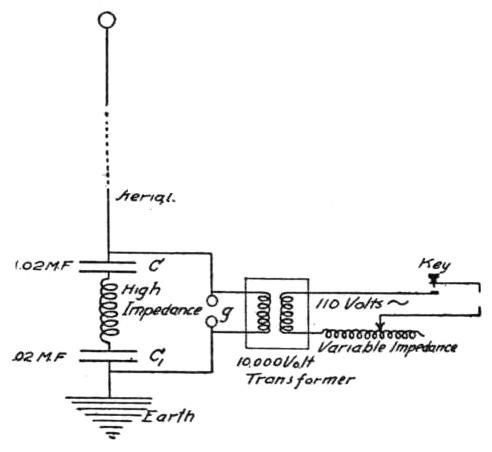
Unquestionably, the best method of charging the aerial wire in wireless telegraphy experiments is by means of an oscillating discharge made with condensers and a transformer. One of the writers in April, 1902, made several experiments on the application of a transformer and condensers to exciting oscillations in the aerial of a wireless telegraph station. We can not enter into a full description of this much discussed subject, but for reference a diagram is here given of one method for exciting the oscillations, which was tried with great success. Consult Fig. 7, which is self-explanatory to those familiar with wireless telegraphy. The method shown in the diagram is only one of several that were successfully tried. The large impedance, which consisted of the secondary of a small induction coil, permitted the two condensers C and C to become charged from the transformer, but when the air-gap broke down a powerful surge of electricity was produced up and down the aerial and through the air-gap g, the resistance of which is greatly reduced by the heavy flow of current from the condensers and transformer. This was proved by the action on the coherer, the blowing of the fuses in the electric light circuits of a near-by building, as well as by the fact that sparks of considerable length could be drawn from the aerial a third way up its length into an insulated conductor, such as the blade of a shovel, which was held near it. In these experiments, the discharge across the gap would answer instantly to the most rapid tapping of the key, and the energy available was vastly in excess of what might be obtained from an induction coil.
In conclusion, we have to say that the phenomena of oscillating currents and high-frequency discharges are so complex, and the observations made so unexpected, that one must rely almost entirely upon experiment to learn what will happen each time that the conditions are slightly varied.
