Nikola Tesla Articles
My Friend Nikola Tesla
A Portrait of a Personality, Creator, and Friend
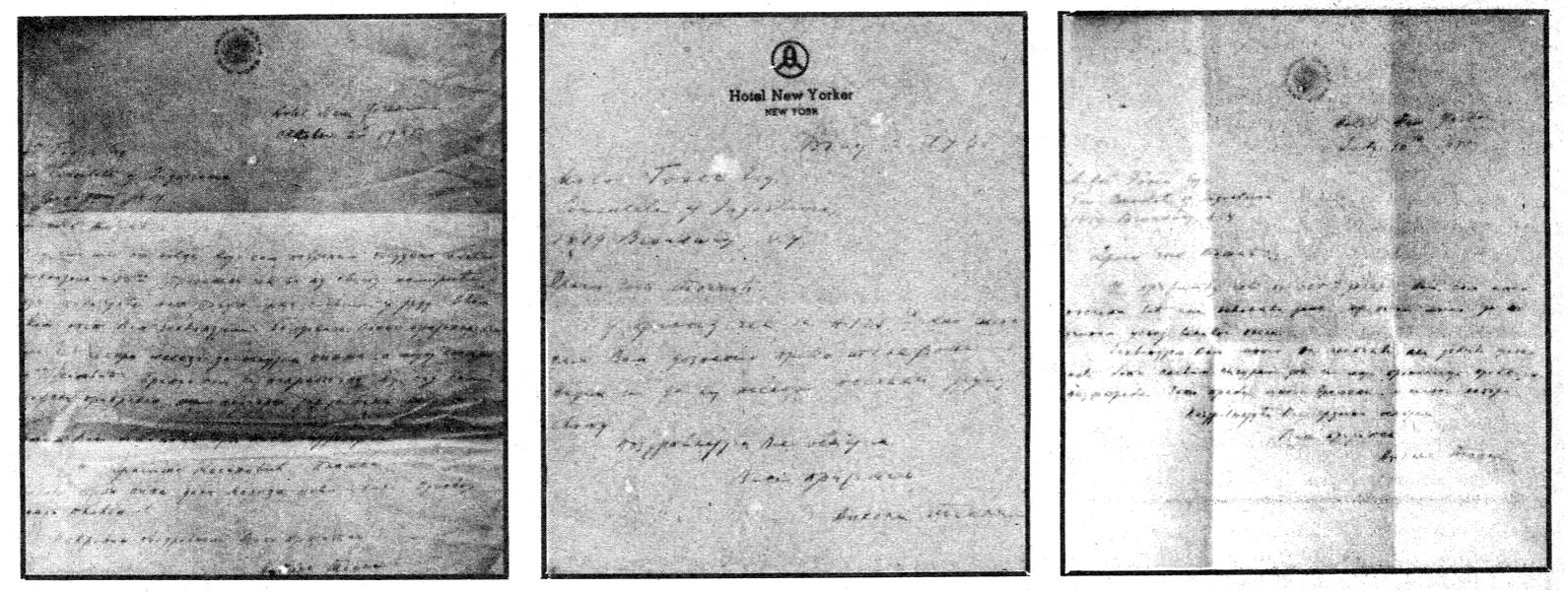
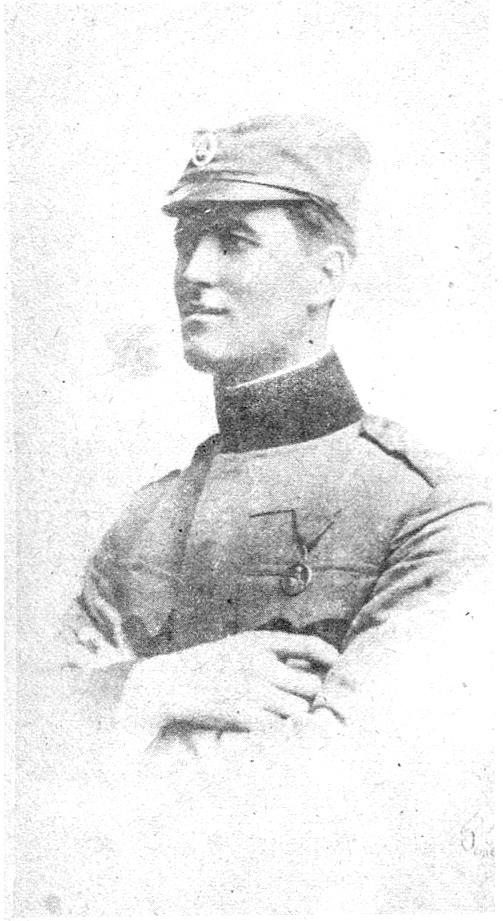
Tall, with completely white hair, 91-year-old Miloš Tošić, a retired consul, is the only living friend of Nikola Tesla. He met the ingenious scientist in 1918 in New York when he arrived with the Serbian army from the Thessaloniki Front. Even today, he vividly remembers every moment spent with the man who contributed so much to humanity. He recounts interesting stories, and in his voice one can feel respect and love for Nikola Tesla.
Their friendship lasted ten years. After his first brief stay, Miloš Tošić returned to the USA in 1928 as the Yugoslav consul and remained there until 1938. We spoke in his apartment in Belgrade. He rarely goes out and complains that his eyesight has rapidly deteriorated. But as soon as he begins to speak of his time in the USA and his encounters with Tesla, his eyes light up.
— In June 1918, I came from Thessaloniki to the USA as a member of the Serbian military mission — recalls Uncle Miloš Tošić. — I stayed in Detroit. One morning I arrived in New York, and as I had no belongings, I set off on foot along Fifth Avenue toward the Public Library. In front of the building, I noticed a flock of pigeons and, among the people feeding them, a very tall man. In his hands were two white birds. They pecked at the seeds from his palm. It seemed to me that I knew him from somewhere. When I looked at him more closely, I thought it was Tesla, because I had heard from someone that he loved to feed pigeons in front of the Public Library.
I was thinking how to approach him and introduce myself. While I was planning, Tesla noticed me, as I was in uniform, and slowly made his way towards me. He addressed me in English:
— Excuse me for disturbing you. I would like to know whose uniform that is?
— It is the uniform of a Serbian officer — I replied.
— Oh, you are a Serb? I am a Serb too.
— I know, you are Nikola Tesla.
— And how do you know me?
I said that I had seen his picture and that I knew he loved pigeons.
— You guessed correctly.
He offered me his hand. Then he asked me if I had some time to take a walk with him.
I agreed. He asked me where I was from. When he heard I was from the Thessaloniki Front, he said he was happy to hear what was happening there. I told him about the famous battles, Duke Mišić, our hardships during the retreat across Albania, our arrival on Corfu, and the opening of the Thessaloniki Front. He listened intently. In the end, he said:
— We should be proud.
He gave me his business card as we parted, asking me to call him when I was free to arrange another meeting. Soon after, I returned to my homeland, not getting a chance to meet Tesla again. I didn’t believe I would ever see him again, even though after our acquaintance by the Public Library, he had bid me farewell with “goodbye.”
Ten years later, again in June, I arrived in New York at the General Consulate after being transferred from the Ministry of Foreign Affairs. As soon as I settled in, I hurried to find Tesla’s address. I dialed the number, and a soft voice answered from the other end of the line.
— This is — I said — an old acquaintance of yours. — I then spoke my name.
— How, how?
I explained to him that we had met ten years ago in front of the City Library when he was feeding pigeons, and that I was the Serbian officer he had approached. Now it was clear to him:
— Oh, my dear friend, here we meet again. If I remember correctly, I told you “goodbye” when we parted.
I explained that I had been transferred to the consulate in New York and that I would be staying longer in America. He was pleased.
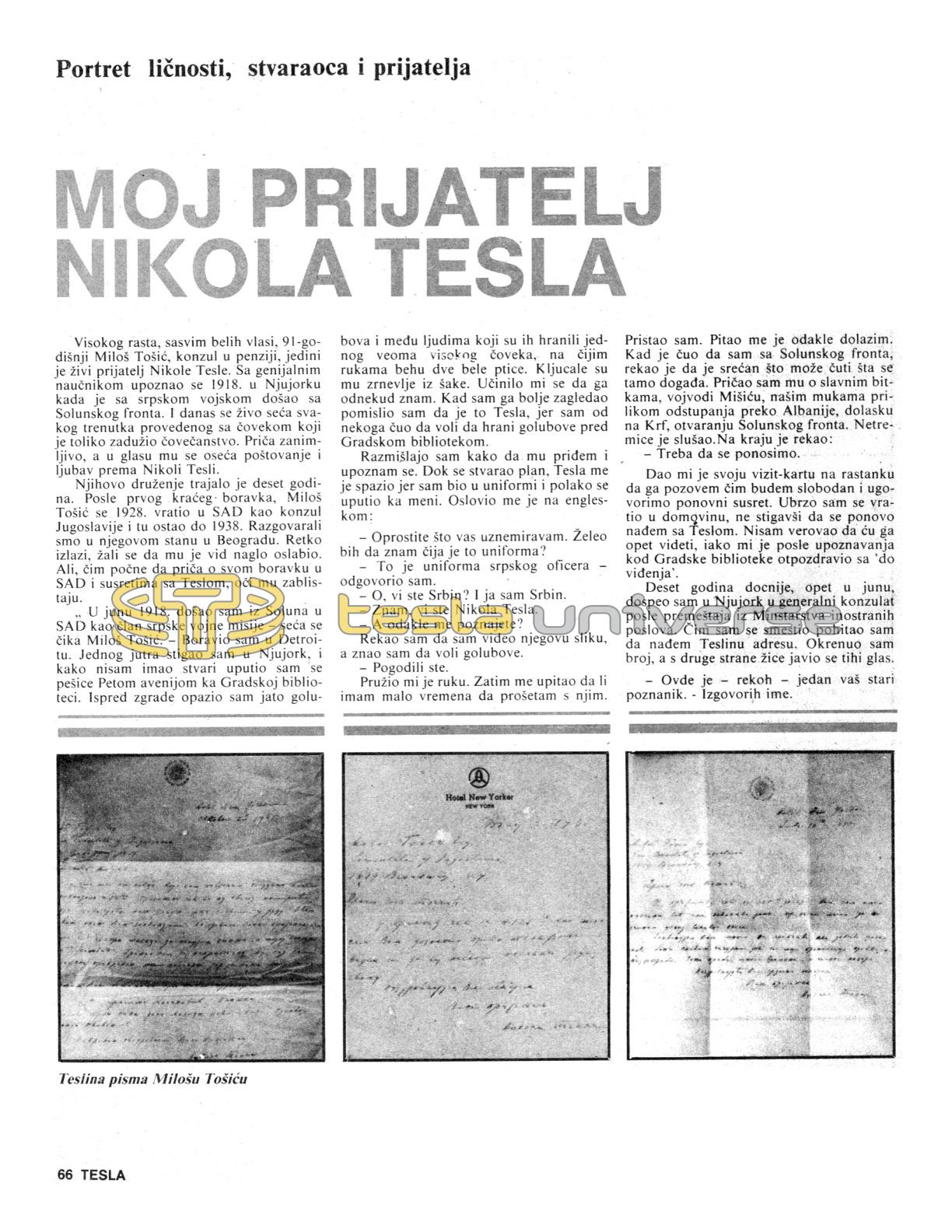
From then on, our friendship began to develop. Tesla was a very sincere man. Once he got to know and like me, he started to reveal his soul to me. He told me about himself, his family, his difficulties. When he was in trouble, he would call me by phone or write me letters, inviting me to talk. He often asked me what to say to people who sought something from him.
One day he called me by phone and asked if I could have lunch with him. I replied that I could. Exactly at 13 o’clock, I was in his apartment on the 34th floor of the “New Yorker” hotel. The waiter brought a container with ice in which there was a bottle of wine, and then the food. We had lunch and talked. When we finished the meal, I thought that the bottle would finally be opened. However, the waiter came and took it away.
After some time, Tesla called me again to have lunch. And again, the container with the bottle of wine was there. I thought: if the host forgets this time too, I will remind him to offer me that wine. We had lunch, but no one opened the bottle. I asked Tesla:
— Excuse my curiosity: What is in that bottle?
— Wine, and that fine Hungarian wine, “Tokay.” My Hungarian friend brought it to me.
— Was that bottle there last time too?
— Yes, it was.
— What a pity, the waiter forgot to open it.
— No, but without my permission, he was not allowed to do so. In my younger years, I was resolute, and if I decided to do something, I would do it. I used to love and drink this wine a lot. Now, in my advanced years, I want to test myself to see if I am still the same man, if I am able to resist. It turned out that I am, and I believe I will not open this bottle. If you’d like to drink, we can order something to be brought to you.
Nikola Tesla loved to help people in need. A compatriot, Nikola Boro, who was dismissed from the bank (he was a plasterer), approached me. He had a loan for a house, and if he didn’t repay it on time, everything would collapse. He asked me to hire him. I remembered Tesla and called him by phone. I told him everything. When I finished, he told me:
— If he is your friend, I will help him. I would ask you to bring him to me so I can meet him.
At the agreed time, we were in his apartment. Tesla asked how long Boro had been in America, if he had a family, and why he was fired. After listening to everything, he wrote a letter to his friend Koteli, the general director of the “Edison Gas Company,” in which, among other things, he wrote: “The bearer of this letter is my compatriot and friend, by profession a plasterer. He is out of work. He has a family and a house he is paying off, and if he does not repay it on time — everything will collapse for him. I ask you to employ him. Hoping you will grant my request, I remain your sincere friend. Nikola Tesla.”
Boro handed the letter to one of the secretaries. Two weeks and one day passed, and Tesla asked me what had happened with my friend. I replied that there was no news. He said he would check. Not long after, he called again. He said he had spoken to the director, who informed him that no letter had arrived. He then ordered them to look for it. They found it quickly. Then Koteli ordered them to call Boro, hire him, and give him a decent salary. After that, the director of Edison’s company called Tesla to inform him about everything.
Later, Tesla was interested in what kind of worker Boro was, and when he heard that he was diligent, he asked for his salary to be increased.
In late August 1937, Tesla called me by phone.
— I don’t feel well — he said.
— Didn’t you catch a cold?
— No, I haven’t. Heavy thoughts have overwhelmed me; I have no peace, so I am calling you to help me. I have a premonition that something bad has happened to my dear sister Marica. I wrote it down in my notes when I felt it. I am ready to think the worst, although I must reconcile with it. Please send a telegram immediately to the address: Engineer Dragiša Kosanović, Plaški, Croatia, Yugoslavia. You sign it and pay for a 15-word reply. The telegram should read: “How is Marica, Nikola is worried, stop. Reply for 15 words paid.” Miloš Tošić, Yugoslav Consulate General, New York City.
I sent the telegram as a night telegraphic letter, as it was half the price. I immediately informed Tesla.
— It’s alright, thank you very much — he replied. — I hope the reply arrives tomorrow at nine o’clock, as there is a six-hour time difference.
The next day at nine, he called me by phone. I told him that the telegram had not arrived.
— It should have arrived — he worried. — My Dragiša is punctual, and I believe he replied immediately upon receiving it. They dispatched it immediately from New York, I have no doubt about that, I just don’t know if our people delivered it right away.
Not ten minutes after our conversation, the telegram arrived: “Marica is well. Nikola should not worry. Letter follows. Dragiša.”
I called Tesla and read it to him. He was happy:
— Now I feel relieved. I didn’t sleep last night. When the letter arrives, I will call you to read it to you.
And so he did. Among other things, it said: “Marica is in bed because she injured her leg. Now everything is in order and she will soon get up. Everything ended well.” The letter stated when it happened (date, hour, and minute). Everything matched what Tesla had recorded.
A very interesting letter, which sheds light on his character. Nikola Tesla sent it to the magazine “Petfindar” and it was published in its entirety:
After receiving numerous letters and praises for your biographical sketch about me, published in your edition of July 24 (1937), I hasten to order several copies for which I enclose postage stamps. I am also sending you a report concerning my speech, in which the discoveries and inventions I foreshadowed are underlined in pencil. In points a, b, and c, I presented some of the obvious fallacies of contemporary pseudo-science. The theory of relativity was initiated more than 200 years ago by my renowned countryman Bošković, a great philosopher, who, despite being burdened by many obligations, managed to write about a thousand volumes on countless different topics. He worked on relativity — even including the space-time continuum — so detailed and without error, that for others there was nothing left but to add some nonsense. Relativists never mentioned his name, because, of course, fish are caught in murky waters.
Regarding your remarks concerning radio and cosmic rays, if I had only done ten percent of what I actually did, posterity would still acknowledge me as the ‘father’ of radio, and as for cosmic rays, there is no force on Earth that can deprive me of the indestructible glory of being their first discoverer.
Nikola Tesla
It is not known to me if any scientists, especially those Nikola Tesla had in mind, responded to his article.
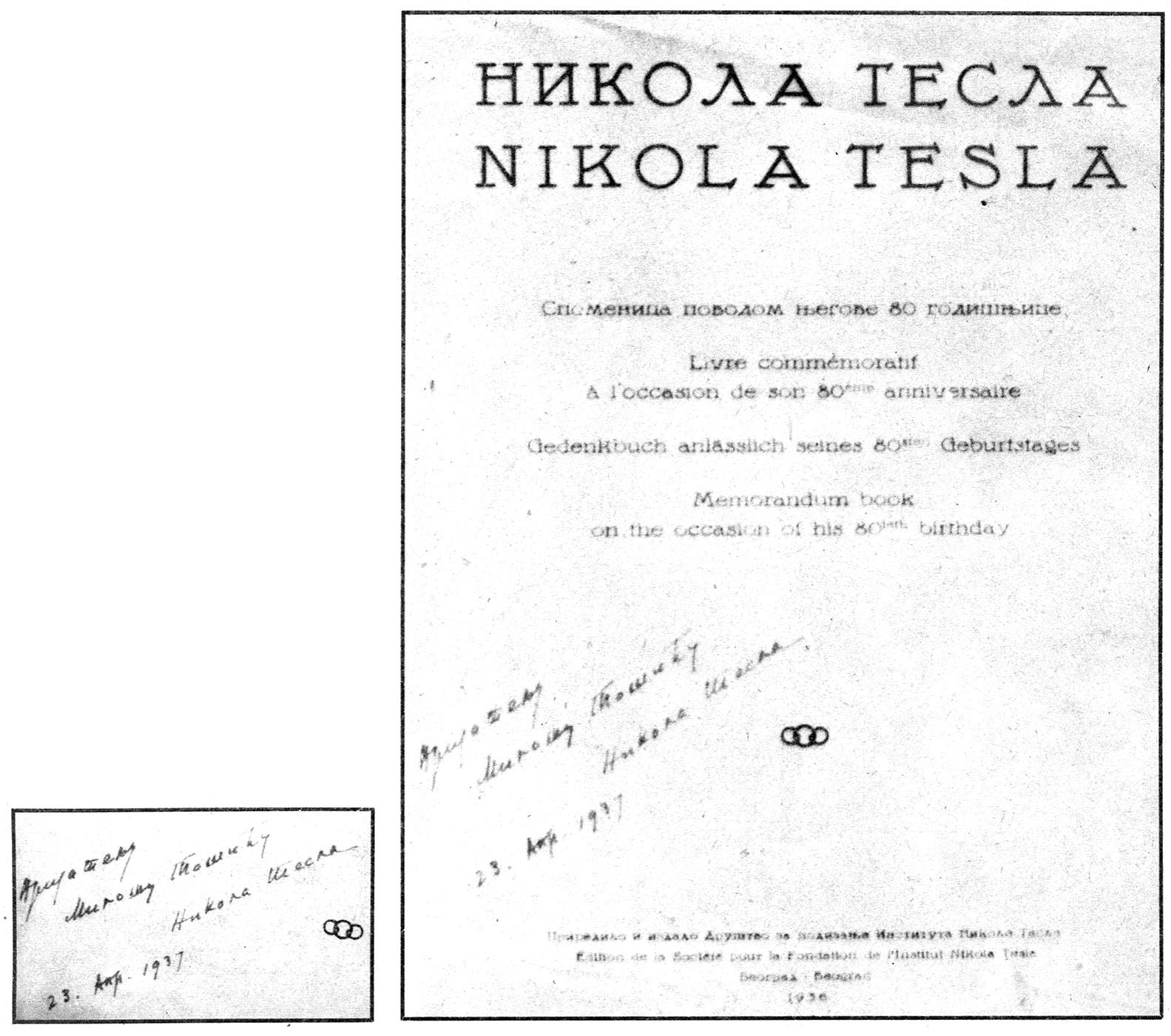
Engineer Slavko Bokšan was the secretary of the Society for the Erection of the Nikola Tesla Institute on the occasion of the great scientist’s 80th birthday. He was very engaged: he gave speeches, spoke about Tesla and his inventions, traveled abroad to participate in scientific symposia. He informed me about everything, with the instruction that I convey it to Tesla. In a letter dated October 3, 1937, among other things, he writes:
“I received your esteemed letter, for which I most sincerely thank you and which I read with great pleasure. Enclosed, I am sending you a copy of a letter from which you can see that the Sorbonne sent N. Tesla a letter as early as June 11, to which, unfortunately, no reply has been received to this day, so I most politely ask you to use all your influence to ensure that Tesla replies, as the Sorbonne believes that the letters did not reach his hands at all.
The same applies to the University of Poitiers, where the lack of a response caused great dissatisfaction, so we must once again ask you to arrange for Mr. Tesla to reply either by phone or by letter to satisfy the gentlemen of the aforementioned University at least somewhat. We thank you once again for your esteemed letter. We ask you to inform us whether the above-mentioned letters reached Mr. Tesla’s hands and whether you managed to get any response from him. This is very urgent! I request an answer immediately! It would be best if Tesla gave you the answers for you to send them.”
As soon as I read the letter, I called Tesla and asked him to receive me. I gave him Bokšan’s letter. He read the response and promised to send telegrams to the universities and thank them for the honor shown. When he sent the telegram to the Sorbonne, he called me to inform me of it. He mentioned Bokšan as his envoy for the ceremony that was to take place at the Sorbonne (November 6, 1937) on the occasion of Nikola Tesla’s 80th birthday.
I informed Bokšan about this and told him that Poitiers had not replied at all. To this, he asked me to talk to Tesla and requested him to send a telegram to Poitiers. I went with that second letter. I read it to him and saw on Tesla’s face that he was not pleased. He got nervous.
— Oh, don’t you remind me of that now — he said. — I am so excited now, and I have learned to always be punctual. Here I missed the moment, and now it is late. Please do not speak to me about this further, as you well know my condition.
I fell silent. Then we talked about other things.
In one conversation, Tesla told me:
— I am in negotiations with the English government. It has been 14 months now that I have been corresponding with them, and I am interested in what the result will be. I asked them to send experts to New York to explain the secrets of my inventions. Primarily, I asked for a written guarantee that everything that was demonstrated would remain in complete discretion. They told me that the Minister of War would give that guarantee. I did not agree with that. Then they suggested sending their people from Canada.
To convince the English of what he was offering, he requested money to construct a miniature machine and demonstrate his invention on site using it. He did that, he told me then, two weeks ago and was waiting for a reply. He said that the English were very interested in his invention, which, in case of war, would completely destroy the enemy. He told me then that he would like to have money and that I should build and test that machine. He was confident in his invention. When I mentioned that he had millions of dollars and that he had not saved them, and now they would come in handy, he laughed:
— You are right. It’s a pity I am not like Pupin.
While telling me about his invention, at one point he pointed to a safe:
— I have it there. That means the plan was in the safe. He died all alone. The one who first opened the room surely knew what was in the safe and what those documents were about.
Tesla did not like to leave New York. During his entire stay in the USA, he only once took a longer absence — for a year — in Pittsburgh while working for Westinghouse. Once he called me to announce news:
— I received a telegram from the congress of the Serbian National Alliance in the USA, which elected me as lifelong president. They are asking me to reply whether I accept this honor. What should I do? Do I have to go to them to preside?
— You don’t have to, it’s an honorary title — I replied. — Answer them in my name that I accept and thank them for the great honor.
I sent a telegram.
As long as Marconi had not patented the invention of wireless telegraphy, Tesla and Pupin lived in friendly relations. Then Tesla appeared in court, proving that he was the first inventor of wireless telegraphy. Pupin, as a witness, testified in Marconi’s favor. This deeply hurt Tesla, and he broke off all relations with Pupin. Many years after Tesla’s death, the US Supreme Court confirmed our scientist’s invention of wireless telegraphy.
Tesla told me about his breakup with Pupin. He said that before that, he, Edison, Pupin, and Marconi often met at the Scientists’ Club in New York. On one occasion, when he had verified wireless telegraphy, he told his colleagues about it. They, he said, looked at him astonished, as if they suspected he had gone mad. Tesla felt this, smiled, and told them:
— Time will show if I am right.
Later, Pupin fell ill and was taken to the hospital. Seriously ill, Pupin contacted his secretary, engineer Jovan Kajganović, and asked him to come to me and jointly visit Tesla and ask him to come to the hospital. He wanted to reconcile before he died.
Kajganović came to the consulate and told me everything. I called Tesla on the phone and asked him if he could receive me immediately, as I had something important to tell him. He said yes. We immediately went to the “New Yorker” hotel.
— What is so important, does it concern me? — Tesla greeted us.
I told him about Pupin’s wish:
— You told me before about your breakup, and I know it well — I said. — But, despite everything, I ask you to forget all that has passed and go to the hospital. He is seriously ill, he is aware that his end is near, and his conscience bothers him because of that.
— Oh, oh, that will be difficult. As you know, I told you that Pupin testified in court in favor of Marconi.
— Mr. Tesla, you are a great man, a genius — you never gave up. Great people forgive. Please, visit your old friend who wants to see you.
He fell silent and thought. Suddenly he stood up and spoke:
— My dear friend, at this moment I cannot make a decision. Tonight I will silently reflect on all of this, and tomorrow morning I will call you on the phone and announce my decision.
We parted. In the morning, I impatiently waited for him to call. The phone rang. On the other end was Tesla:
— I am calling to tell you that last night I thought about the whole matter and decided to go to the hospital to see Pupin. Can you come with me?
I replied that I could. In Pupin’s room, we found several doctors beside his bed. The meeting was very emotional. Tesla approached the patient and offered his hand, saying:
— How are you, my old friend?
Pupin was too agitated to speak. He cried, tears streaming down his face. We went outside and left them alone. Thus, Tesla had the opportunity to speak with Pupin privately. Later, he told me that Pupin struggled to open his mouth. At parting, Tesla wished him that they would meet again at the Scientists’ Club where they would talk as they used to. When he left the room, he inquired with the doctors about Pupin’s health and told them to use all their strength to save him.
Soon after Tesla’s visit, Pupin died. Tesla attended the funeral.
Tesla was a handsome man, and it is no wonder that many rich daughters tried to win him over. They invited him to the Metropolitan Opera because they knew he loved to go there. One evening, he told me, Morgan’s sister came to his laboratory and invited him to “Prince Igor.”
— I couldn’t refuse, we went to the performance — he told me.
— Well, where would you be if you had married this rich girl! — I said.
— Where? Nowhere! Do you know what it means to marry a rich girl? She needs a significant part of your free time devoted to her. And science? I married science. Only once in my life was I in love.
I expected to hear that story. He told me that when he was in elementary school, he loved a girl from his class very much. They always played together. To his sorrow, one day her parents moved away. He remained sad, he cried. Time passed. She got married and had a son. When her son finished high school, she sent him to Tesla in New York with a plea for help. Tesla cordially welcomed him. He asked the young man what he wanted to be. He was surprised when he heard that he wanted to become a boxer. Deterrents did not help, so he took him to a boxing school. He was talented. A match was scheduled in Madison Square Garden. Tesla came to see him. From a powerful blow, the young man fainted and died in the hospital. Tesla told me that he grieved for him as if for his own son.
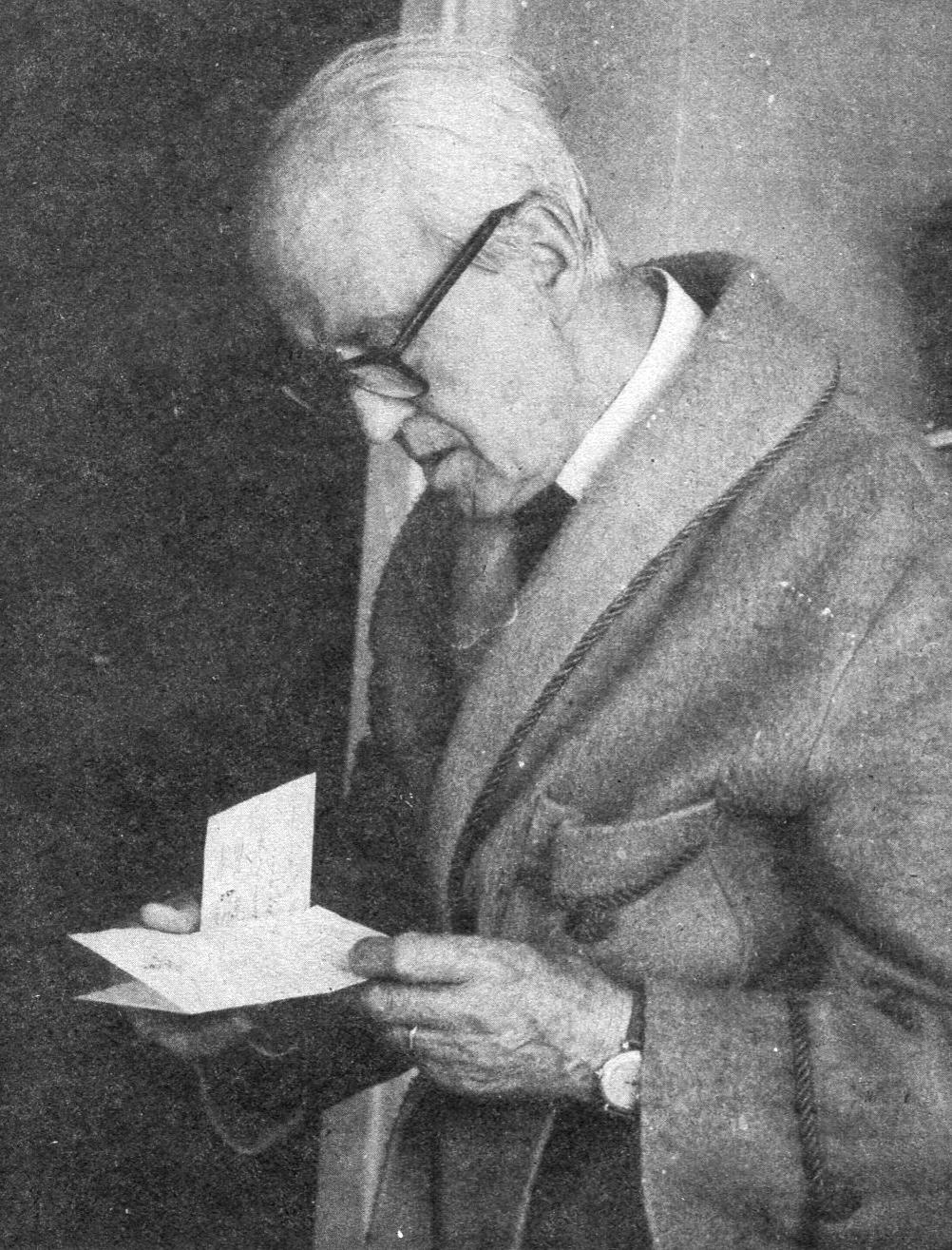
This is just part of the memories of Uncle Miloš Tošić about the brilliant scientist. He also saved forty letters that Tesla sent him. He will leave them to his grandchildren.
Stanko STOJILJKOVIĆ