Nikola Tesla Articles
Nikola Tesla Duplicates the Light of Day
WITHOUT WICK, WIRE OR CARBON FILAMENT THE INVENTOR'S NEW ELECTRIC LAMP SHEDS THE RADIANCE OF MORNING—IS THE PRODUCT OF TESLA'S FAMOUS OSCILLATOR — A SOFT, WHITE, COLORLESS LIGHT WITHOUT HEAT — THE LAMP A BABY SUN — WONDROUS SANITARY QUALITIES ATTRIBUTED TO THE NEW ILLUMINATOR.
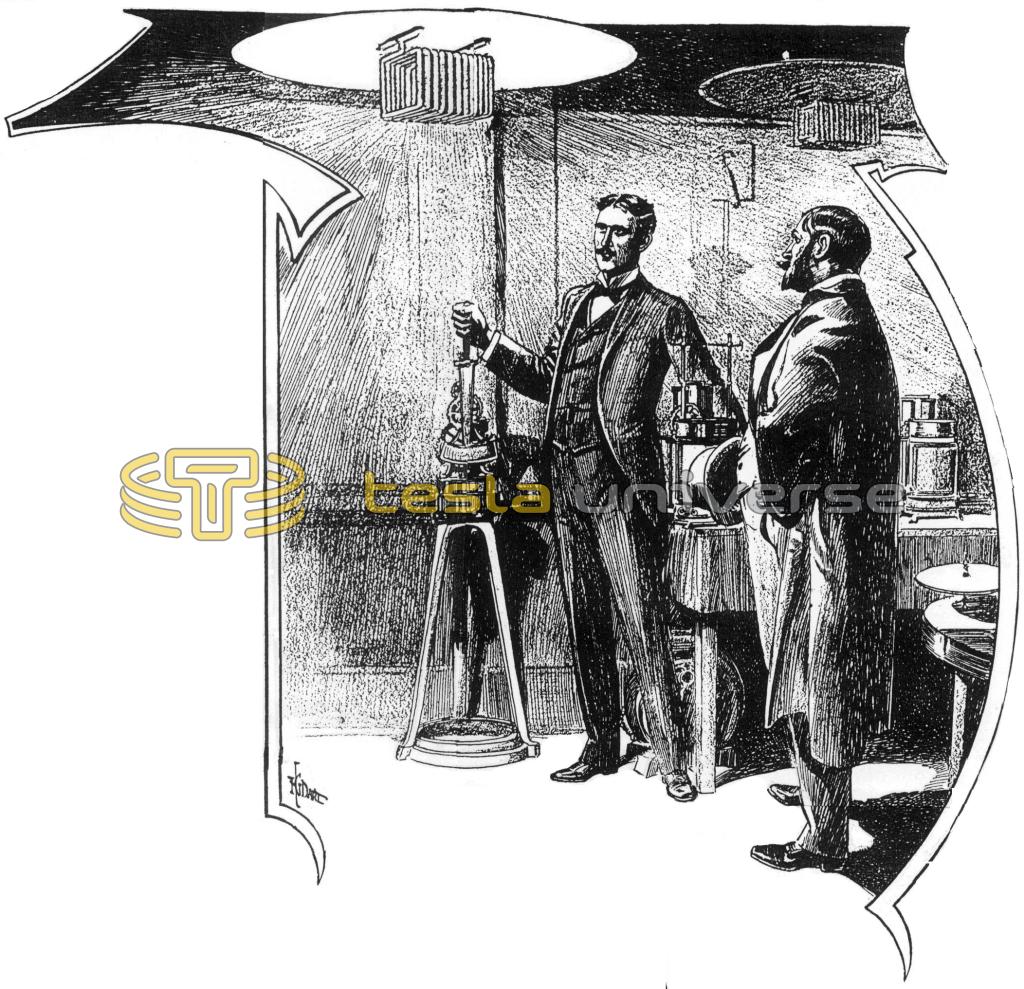
With the new century come new discoveries. Remarkable interest is now awakened by Tesla's new light. "Artificial sunlight," he calls it, "the result of ten years of thought and experiment."
Under a full flood of electricity the lamp presents a magic spectacle. Without wick, wire or carbon filament it floods an apartment with the light of day. It is soothing to the eye and wonderfully diffused — almost shadowless. In its soft radiance one may read and write in any corner of the room as if it were day.
And how is this light produced?
By electrical vibrations of tremendous speed. For years the public has heard of Tesla's oscillator — that wonderful machine foaming out lightning in zigzag leaping tongues of flame, which Tesla claimed was to produce wonders, such as sending currents around the world without wires and burning the nitrogen of the air.
A thousand times it was asked, "Of what practical use is such a machine?"
One of the answers to this question is this daylight illumination.
His oscillator, the inventor says, is the key to solving the most important problems of the age. By its vibrations this new radiance is produced, as from the sun, its pulsations amounting to millions per second.
The electrical vibrations of the oscillator cause the atoms of the gases in Tesla's lamp to become little comets, shooting through the space at enormous speed, leaving trains of light filling the lamp with the brightness of noon.
It is a miracle, seemingly. The sudden starting and stopping of the electrical current at inconceivable velocity produce a continuous glow, neither of the incandescent nor arc light character, but pure solar light, the light of day.
THE OSCILLATOR EXPLAINED.
How does the oscillator accomplish this wonder? Simply by storing and discharging alternately, electricity. An instrument called a "condenser" is used for this purpose. According to Tesla, it is the most marvellous appliance ever invented.
"It can discharge," he says, "or explode its stored energy in an inconceivably short time. Owing to this it is unequalled in explosive violence. The explosion of dynamite is only the breath of a consumptive compared with its discharge. It is the means of producing the strongest current, the highest electrical pressure, the greatest commotion in the medium. Another of its properties equally valuable is that its discharge may vibrate at any rate desired up to many millions per second.

"I arranged such an instrument so as to be charged and discharged alternately in rapid succession through a coil with a few turns of stout wire, forming the primary of a transformer or induction coil. Each time the condenser was discharged the current would quiver in the primary wire and induce corresponding oscillations in the secondary. Thus a transformer or induction coil on new principles was evolved, which I have called the electrical oscillator, partaking of those unique qualities which characterize the condenser and enabling results to be attained impossible by other means."
Such is the much discussed machine of Tesla's, which, he claims, will accomplish many more wonders in light, telegraphy, telephony and the transmission of power, and set up vibrations and electric wave currents pervading the universe of matter, and perhaps entering a new world hitherto penetrated only by the imagination.
HOW THE LIGHT IS MADE
Regarding his new system of illumination, Tesla says: — "The light is the result of continuous efforts since my early experimental demonstrations before scientific societies here and abroad. In order to make it suitable for commercial use, I had to overcome great difficulties. One of these was to produce from ordinary currents of supply electrical oscillations of enormous rapidity in a simple and economical manner. This, I am glad to say, I have now accomplished, and the results show that with this new form of light a higher economy is practicable than with the present illuminants. The light offers, besides, many specific advantages, not the least of which is found in its hygienic properties. It is, I believe, the closest approach to daylight which has yet been reached from any artificial source."
Tesla's lamps are tubes of glass of the size of one's finger. They may be bent in any ornamental fashion — in spirals, expanding circles, rectangular clusters and the like. He says: —
"I generally use a rectangular spiral, containing about twenty to twenty-five feet of tubing, making some twelve to fourteen convolutions. The total illuminating surface of a lamp is from three hundred to four hun- dred square inches. The ends of the spiral tubes are covered with metallic coating and provided with hooks for hanging the lamp on the terminals of the source of oscillations. The tube contains gases rarefied to a certain degree, determined in the course of long experimentation as being conducive to the best results."
ILLUMINATION WITHOUT HEAT.
Here is a technical but plain description in Tesla's own words of how the light is produced: —
"The street current is passed through a machine which is an electrical oscillator of peculiar construction, and transforms the supply current, be it direct or alternating, into electrical oscillations of a very high frequency.
"These oscillations, coming to the metallically coated ends of the glass tube, produce in the interior corresponding electrical oscillations, which set the molecules and atoms of the enclosed rarefied gases into violent commotion, causing them to vibrate at enormous rates and emit those radiations which we know as light.
"The gases are not rendered incandescent in the ordinary sense, for were it so, they would be hot, like an incandescent filament. As a matter of fact, there is very little heat noticeable, which speaks well for the economy of the light, since all heat would be loss.
"This high economy results chiefly from three causes: First from the high rate of the electrical oscillations; second, from the fact that the entire light-giving body, being a highly attenuated gas, is exposed and can throw out its radiations unimpeded, and, third, because of the smallness of the particles composing the light-giving body, in consequence of which they can be quickly thrown into a high rate of vibration, so that comparatively little energy is lost in the lower or heat vibrations."
NO WIRES OR CARBONS.
One great disadvantage in using electrical lamps has been breakage. The carbon filaments are sometimes defective, often short lived and more or less of a nuisance. Tesla has no filaments to become incandescent, neither carbons nor wires. Thus an important point is gained. He says: —
"The lamps need not be renewed like the ordinary ones, as there is nothing in them to consume. Some of these lamps I have had for years, and they are now in just as good a condition as they ever were.
"The illuminating power of each of these lamps is, measured by the photometric method, about fifty candle power, but I can make them of any power desired up to that of several arc lights. It is a remarkable feature of the light that during the day it can scarcely be seen, whereas at night the whole room is brilliantly illuminated.
"When the eye becomes used to the light of these tubes, an ordinary incandescent lamp or gas burner produces a violent pain in the eye when it is turned on, showing in a striking manner to what degree these concentrated sources of light which we now use are detrimental to the eye."
"A SANITARY LIGHT."
Regarding the sanitary features of the light, Tesla says: —
"I have found that in almost all its actions the light produces the same effects as sunlight, and this makes me hopeful that its in- troduction into dwellings will have the effect of improving, in a measure now impossible to estimate, the hygienic conditions.
"Since sunlight is such a very powerful curative agent, and since this light makes it possible to have sunlight, so to speak, of any desired intensity, day and night in our homes, it stands to reason that the development of germs will be checked and many diseases, as consumption, for instance, successfully combated by continually exposing the patients to the rays of these lamps.
"I have ascertained unmistakably that the light produces a soothing action on the nerves, which I attribute to the effect which it has upon the retina of the eye. It also improves vision, just exactly as the sunlight, and it ozonizes slightly the atmosphere.
"These effects can be regulated at will. For instance, in hospitals, where such a light is of paramount importance, lamps may be de- signed which will produce just that quantity of ozone which the physician may desire for the purification of the atmosphere, or if necessary, the ozone production can be stopped altogether."
As to the cost of these lamps, Tesla says: —
"The lamps are very cheap to manufacture, and by the fact that they need not be exchanged like ordinary lamps or burners they are rendered still less expensive. The chief consideration is, of course, in commercial introduction, the energy consumption. While I am not yet prepared to give exact figures, I can say that, given a certain quantity of electrical energy from the mains, I can produce more light than can be produced by the ordinary methods.
"In introducing this system of lighting my transformer, or oscillator, will be usually located at some convenient place in the basement, and from there the transformed currents will be led as usual through the building.
"The lamps can be run with one wire alone, as I have shown in my early demonstrations, and in some cases I can dispense entirely with the wires.
"I hope that ultimately we shall get to this ideal form of illumination, and that we shall have in our rooms lamps which will be set aglow, no matter where they are placed, just as an object is heated by heat rays emanating from a stove. The lamps will then be handled like kerosene lamps, with this difference, however, that the energy will be conveyed through space.
"The ultimate perfection of apparatus for the production of electrical oscillations will probably bring us to this great realization, and then we shall finally have the light without heat, of 'cold' light. I have no difficulty now in illuminating the room with such wireless lamps, but a number of improvements must be made yet before it can be generally introduced."
BABY SUNS AND DAYLIGHT.
In conclusion one may say of this strange all pervading crystal radiance of Tesla's that each lamp is a little baby sun filling the room with the flaming magic of life and health, the same that floods the solar system, making animal and vegetable existence possible on our earth.
As the lamps are lighted at evening you see dawn stealing over the room. It is like early morning. So perfect is the illusion that the change does not come instantly, but gradually, every corner growing brighter. Dark nooks fade out. Books, pictures and figures on walls and carpets, appear — their colors in natural shades, as at noonday.
Because of this wonderful artificial sunlight you now think the lamps may be extinguished. Day has indeed come — each moment it grows lighter. So out go the lamps.
Alas! your room is in darkness, and you see the streets dusky in the yellow glare of the city's night. But if you light the lamps again the dawn reappears, and again morning has come.
