Nikola Tesla Articles
Phosphorescence as the Source of X-Rays
BY EDWARD P. THOMPSON, M. E.
One of the most important facts necessary in order to determine the nature of the X-rays is that which will prove their source. In the first place Prof. Röntgen alleges that they radiate solely from the phosphorescent spot upon the Crookes tube. Dr. Morton's experiment indicates the same feature. M. Charles Henry thinks he obtained X-rays from a phosphorescent substance, which he exposed to the light. Niewenglowski finds that phosphorescent bodies increase the penetrating power of sunlight like the sulphide of zinc increases that of X-rays. Poincaré at an early date advanced the hypothesis that the rays are due to phosphorescence, whether produced by electrical or other means. Professors Thomson and Rowland maintain that they radiate from the anode. Tesla has obtained effects by a closed bulb without any electrodes. In one of Tesla's experiments, he employed only one and either electrode, while the other was away off in space somewhere, and yet he obtained penetrating power at great distances. He is convinced that phosphorescence is not the source, because he believes that aluminum X-ray tubes do not phosphoresce. He gave no other explanation. Silvanus P. Thompson thinks that certain of his experiments prove that the rays do not come from either the cathode or from the phosphorescent spot individually, but jointly from both.
I have obtained fluorescence from X-rays after they have passed through a fluorescent substance. Experiments have also proved, apparently, that there are no X-rays radiating from the arc light, sun, flames or other sources of light. Other experiments show that although a Crookes tube may phosphoresce, yet no X-rays can be detected. Sometimes the phosphorescent light is local, occurring in spots here and there. It may be near the cathode or anode, or between them, or as in a tube with which I experimented, the light was practically uniform on the whole surface, and a fluorescent screen was illuminated by all parts of the Crookes tube equally. Experiment also shows that with a given Crookes tube, the penetrating power of the rays seems to depend upon the electromotive force of the electrical energy, all other things remaining the same. Tesla, with his apparatus, has projected them through the thickest part of the human body, so as to affect the photographic plate.
Upon first reading the statement of Prof. Röntgen as to the phosphorescent spot being the source, it occurred to me that phosphorescence by other means might also radiate X-rays, and I was anxious to learn in the most emphatic manner the truth of the matter, whether it ended in negative or positive results. I have, therefore, been carrying out a series of experi- ments to determine whether ordinary phosphorescence will pro- duce X-rays. Although I obtained negative results, yet the conclusion should not be drawn to the effect that X-rays may not be obtained by phosphorescence produced otherwise than by electricity, because by no possible means imaginable could I cause light to produce upon a Crookes tube the phosphor- escence obtainable by the current, which, as well known, is visible even by daylight. Parenthetically, the intensity of light spoken of in text books is a misnomer. The light considered as to its penetrating power at the focus of the lens is no more intense than elsewhere. It will not penetrate anything to any greater distance by being condensed. It merely appears brighter to the eye, because there is more of it upon a given area, or because more of it has penetrated a given substance. The volume alone is greater.
To determine the degree of phosphorescence obtainable upon a Crookes tube by direct sunlight, it was placed inside of a box having an opening covered by violet glass. When the box was looked into, so as to exclude all other light the tube did not even appear green. However, under the same circumstances, uranium glass, barium platino cyanide, also a screen of ammonium uranate, potassium platino cyanide and others, each appeared of a vivid green or yellowish green. The experi- ment was repeated with focused sunlight on a very large scale, the lens being about five inches in diameter and having a focus of sixteen inches, and provided also with a funnel, white inside, which brought to a focus much diffused sunlight. The small end of the funnel was located in a dark room. The light was condensed upon violet glass.
The light passed through the glass, and, upon striking the phosphorescent and fluorescent materials, its refrangibility was changed; while the substances were as vividly green as when produced by the radiations in the Crookes tube, and, light cannot cause the same phosphorescence upon a Crookes tube did not become green. Uranium glass seemed as bright as when forming a Crookes tube highly charged. The Crookes tube had been before tested, and showed a green phosphorescence with a high electromotive force. The experiment with violet glass, although perfectly simple, and although the results, perhaps, could have been conjectured, proves that sunlight cannot cause the same phosphorescence upon a Crookes tube as that produced by the current.
Another experiment indicated somewhat otherwise. In the direct focus, without blue glass, a livid green (as when electrified) was discernible as a fringe around the focus.
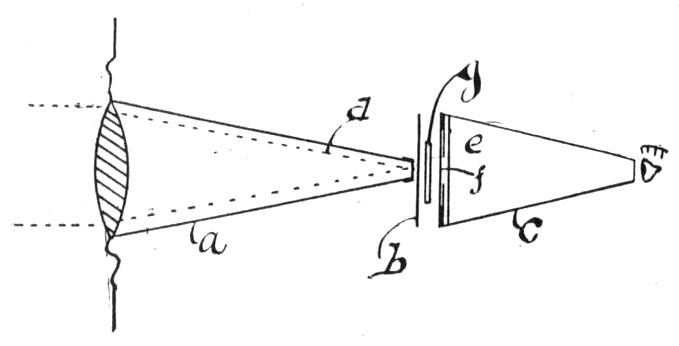
Inasmuch as the other substances fluoresced better with the violet light than with the electrified Crookes tube, as far as the eye could remember, an experiment was performed with the apparatus shown in the accompanying diagram, in order to determine whether condensed sunlight would produce sufficient phosphorescence for the generation of X-rays. The funnel above described was closed at the small end successively by different phosphorescent and fluorescent substances, b. The instrument which has now become known as the fluoroscope was directed towards the substance, b, which was made phosphorescent or fluorescent by the condensed sunlight, d, in order to detect fluorescence upon the screen, e, within the fluoroscope, which was covered at the large end partly with one thickness, b, partly with two thicknesses, and on another portion by three thicknesses of black paper.
The fluorescent screen, f, appeared green only at the part covered with one thickness. It was brighter without screen, b, which seems to contradict Niewenglowski's result. If there had been X-rays of any appreciable extent, they would have caused fluorescence through the three thicknesses and through a block of wood, g, interposed between the two fluorescent screens outside of the fluoroscope, as illustrated in the diagram. It should be noticed that the fluoroscope was exceedingly sensitive, and yet the results were negative.
The same instrument was tried with a Crookes tube generating X-rays by a current, and it became uniformly luminous at a distance of six feet from the electrified Crookes tube; therefore, it may be concluded, I think, that X-rays cannot be obtained from phosphorescence produced by sunlight. It may be noted that the objects were not placed exactly in focus because they would burn. The funnel, a, was cut off so that the cross sectional area of the path of the condensed rays was about one-fourth of an inch in diameter, and in this case heat absorbing substances were not needed further than that of the lens itself.
Aluminum was substituted for the block of wood, g, but no fluorescence occurred with the fluoroscope. The experiment was modified in a great many different directions; for example, by using the focused light when reflected from the screen, b, although (as the latter was made of a mixture of pulverized fluorescent material and varnish) the fluorescence was caused by reflection from each particle when the light was transmitted by the screen, as well as when reflected therefrom. A gas flame was also employed as a source of light; also sunlight without a lens.
Remembering how a little daylight entering the eye while viewing fluorescence by X-rays nearly neutralized the effect, I thought, perhaps, persistence of vision prevented my seeing any fluorescence which might have been produced through the three thicknesses of black paper, and therefore I applied the most severe test. A photographic plate with a metal ring attached to it was wrapped closely in several folds of black paper and inclosed in an aluminum box, which, in turn, was wrapped in cloth. On the outside of all was fastened a plate of uranium glass, which was exposed to direct sunlight for over seven hours. No effect whatever was produced upon the photographic plate. With X-rays, an effect would have occurred through the same thickness in a few minutes.
A large glass plate covered with calcic sulphide, which remains luminous in a dark room after having been exposed to sunlight, was tested. I exposed the plate to the condensed sunlight, forming a bright, luminous spot, and at another time I exposed the whole plate to sunlight for an hour or more. When the fluoroscope was directed toward it in the dark and certain experiments performed, sufficient light was produced to illuminate the screen in the fluoroscope, but not through even a single thickness of black paper, but only enough to cast a shadow. Here again the bluish brightness of the luminous paint is not visible in daylight, while a Crookes tube energized, by electricity radiates green light abundantly and is easily visible in daylight.
While these experiments do not prove that the X-rays do not have their source alone in the phosphorescence of a charged Crookes tube, yet they form substantial evidence that X-rays are not obtained from phosphorescence by sunlight.