Nikola Tesla Articles
In Recognition - Nikola Tesla Plaque Dedicated to Peerless at Wardenclyffe
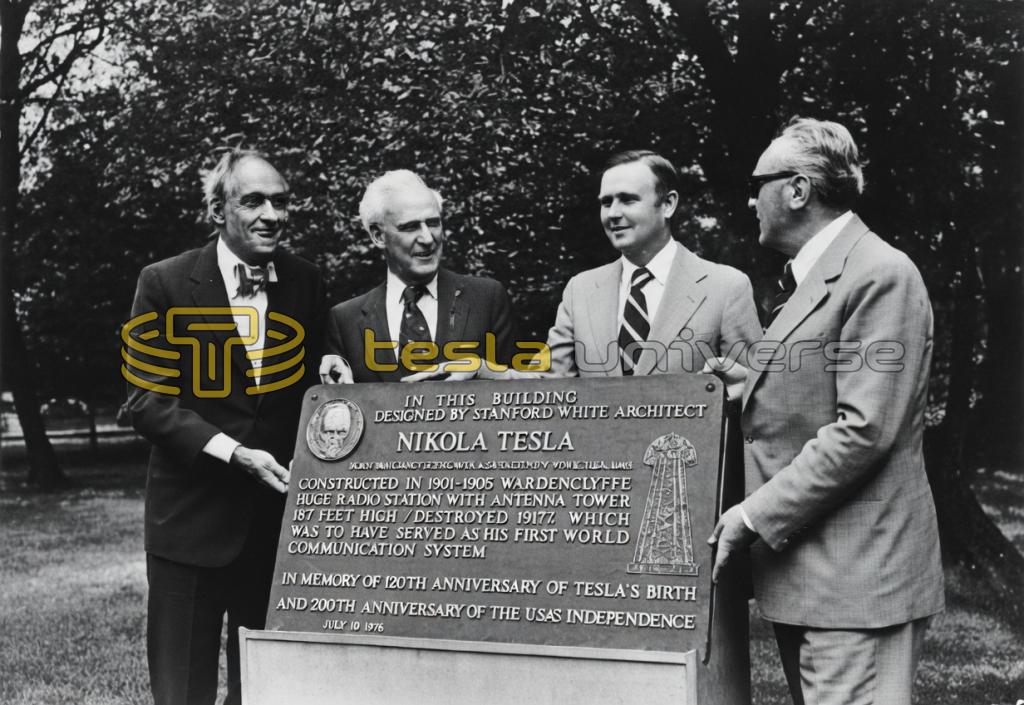
Nikola Tesla, the inventive genius whose concepts revolutionized the electrical power industry and whose once famous name is now largely forgotten, was remembered in simultaneous ceremonies held July 7, at Brookhaven and in Yugoslavia, the country of his birth. Tesla emigrated to the United States in 1884 and later became a U.S. citizen. In recognition of Tesla's contribution to America, President Ford sent a delegation to Yugoslavia to participate in that country's tribute to him.
About 150 people attended the symposium at Brookhaven, co-chaired by Vasa Veskovic, Consul General of Yugoslavia in New York City, and R.C. Anderson, Laboratory Assistant Director. Percy Sutton, President of the Borough of Manhattan, City of New York, who was unable to attend the ceremonies, hailed Tesla's work in a telegram to the Laboratory:
"I deeply regret that I am unable to join you today as you honor the great immigrant inventor/creator Nikola Tesla, born in Yugoslavia, but benefiting America so greatly with his creativity. He is ours as well as Yugoslavia's. Your honoring of him today at Brookhaven in this Bicentennial year is to be applauded and praised. Nikola Tesla's prolific and masterful achievements ought to be saluted by all."
In his opening remarks Anderson noted that a recognition dear to the hearts of all scientists had now been given Tesla. In the new international system of standard units, the unit of magnetic force has been named the tesla.
Frank A. Jenkins, President of the IEEE Power Engineering Society, said that Tesla worked by what he called "instinct" and preferred to be considered a "discoverer of new principles, rather than an inventor." He was the first to conceive an effective method of utilizing the alternating current and in 1888 was granted patents on the induction motor and on polyphase systems. He invented the principle of the rotary magnetic field embodied in the apparatus used in the transmission of power from Niagara Falls.
Jenkins said Tesla attributed much to his mother who apparently invented labor saving devices in the home for her family and possessed a phenomenal memory, gifts he inherited. Tesla started his career in the United States working for a time with Edison and later with Westinghouse. His inventions were many: new forms of dynamos, transformers, induction coils, condensers, arc and incandescent lamps and other electrical apparatus. Although his patents were purchased for a million dollars, Tesla died penniless in New York City in 1943.
In recognition of his many achievements, Jenkins announced that the IEEE has established a Nikola Tesla Award.
Other speakers, introduced by Veljko Radeka, Yugoslav-born Head of the Laboratory's Instrumentation Division, were Walter H. Bales, Westinghouse Electric Corporation, Gordon D. Friedlander, Senior Editor, IEEE Spectrum, and Eric B. Forsyth, Head of the Power Transmission Project at Brookhaven.
In 1901 Tesla came to Long Island and built a laboratory at Shoreham. A plaque in his memory, given by Yugoslavia to the United States as a Bicentennial gesture, was dedicated at the climax of the ceremonies, at the site of his laboratory on Route 25A, which now houses the Peerless Photo Products, Inc. The 200-foot experimental tower which Tesla built was dynamited during World War I when it was felt by some to be a menace to national security, and all that remains is the concrete base.