Nikola Tesla Articles
Tesla Describes Wireless Warfare of the Future
If Tesla's secret invention fulfills expectations it will be possible to blow up battleships at a distance of 1,000 miles from the aerial station.
For Gunpowder Will Be Substituted Electrical Waves Transmitted Over Great Distances and Focussed on Given Targets — Aerial Projectiles Will Be Exploded From Wireless Stations — Whole Populations May Be Wiped Out By Pressure of a Key.
By Edward H. Smith.

In the imagination of every electrical expert in the world — from the famous Marconi, Edison and Tesla to the prospective aspirants to glory — there is to-day one vision. This is that of a little machine with a key by means of which a wave of electric energy will be flashed through the air to explode the enemy's bombs, torpedoes, cartridges and magazines.
The man who will perfect a device whereby an electric wave can be aimed and steered through the air in one direction only, all its force concentrated on a given target, will go down in history as the greatest inventor of all time, for his machine will make gunpowder and dynamite obsolete and will send rifles and cannon to the junk-heap.
In an interview published in a Paris newspaper recently Marconi speculated upon the possibilities of such an invention, saying it would mean the abolition of firearms and a reversion to hand-to-hand fighting.

A Dutch engineer named Lanzius, now in New York, claims to have invented such an apparatus. He is by no means the first to make such a claim. An Italian engineer won for himself much notoriety two years ago with his demonstrations of a machine that seemed to do just that, until he was exposed as a fraud. A young New Yorker, who already has several valuable and authentic inventions to his credit, claims to have perfected a way of emitting a wireless electric current that will instantly melt all metals within a certain radius. He, however, has been unable to demonstrate it, except on a small scale, owing to the difficulty of banishing every bit of metal from the persons of the experimenters. These would have to wear buttons and studs of bone, suspenders with fabric buckles, shoes with wooden nails, and would have to lay aside all money, pocket knives, steel or gold-mounted eyeglasses, watches, chains and scarfpins, and their teeth would have to be innocent of gold, silver or amalgam fillings!
Today the Russians report that "the Germans have melted down their barbed entanglements from distant trenches." Yesterday a Californian pretended to defend the country from invasion by wireless energy.
The electrical wizards whose names are household words admit that they are busy along just these lines, but they refuse to commit themselves as to the precise object of their research. It is a race between experts and the side whose experts first discover the secret of directing powerful wireless waves will win the war, for it will mean annihilation for its enemies on land and sea.
The idea is real and fascinating; it has the romance of the startling possibility. Who? What? How? I have just talked with Nikola Tesla, that genius product of Serbian soil and Austrian training, who has just been awarded a partnership in this year's Nobel prize for physics, surely one of the first inventive imaginations of the world, a unit of the miraculous. And he has told me that:
1. Probably no revolutionary invention will decide this war, unless one counts the provision of internal needs in Germany by scientific substitution.
2. This is the last war in which gunpowder will decide the issue.
3. The whole aspect and conduct of war will change. Electricity will be the force of organized murder tomorrow.
4. It is not unlikely that that ignis fatuus, an invention so terrible as to make war impossible, will be found. Has been found, perhaps!
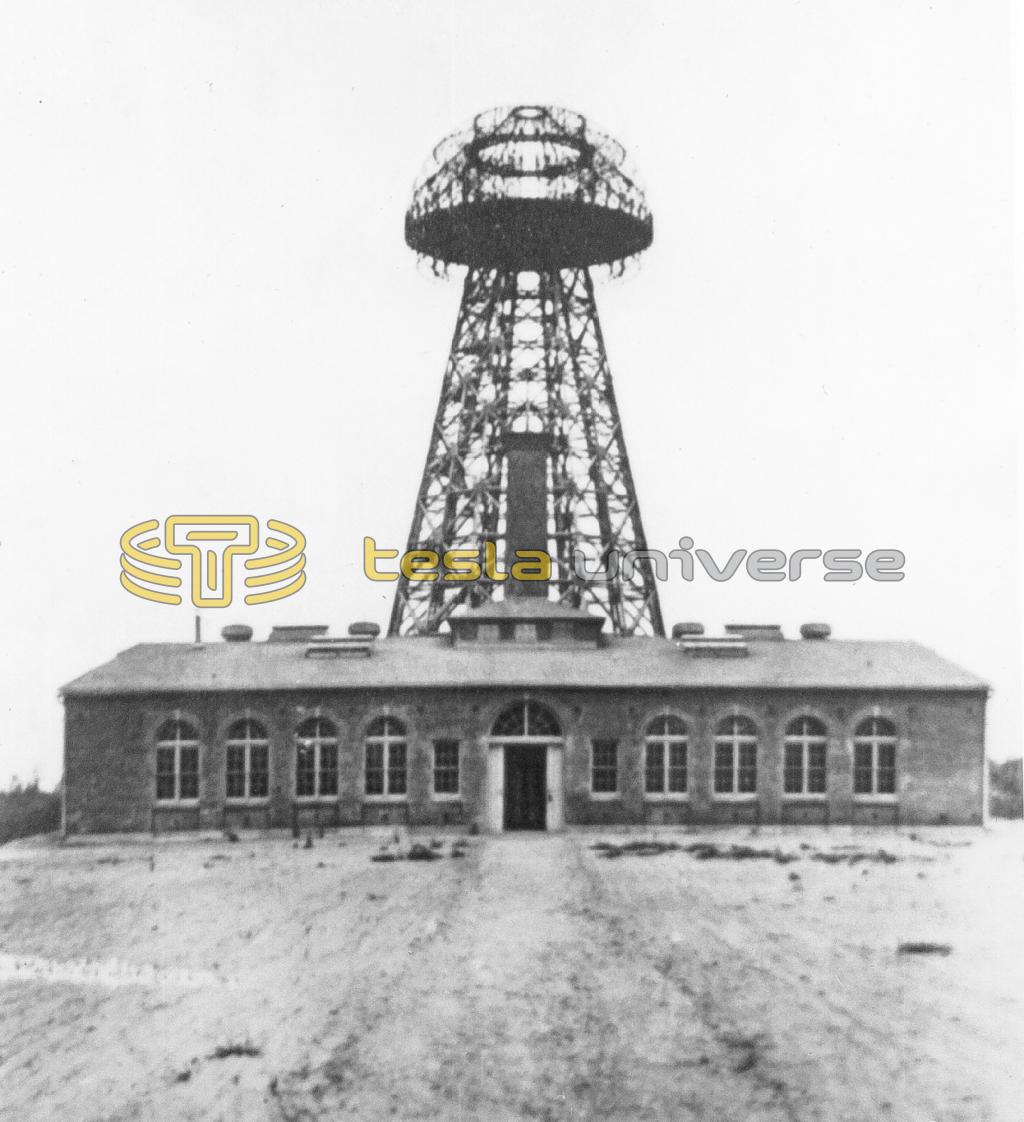
We sat in the inventor's offices, near Fifth Avenue, looking at a picture of his new wireless telephone plant, designed to develop unlimited, undreamed of electrical energy for wireless transmission, a Merlin's tower, overshadowing the imagination. From the desk Lord Kelvin watched us from his portrait, and there gleamed elusively a thing the size of a watch and the power of ten horses.
"The next war will be fought with electricity," he said. "Cannon will be impotent compared with what is to come."

In other words, the Promethean struggle now taxing the vitality of a hemisphere will mark the end of the potency of gunpowder. The invention of Schwartz and Bacon, which first unthroned the armored knight at Crecy in 1346, if there be not some fiction in history, was to give way after 600 years of dominance in the affairs of men and their nations.
The career of this old monarch of mortal destinies has waxed through the centuries. His kingdom has become ever wider and more terrible. The conquering Turks used a cannon or two, hurling 600 pound stones, in their sieges of Europe's capitals. At Marignana, in 1515, the French under Francis I fought the first real artillery battle of history, defeating the Swiss and Milanese with his 350 primitive cannon. Since then battles have come to be, more and more, the applications of gunpowder to great arms. Now whole nations devote their complete industrial resources to feeding these cannon, to supplying their deadly loads. "The limit has been reached. War can be no worse," say the hopeful.
"The limit has no more been reached in the great cannon than in the two-handed sword," says Mr. Tesla. "The world will merely change arms. But the change will not come in time to decide this war, because it takes time to develop great, revolutionary things."
I showed the inventor a clipping reporting that the Germans had cut down Russian entanglements with heat, supposed to have been applied from their trenches by the use of reflecting mirrors. It gave the impression that troops themselves might be thus incinerated from afar.
"In my opinion," said Mr. Tesla, "the melting of barbed wire from a distance is entirely feasible, the result was achieved, I think more likely, by the projection of a hot flame produced by gas under high pressure. The Germans are experts in the manufacture and use of hydrogen, and it is very likely that they have used this gas on account of its enormous heat value. Such a flame can readily be projected for 100 feet, which is ample for the uses involved, on account of the nearness of trenches. Saps can be run out to the needed proximity where intervals between trenches are wider. The action of such a flame is instantaneous. Barbed wire will melt under it like wax.
"As to the use of a reflector for the same purpose, it is, of course, not impossible to concentrate enough heat at 100 feet to melt a wire. The great natural philosopher, Buffon, in order to test the probability of the achievement of Archimedes (setting fire to the ships of Marcellus with mirrors and the sun's rays), constructed a composite mirror of 128 plane mirrors 8 inches high and 5 wide. With this he was able to ignite wood at 210 feet. But such a device would be too cumbersome and too fragile for us in a trench. Modern means would do much better than did Buffon, but it must be remembered that heat reflected by mirrors will fuse a wire only at the point of focus, so that the destruction of an entanglement would be very slow and difficult."
Thus, if the Germans are going to burn their way through the entanglements of their enemies, they must do it by the aid of the chemists, not the physicists.
An inventor in California, so the announcements said recently, had found a new way of creating a wireless flame by wireless power, and hoped his invention would be potent to defend the coast against attacking war vessels.
"To do that," said the Inventor; "the entire power in the United States is not sufficient. The report likely came from some novice in the art of wireless transmission of energy. But it is, nevertheless, possible to produce electrical effects at a distance by means of wireless energy. This is an old subject to me. I have been working on the problem for more than twenty years."
The electrical miracle man stopped and considered as one facing a delicate revelation.
"You can say," he resumed, "that I have just made a wonderful advance in this direction. In my twenty years of application to the problem of the transmission of energy by wireless, gradual improvements have been made. Now the stage has been reached where it is possible to use this force in war and with an effect from which it is safe to infer that this means will be used in future battles instead of guns."
But I wanted specific details. The inventor, however, was not to be persuaded or overcome with attacks or stratagems.
"It is impossible for me to give details at this time. It would jeopardize my own interests and it would contribute ideas to the belligerents which they might be able to develop to increase the horror of the war. But I can tell you in a general way what there is to the invention:
"It can be applied in three ways:
"First. It will make it possible to send an explosive body through the air — an aerial projectile flying many times faster than an aeroplane and direct this object to the spot desired, where it can be exploded from the seat of the wireless operator. Other aerial machines can be directed in the same way and made to perform other work at a distance. This cannot be done by wireless as it is understood now, but by means of my invention it will be possible to direct the projectile I mention, without seeing it at all. It is, moreover, so accurate that it is possible to reduce the error to a few feet in a flight of a thousand miles.
"Second — It will be possible to produce with this invention local actions at a distance; such actions as will interfere with the enemy and render him ineffective.
"Third — It will actually produce at a distance, effects of electrical tension (electrical effects of great intensity) to interfere with life and property."
The inference was that death, fire and explosion at great distances were to be dealt out by wireless, but this the inventor would not put into specific words.
"It is safer," he said, "to be specific after the fact."
Summing up the inventor-scientist's future war, it is to be one in which electrical appliances more deadly than all the cannon on earth will be the dominant arms. It is not unlikely that whole areas will be electrified and made untenable to any living creature. Death and destruction may be dealt out at undreamed of distances, with zones of destruction as yet unfancied. This war will be a conflict in which not armies but whole populations may be destroyed in a single action. Thus there is foreshadowed a conflict of such horror as to recoil even the twentieth century imagination.
"I hope it is the invention that will make war impossible," said the electrician, perhaps with a thought of Nobel, who had dreamed as much, whose prize this new aspirant had won.
