Nikola Tesla Articles
The Tesla Oscillator (December 29, 1893)
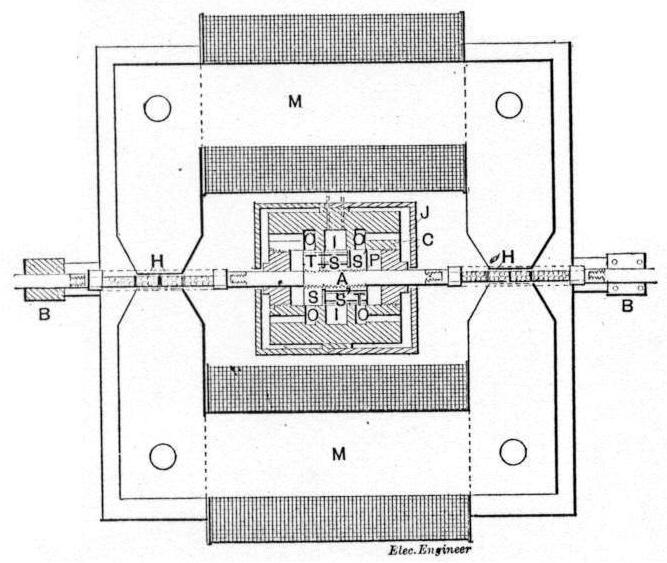
This apparatus, exhibited by Tesla at the World's Fair, Chicago, attracted some attention. From a description in the Electrical Engineer, of New York, we take a sectional view, fig. 1, of the apparatus, and our readers may gather some notion of its construction from that and the description.
Just what this apparatus accomplishes is not made clear; no figures are given upon which one could calculate. It seems to be a kind of alternator designed to give very high frequency by imparting a rapid to and fro motion to two pairs of coils in a very strong magnetic field. The greatest frequency thus obtained is not stated, so that we are unable to compare it with rotary alternators; in that respect it would be interesting to compare it with Prof. Ewing's oscillator or alternator for high frequency, consisting of a Parsons steam turbine and a multipolar alternator.
In the sectional view a piston, P, is seen fitted into the hollow of a cylinder, C, which is provided with channel posts, O, O, and I, extending all round the inside surface. In this particular apparatus there are two channels, O, O, for the outlet of the steam or air used to drive the piston to and fro; I, being the inlet for the air or steam. The piston, P, is provided with two slots, S, S', at a carefully determined distance, one from the other. The tubes, T, T, which are screwed into the holes drilled into the piston, establish communication between the slots, S, S', and chambers on each side of the piston, each of these chambers connecting with the slot which is remote from it. The piston, P, is screwed tightly on a shaft, A, which passes through fitting boxes at the end of the cylinder, C. The boxes project to a carefully determined distance into the hollow of the cylinder, C, thus determining the length of the stroke. Surrounding the whole is a jacket, J, to deaden the sound produced by the action of the oscillator.
A magnetic frame, M, M, is fastened so as to closely surround the oscillator and is provided with energising coils which establish two strong magnetic fields on opposite sides. The magnetic frame is made up of thin sheet iron. In the intensely concentrated field thus produced, there are arranged two pairs of coils, H, H, supported in metallic frames which are screwed on the shaft, A, of the piston and have additional bearings in the boxes, B, B, on each side. The whole is mounted on a metallic base resting on two wooden blocks.
The operation of the device is as follows: The working fluid being admitted through an inlet pipe to the slot, I, and the piston being supposed to be in the position indicated, it is sufficient, though not necessary, to give a gentle tap on one of the shaft ends protruding from the boxes, B. Assuming that the motion imparted be such as to move the piston to the left (when looking at the diagram), then the air rushes through the slot, S', and tube, T, into the chamber to the left. The pressure now drives the piston towards the right and, owing to its inertia, it overshoots the position of equilibrium and allows the air to rush through the slot, S, and tube, T, into the chamber to the right, while the communication to the left hand chamber is cut off, the air of the latter chamber escaping through the outlet, O, on the left. On the return stroke a similar operation takes place on the right hand side. The oscillation is maintained continuously and the apparatus performs vibrations from a scarcely perceptible quiver amounting to no more than 1/64 th of an inch, to vibrations of a little over 5/64 ths of an inch, according to the air pressure and load. It is, indeed, interesting to see how an incandescent lamp is kept burning with the apparatus showing a scarcely perceptible quiver.
The piston cushions against the enclosed air in the cylinder so that even at high velocities it is stopped and reversed without shock. As an apparatus for experimental research on high frequency alternating currents this alternator or oscillator may have the advantages claimed for it, but it does not possess any recommendations as a practical alternator.
As to the novelty of the air or steam oscillator for producing the rapid to and fro motions there is none; a common stone-cutting or engraving tool has long been in use in which this very same idea has been worked out in a thoroughly efficient manner, a piston and cylinder working a small chisel to and fro at a speed of 20,000 per minute by means of compressed air.