Nikola Tesla Articles
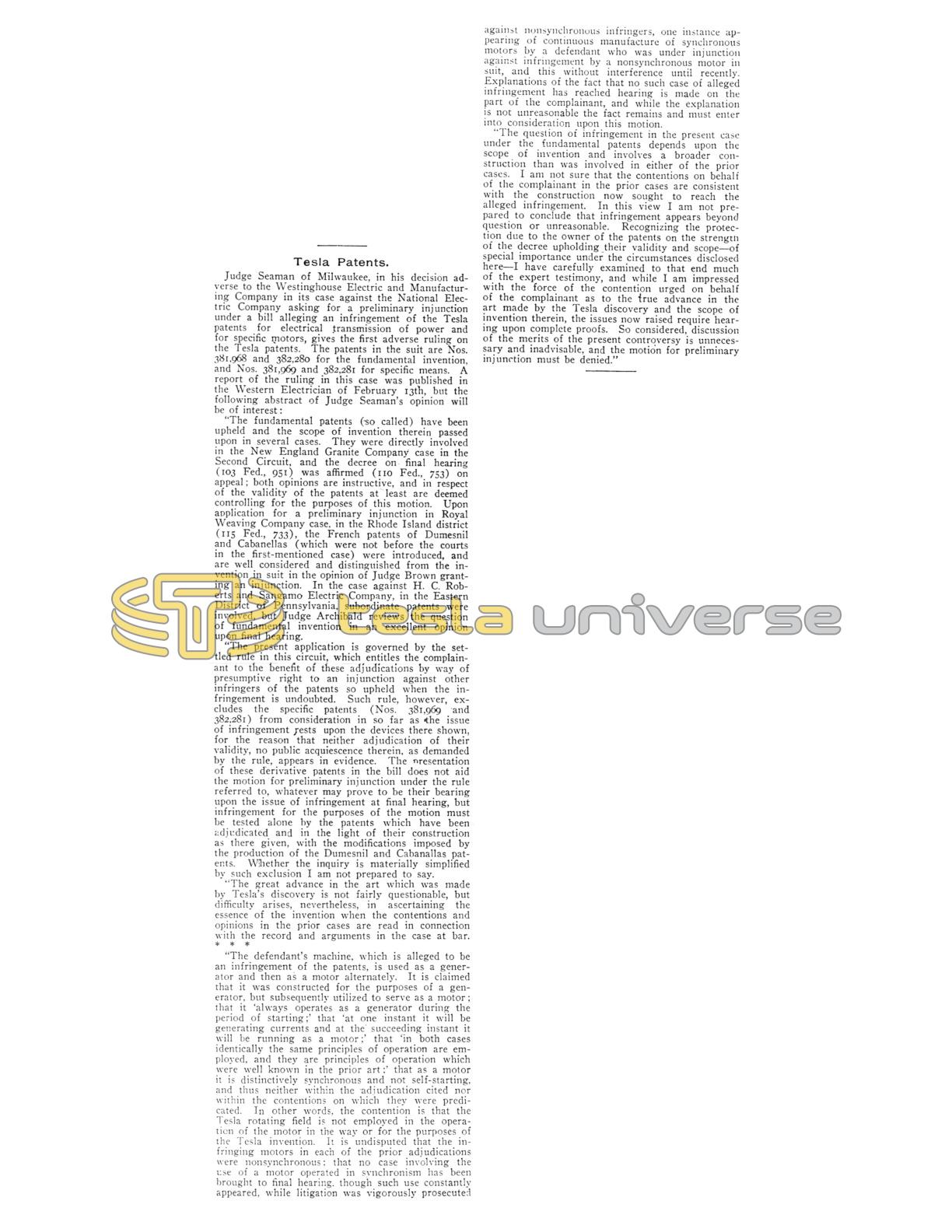
Tesla Patents - Judge Seaman Makes Decision
Judge Seaman of Milwaukee, in his decision adverse to the Westinghouse Electric and Manufacturing Company in its case against the National Electric Company asking for a preliminary injunction under a bill alleging an infringement of the Tesla patents for electrical transmission of power and for specific motors, gives the first adverse ruling on the Tesla patents. The patents in the suit are Nos. 381,968 and 382,280 for the fundamental invention, and Nos. 381,969 and 382,281 for specific means. A report of the ruling in this case was published in the Western Electrician of February 13th, but the following abstract of Judge Seaman's opinion will be of interest:
“The fundamental patents (so called) have been upheld and the scope of invention therein passed upon in several cases. They were directly involved in the New England Granite Company case in the Second Circuit, and the decree on final hearing (103 Fed., 951) was affirmed (110 Fed., 753) on appeal; both opinions are instructive, and in respect of the validity of the patents at least are deemed controlling for the purposes of this motion. Upon application for a preliminary injunction in Royal Weaving Company case, in the Rhode Island district (115 Fed., 733), the French patents of Dumesnil and Cabanellas (which were not before the courts in the first-mentioned case) were introduced, and are well considered and distinguished from the invention in suit in the opinion of Judge Brown granting an injunction. In the case against H. C. Roberts and Sangamo Electric Company, in the Eastern District of Pennsylvania, subordinate patents were involved, but Judge Archibald reviews the question of fundamental invention in an excellent opinion upon final hearing.
“The present application is governed by the settled rule in this circuit, which entitles the complainant to the benefit of these adjudications by way of presumptive right to an injunction against other infringers of the patents so upheld when the infringement is undoubted. Such rule, however, excludes the specific patents (Nos. 381,969 and 382,281) from consideration in so far as the issue of infringement rests upon the devices there shown, for the reason that neither adjudication of their validity, no public acquiescence therein, as demanded by the rule, appears in evidence. The presentation of these derivative patents in the bill does not aid the motion for preliminary injunction under the rule referred to, whatever may prove to be their bearing upon the issue of infringement at final hearing, but infringement for the purposes of the motion must be tested alone by the patents which have been adjudicated and in the light of their construction as there given, with the modifications imposed by the production of the Dumesnil and Cabanellas patents. Whether the inquiry is materially simplified by such exclusion I am not prepared to say.
“The great advance in the art which was made by Tesla's discovery is not fairly questionable, but difficulty arises, nevertheless, in ascertaining the essence of the invention when the contentions and opinions in the prior cases are read in connection with the record and arguments in the case at bar.
“The defendant's machine, which is alleged to be an infringement of the patents, is used as a generator and then as a motor alternately. It is claimed that it was constructed for the purposes of a generator, but subsequently utilized to serve as a motor; that it 'always operates as a generator during the period of starting;' that 'at one instant it will be generating currents and at the succeeding instant it will be running as a motor;' that 'in both cases identically the same principles of operation are employed, and they are principles of operation which were well known in the prior art: that as a motor it is distinctively synchronous and not self-starting, and thus neither within the adjudication cited nor within the contentions on which they were predicated. In other words, the contention is that the Tesla rotating field is not employed in the operation of the motor in the way or for the purposes of the Tesla invention. It is undisputed that the infringing motors in each of the prior adjudications were nonsynchronous; that no case involving the use of a motor operated in synchronism has been brought to final hearing, though such use constantly appeared, while litigation was vigorously prosecuted against nonsynchronous infringers, one instance appearing of continuous manufacture of synchronous motors by a defendant who was under injunction against infringement by a nonsynchronous motor in suit, and this without interference until recently. Explanations of the fact that no such case of alleged infringement has reached hearing is made on the part of the complainant, and while the explanation is not unreasonable the fact remains and must enter into consideration upon this motion.
“The question of infringement in the present case under the fundamental patents depends upon the scope of invention and involves a broader construction than was involved in either of the prior cases. I am not sure that the contentions on behalf of the complainant in the prior cases are consistent with the construction now sought to reach the alleged infringement. In this view I am not prepared to conclude that infringement appears beyond question or unreasonable. Recognizing the protection due to the owner of the patents on the strength of the decree upholding their validity and scope of special importance under the circumstances disclosed here — I have carefully examined to that end much of the expert testimony, and while I am impressed with the force of the contention urged on behalf of the complainant as to the true advance in the art made by the Tesla discovery and the scope of invention therein, the issues now raised require hearing upon complete proofs. So considered, discussion of the merits of the present controversy is unnecessary and inadvisable, and the motion for preliminary injunction must be denied.”