Nikola Tesla Articles
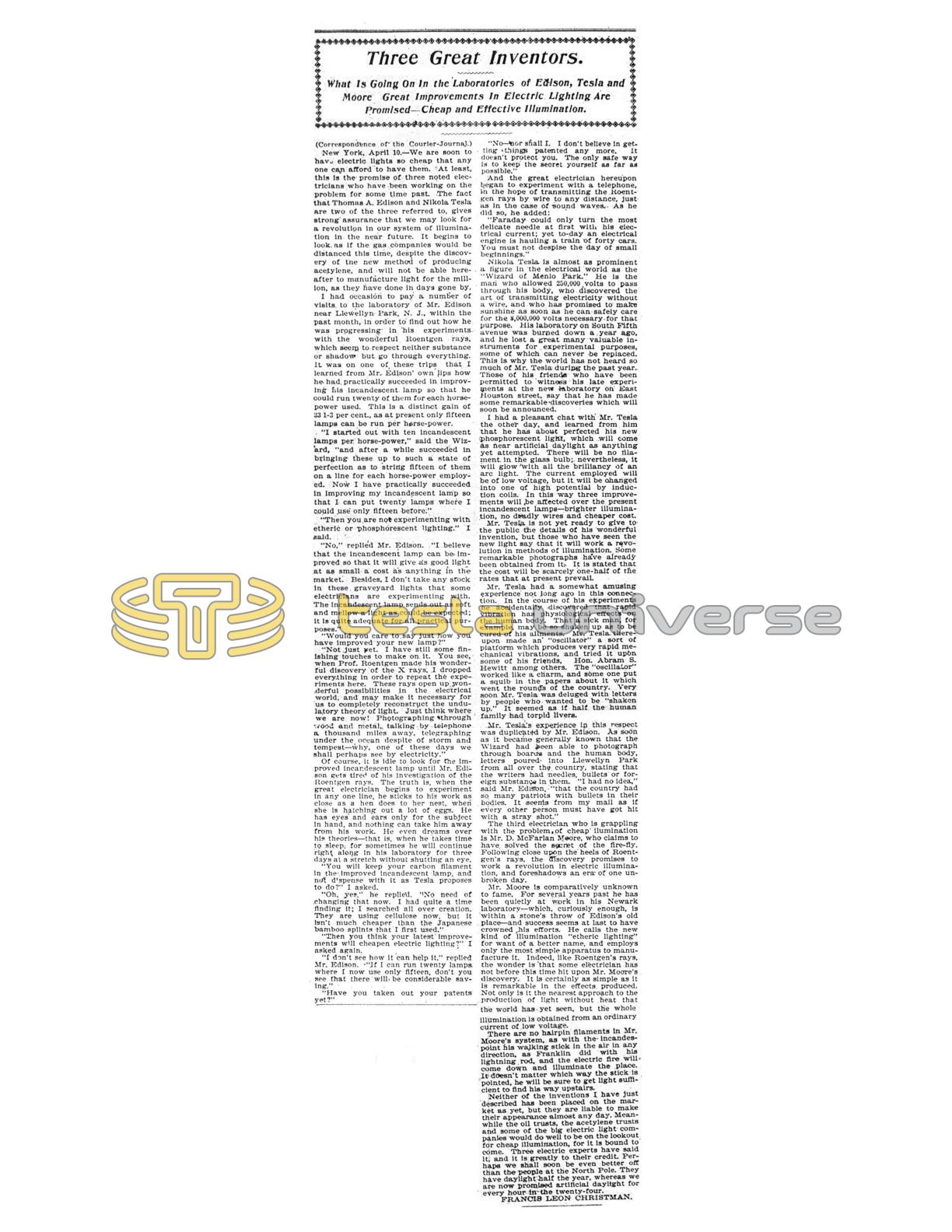
Three Great Inventors
Webmaster note: This article is incomplete, but because of its uniqueness, it is being posted as-is with the hope that someone will be able to help locate the missing portion. If you have any information, please contact us.
What Is Going On In the Laboratories of Edison, Tesla and Moore
Great Improvements In Electric Lighting Are Promised - Cheap and Effective Illumination.
(Correspondence of the Courier-Journal.)
New York, April 10. — We are soon to have electric lights so cheap that any one can afford to have them. At least, this is the promise of three noted electricians who have been working on the problem for some time past. The fact that Thomas A. Edison and Nikola Tesla are two of the three referred to, gives strong assurance that we may look for a revolution in our system of illumination in the near future. It begins to look, as if the gas companies would be distanced this time, despite the discovery of the new method of producing acetylene, and will not be able hereafter to manufacture light for the million, as they have done in days gone by.
I had occasion to pay a number of visits to the laboratory of Mr. Edison. near Llewellyn Park, N. J., within the past month, in order to find out how he was progressing in his experiments. with the wonderful Roentgen rays, which seem to respect neither substance or shadow but go through everything. It was on one of these trips that I learned from Mr. Edison' own lips how he had practically succeeded in improving his incandescent. lamp so that he could run twenty of them for each horse-power used. This is a distinct gain of 33 1-3 per cent., as at present only fifteen lamps can be run per horse-power.
"I started out with ten incandescent lamps per horse-power," said the Wizard, "and after a while succeeded in bringing these up to such a state of perfection as to string fifteen of them on a line for each horse-power employed. Now I have practically succeeded in improving my incandescent lamp so that I can put twenty lamps where I could use only fifteen before."
"Then you are not experimenting with etheric or phosphorescent lighting." I said.
"No," replied Mr. Edison. "I believe that the incandescent lamp can be improved so that it will give as good light at as small a cost as anything in the market. Besides, I don't take any stock in these graveyard lights that some electricians are experimenting with. The incandescent lamp sends out as soft and mellow a light as could be expected; it is quite adequate for all practical purроses."
"Would you care to say just how you have improved your new lamp?"
"Not just yet. I have still some finishing touches to make on it. You see, when Prof. Roentgen made his wonderful discovery of the X rays, I dropped everything in order to repeat the experiments here. These rays open up wonderful possibilities in the electrical world; and may make it necessary for us to completely reconstruct the undulatory theory of light. Just think where we are now! Photographing through wood and metal, talking by telephone. a thousand miles away, telegraphing under the ocean despite of storm and tempest — why, one of these days we shall perhaps see by electricity."
Of course, it is idle to look for the improved incandescent lamp until Mr. Edison gets tired of his investigation of the Roentgen rays. The truth is, when the great electrician begins to experiment in any one line, he sticks to his work as close as a hen does to her nest, when she is hatching out a lot of eggs. He has eyes and ears only for the subject In hand, and nothing can take him away from his work. He even dreams over his theories — that is, when he takes time to sleep; for sometimes he will continue right along In his laboratory for three days at a stretch without shutting an eye.
"You will keep your carbon filament In the Improved incandescent lamp, and not dispense with it as Tesla proposes to do?" I asked.
"Oh, yes," he replied. "No need of changing that now. I had quite a time finding it; I searched all over creation. They are using cellulose now, but it isn't much cheaper than the Japanese bamboo splints that I first used."
"Then you think your latest improvements will cheapen electric lighting?" I asked again.
"I don't see how it can help it," replied Mr. Edison. "If I can run twenty lamps where I now use only fifteen, don't you see that there will be considerable saving."
"Have you taken out your patents yet?"
"No — nor shall I. I don't believe in getting things patented any more. It doesn't protect you. The only safe way is to keep the secret yourself as far as possible."
And the great electrician hereupon began to experiment with a telephone, In the hope of transmitting the Roentgen rays by wire to any distance, just as in the case of sound waves. As he did so, he added:
"Faraday could only turn the most delicate needle at first with his electrical current; yet today an electrical engine is hauling a train of forty cars. You must not despise the day of small beginnings."
Nikola Tesla is almost as prominent a figure in the electrical world as the "Wizard of Menlo Park." He is the man who allowed 250,000 volts to pass through his body, who discovered the art of transmitting electricity without a wire, and who has promised to make sunshine as soon as he can safely care for the 8,000,000 volts necessary for that purpose. His laboratory on South Fifth avenue was burned down a year ago, and he lost a great many valuable instruments for experimental purposes, some of which can never be replaced. This is why the world has not heard so much of Mr. Tesla during the past year. Those of his friends who have been permitted to witness his late experiments at the new laboratory on East Houston street, say that he has made some remarkable discoveries which will soon be announced.
I had a pleasant chat with Mr. Tesla the other day, and learned from him that he has about perfected his new phosphorescent light, which will come as near artificial daylight as anything yet attempted. There will be no filament in the glass bulb; nevertheless, it will glow with all the brilliancy of an arc light. The current employed will be of low voltage, but it will be changed into one of high potential by induction coils. In this way three improvements will be affected over the present incandescent lamps — brighter illumination, no deadly wires and cheaper cost.
Mr. Tesla is not yet ready to give to the public the details of his wonderful invention, but those who have seen the new light say that it will work a revolution in methods of illumination. Some remarkable photographs have already been obtained from it. It is stated that the cost will be scarcely one-half of the rates that at present prevail.
Mr. Tesla had a somewhat amusing experience not long ago in this connection. In the course of his experiments he accidentally discovered that rapid vibration has physiological effects on the human body. That a sick man, for example, may be so shaken up as to be cured of his aliments. Mr. Tesla thereupon made an "oscillator" a sort of platform which produces very rapid mechanical vibrations, and tried it upon some of his friends, Hon. Abram S. Hewitt among others. The "oscillator" worked like a charm, and someone put a squib in the papers about it which I went the rounds of the country. Very soon Mr. Tesla was deluged with letters by people who wanted to be "shaken up." It seemed as if half the human family had torpid livers.
Mr. Tesla's experience in this respect was duplicated by Mr. Edison. As soon as it became generally known that the Wizard had been able to photograph through boards and the human body, letters poured into Llewellyn Park from all over the country, stating that the writers had needles, bullets or foreign substance in them. "I had no idea," said Mr. Edison, that the country had so many patriots with bullets in their bodies. It seems from my mail as if every other person must have got hit with a stray shot."
The third electrician who is grappling with the problem, of cheap illumination is Mr. D. McFarlan Moore, who claims to have solved the secret of the fire-fly. Following close upon the heels of Roentgen's rays, the discovery promises to work a revolution in electric Illumination, and foreshadows an era of one unbroken day.
Mr. Moore is comparatively unknown to fame. For several years past he has been quietly at work in his Newark laboratory — which, curiously enough, is within a stone's throw of Edison's old place and success seems at last to have crowned his efforts. He calls the new kind of illumination "etheric lighting" for want of a better name, and employs only the most simple apparatus to manufacture it. Indeed, like Roentgen's rays, the wonder is 'that some electrician has not before this time hit upon Mr. Moore's discovery. It is certainly as simple as it is remarkable in the effects. produced. Not only is it the nearest approach to the production of light without heat that the world has yet seen, but the whole illumination is obtained from an ordinary current of low voltage.
There are no hairpin filaments in Mr. Moore's system, as with the incandes- ... point his walking stick in the air in any did with his direction, as Franklin lightning rod, and the electric fire will. come down and illuminate the place. It doesn't matter which way the stick is pointed, he will be sure to get light sufficient to find his way upstairs.
Neither of the inventions I have just described has been placed on the market as yet, but they are liable to make their appearance almost any day. Meanwhile the oil trusts, the acetylene trusts and some of the big electric light companles would do well to be on the lookout for cheap illumination, for it is bound to come. Three electric experts have sald it, and it is greatly to their credit. Perhaps we shall soon be even better off than the people at the North Pole. They have daylight half the year, whereas we are now promised artificial daylight for every hour in the twenty-four.
FRANCIS LEON CHRISTMAN.