Nikola Tesla Articles
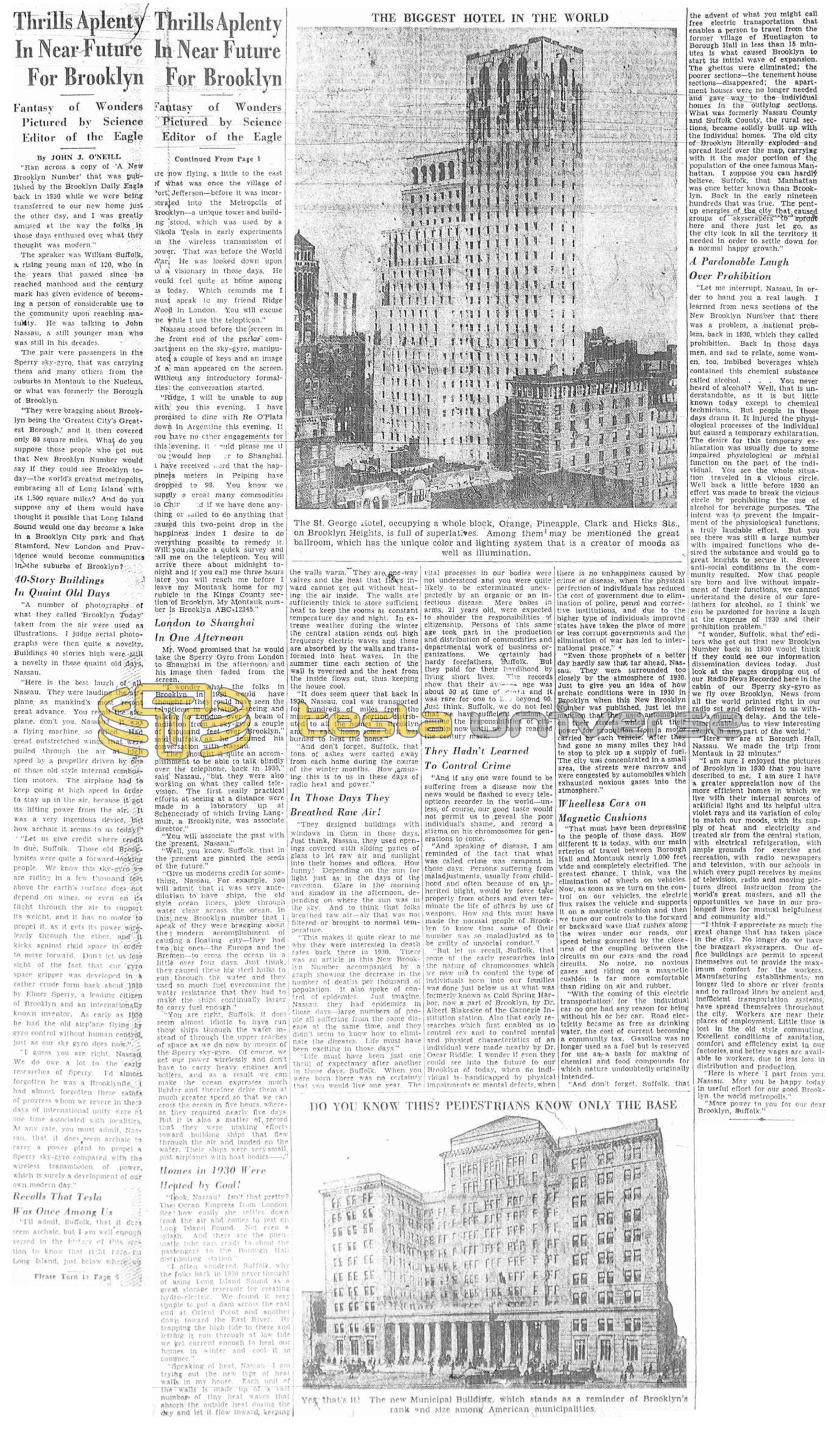
Thrills Aplenty In Near Future For Brooklyn
Fantasy of Wonders Pictured by Science Editor of the Eagle
“Ran across a copy of ‘A New Brooklyn Number’ that was published by the Brooklyn Daily Eagle back in 1930 while we were being transferred to our new home just the other day, and I was greatly amused at the way the folks in those days enthused over what they thought was modern.
“The speaker was William Suffolk, a rising young man of 120, who in the years that passed since he reached manhood and the century mark has given evidence of being a person of considerable use to the community upon reaching maturity. He was talking to John Nassau, a still younger man who was still in his decades.
The pair were passengers in the Sperry sky-gyro that was carrying them and many others from the suburbs in Montauk to the Nucleus, or what was formerly the Borough of Brooklyn.
“They were bragging about Brooklyn being the ‘Greatest City’s Greatest Borough,’ and it then covered only 80 square miles. What do you suppose those people who got out the New Brooklyn Number would say if they could see Brooklyn today — the world’s greatest metropolis, embracing all of Long Island with its 1,500 square miles? And do you suppose any of them would have thought it possible that Long Island Sound would one day become a lake in a Brooklyn City park and that Stamford, New London and Providence would become communities in the suburbs of Brooklyn?”
40-Story Buildings In Quaint Old Days
“A number of photographs of what they called ‘Brooklyn Today’ taken from the air were used as illustrations. I judge aerial photographs were then quite a novelty. Buildings 40 stories high were still a novelty in those quaint old days, Nassau.
“Here is the best laugh of all, Nassau. They were lauding the airplane as mankind’s most recent great advance. You recall the airplane, don’t you, Nassau? It was a flying machine, so called. It had great outstretched wings that were pulled through the air at high speed by a propeller driven by gasoline motors. The airplane had to keep going at high speed in order to stay up in the air, because it got its lifting power from the air. It was a very ingenious device, but how archaic it seems to us today!”
“Let us give credit where credit is due, Suffolk. Those old Brooklynites were quite a forward-looking people. We know this sky-gyro we are riding in a few thousand feet above the earth’s surface does not depend on wings, or even on its flight through the air to support its weight, and it has no motor to propel it, as it gets its power wirelessly through the ether, and it bucks against rigid space in order to move forward. Don’t let us lose sight of the fact that our gyro space gripper was developed in rather crude form back about 1980 by Elmer Sperry, a leading citizen of Brooklyn and an internationally known inventor. As early as 1930 he had the old airplane flying by gyro control without human control, just as our sky gyro does now.”
“I guess you are right, Nassau. We do owe a lot to the early researches of Sperry. I’d almost forgotten he was a Brooklynite. I had almost forgotten those early days of progress whom we revere in these days of international unity were at one time associated with localities. At any rate, you must admit, Nassau, that it does seem archaic to carry a power plant to propel a Sperry sky-gyro compared with the wireless transmission of power, which is surely a development of our own modern days.”
Recalls That Tesla Was Once Among Us
“I’ll admit, Suffolk, that it does seem archaic, but I am well enough versed in the history of this section to know that right here on Long Island, just below where we are now flying, a little to the east of what was once the village of Port Jefferson — before it was incorporated into the Metropolis of Brooklyn — a unique tower and building stood, which was used by Nikola Tesla in early experiments in the wireless transmission of power. That was before the World War. He was looked down upon as a visionary in those days. He could feel quite at home among us today. Which reminds me I must speak to my friend Ridge Wood in London. You will excuse me while I use the telephoton.”
Nassau stood before the screen in the front end of the parlor compartment on the sky-gyro, manipulated a couple of keys, and an image of a man appeared on the screen. Without any introductory formalities the conversation started.
“Ridge, I will be unable to sup with you this evening. I have promised to dine with De O’Plata d’or in Argentine this evening. If you have no other engagements for this evening, it would please me if you would hop over to Shanghai. I have received word that the happiness meters in Peiping have dropped to .93. You know we supply a great many commodities to China and if we have done anything or failed to do anything that caused this two-point drop in the happiness index I desire to do everything possible to remedy it. Will you make a quick survey and call me on the telephoton. You will arrive there about midnight tonight and if you call me three hours later you will reach me before I leave my Montauk home for my rubic in the Kings County section of Brooklyn. My Montauk number is Brooklyn ABC-12345.”
London to Shanghai In One Afternoon
Mr. Wood promised that he would take the Sperry Gyro from London to Shanghai in the afternoon and his image then faded from the screen.
“I wonder what the folks in Brooklyn in 1930 would have thought if they could have seen the telephoton in operation — seeing and talking to London over a beam of radiation from a sky-gyro a couple of thousand feet over Brooklyn,” said Suffolk, as he resumed his conversation with Nassau.
“They thought it quite an accomplishment to be able to talk blindly over the telephone, back in 1930,” said Nassau, “but they were also talking on what they called television. The first really practical efforts at seeing at a distance were made in a laboratory up at Schenectady of which Irving Langmuir, a Brooklynite, was associate director.”
“You will associate the past with the present, Nassau.”
“Well, you know, Suffolk, that in the present are planted the seeds of the future.”
“Give us moderns credit for something, Nassau. For example, you will admit that it was very antediluvian to have ships, the old style ocean liners, plow through water clear across the ocean. In this new Brooklyn number that I speak of they were bragging about the modern accomplishment of causing a floating city — they had two big ones — the Europa and the Bremen—to cross the ocean in a little over four days. Just think, they caused these big steel hulks to run through the water and they used so much fuel overcoming the water resistance that they had to make the ships continually larger to carry fuel enough.”
“You are right, Suffolk, it does seem almost idiotic to have run those ships through the water instead of through the upper reaches of space as we do now by means of the Sperry sky-gyro. Of course, we get our power wirelessly and don’t have to carry heavy engines and boilers, and as a result we can make the ocean expresses much lighter and therefore drive them at much greater speed so that we can cross the ocean in five hours, whereas they required nearly five days. But it is also a matter of record that they were making efforts toward building ships that flew through the air and landed on the water. Their ships were very small, just airplanes with boat bodies —.”
Homes in 1930 Were Heated by Coal!
“Look, Nassau! Isn’t that pretty? The Ocean Empress from London. See how easily she settles down from the air and comes to rest on Long Island Sound. Not even a splash. And there goes the pneumatic tube car ready to shoot the passengers to the Borough Hall distributing station.”
“I often wondered, Suffolk, why the folks back in 1930 never thought of using Long Island Sound as a great storage reservoir for creating hydro-electric. We found it very simple to put a dam across the east end at Orient Point and another down toward the East River. By trapping the high tide there and letting it run through at low tide we get current enough to heat our homes in winter and cool it in summer.”
“Speaking of heat, Nassau, I am trying out the new type of heat walls in my house. Each unit of the walls is made up of a vast number of tiny heat waves that absorb the outside heat during the day and let it flow inward, keeping the walls warm. They are one-way valves and the heat that flows inward cannot get out without heating the air inside. The walls are sufficiently thick to store sufficient heat to keep the rooms at constant temperature day and night. In extreme weather during the winter the central station sends out high frequency electric waves and these are absorbed by the walls and transformed into heat waves. In the summer time each section of the wall is reversed and the heat from the inside flows out, thus keeping the house cool.
“It does seem queer that back in 1930, Nassau, coal was transported for hundreds of miles from the mines and then a portion distributed to all the homes in Brooklyn and in each home some of it was burned to heat the home.”
“And don’t forget, Suffolk, that tons of ashes were carted away from each home during the course of the winter months. How amusing this is to us in these days of radio heat and power.”
In Those Days They Breathed Raw Air!
“They designed buildings with windows in them in those days. Just think, Nassau, they used openings covered with sliding panes of glass to let raw air and sunlight into their homes and offices. How clumsy! Depending on the sun for light just as in the days of the caveman. Glare in the morning and shadow in the afternoon, depending on where the sun was in the sky. And to think that folks breathed raw air — air that was not filtered or brought to normal temperature.
“This makes it quite clear to me why they were interested in death rates back there in 1930. There was an article in this New Brooklyn Number accompanied by a graph showing the decrease in the number of deaths per thousand of population. It also spoke of control of epidemics. Just imagine, Nassau: They had epidemics in those days — large numbers of people all suffering from the same disease at the same time, and they didn’t seem to know how to eliminate the diseases. Life must have been exciting in those days.”
“Life must have been just one thrill of expectancy after another in those days, Suffolk. When you were born there was no certainty that you would live one year. The vital processes in our bodies were not understood and you were quite likely to be exterminated unexpectedly by an organic or an infectious disease. Mere babes in arms, 21 years old, were expected to shoulder the responsibilities of citizenship. Persons of this same age took part in the production and distribution of commodities and departmental work of business organizations. We certainly had hardy forefathers, Suffolk. But they paid for their hardihood by living short lives. The records show that their average age was about 50 at time of death and it was rare for one to live beyond 90. Just think, Suffolk, we do not feel that we have sufficient wisdom to assume the responsibilities of citizenship now until we have reached the century mark.”
They Hadn’t Learned To Control Crime
“And if any one were found to be suffering from a disease now the news would be flashed to every teleopticon recorder in the world — unless, of course, our good taste would not permit us to reveal the poor individual’s shame, and record a stigma on his chromosomes for generations to come.
“And speaking of disease, I am reminded of the fact that what was called crime was rampant in those days. Persons suffering from maladjustments, usually from childhood and often because of an inherited blight, would by force take property from others and even terminate the life of others by use of weapons. How sad this must have made the normal people of Brooklyn to know that some of their number was so maladjusted as to be guilty of unsocial conduct.
“But let us recall, Suffolk, that some of the early researches into the nature of chromosomes which we now use to control the type of individuals born into our families was done just below us at what was formerly known as Cold Spring Harbor, now a part of Brooklyn, by Dr. Albert Blakeslee of the Carnegie Institution station. Also that early researches which first enabled us to control sex and to control mental and physical characteristics of an individual were made nearby by Dr. Oscar Riddle. I wonder if even they could see into the future to our Brooklyn of today, when no individual is handicapped by physical impairments or mental defects, when there is no unhappiness caused by crime or disease, when the physical perfection of individuals has reduced the cost of government due to elimination of police, penal and corrective institutions, and due to the higher type of individuals improved states have taken the place of more or less corrupt governments and the elimination of war has led to international peace.”
“Even those prophets of a better day hardly saw that far ahead, Nassau. They were surrounded too closely by the atmosphere of 1930. Just to give you an idea of how archaic conditions were in 1930 in Brooklyn when this New Brooklyn Number was published, just let me mention that they used automobiles on their streets which got their power for propulsion from a motor carried by each vehicle. After they had gone so many miles they had to stop to pick up a supply of fuel. The city was concentrated in a small area, the streets were narrow and were congested by automobiles which exhausted noxious gases into the atmosphere.”
Wheel-less Cars on Magnetic Cushions
“That must have been depressing to the people of those days. How different it is today, with our main arteries of travel between Borough Hall and Montauk nearly 1,000 feet wide and completely electrified. The greatest change, I think, was the elimination of wheels on vehicles. Now, as soon as we turn on the control on our vehicles, the electric flux raises the vehicle and supports it on a magnetic cushion and we tune our controls and the forward or backward way that rather along the wires under our roads, our speed being governed by the closeness of the coupling between the circuits on our cars and the road circuits. No noise, no noxious gases and riding on a magnetic cushion is far more comfortable than riding on air and rubber.
“With the coming of this electric transportation for the individual car no one had any reason for being without his or her car. Road electricity became as free as drinking water, the cost of current becoming a community tax. Gasoline was no longer used as a fuel but is reserved for use as a basis for many fine chemical and food compounds for which nature undoubtedly originally intended.
“And don’t forget, Suffolk, that the advent of what you might call free electric transportation that enables a person to travel from the former village of Huntington to Borough Hall in less than 15 minutes is what caused Brooklyn to start its initial wave of expansion. The ghettos were eliminated; the poorer sections — the tenement house sections — disappeared; the apartment houses were no longer needed and gave way to the individual homes in the outlying sections. What was formerly Nassau County and Suffolk County, the rural sections, became solidly built up with the individual homes. The old city of Brooklyn literally exploded and spread itself over the map, carrying with it the major portion of the population of the once famous Manhattan. I suppose you can hardly believe, Suffolk, that Manhattan was once better known than Brooklyn. Back in the early nineteen hundreds that was true. The pent up energies of the city that caused groups of ‘skyscrapers’ to sprout here and there just let go, as the city took in all the territory it needed in which to settle down for a normal happy growth.”
A Pardonable Laugh Over Prohibition
“Let me interrupt, Nassau. In order to hand you a real laugh. I learned from news sections of the New Brooklyn Number that there was a problem, a national problem, back in 1930, which they called prohibition. Back in those days men, and sad to relate, some women, too, imbibed beverages which contained chemical substances called alcohol. You never heard of alcohol? Well, that is understandable, as it is but little known today except to chemical technicians. But people in those days drank it. It injured the physiological processes of the individual but caused a temporary exhilaration. The desire for this temporary exaltation was so strong that they impaired physiological or mental function on the part of the individual. You see the whole situation traveled in a vicious circle. Well back a little before 1930 an effort was made to break the vicious circle by prohibiting the use of alcohol for beverage purposes. The intent was to prevent the impairment of the physiological functions, a truly laudable effort. But you see there was still a large number with impaired functions who desired the alcohol and they went to great lengths to secure it. Severe anti-social conditions in the community resulted. Now that people are born and live without impairment of the physiological functions we understand the desire of our forefathers for alcohol. I think we can be pardoned for having a laugh at the expense of 1930 and their prohibition problem.
“I wonder, Suffolk, what the editors of the New Brooklyn Number back in 1930 would think if they could see our television dissemination devices today. Just look at the pages dropping out of our radio set. Recorded here in the cabin of our Sperry sky-gyro as we fly over Brooklyn. News from all the world’s printed right in our radio set and delivered to us without a minute’s delay. And the television enables us to view interesting events in any part of the world.”
“Here we are at Borough Hall, Nassau. We made the trip from Montauk in 22 minutes.”
“I am sure I enjoyed the pictures of Brooklyn in 1930 that you have described to me. I am sure I have a greater appreciation now of the more efficient homes in which we live with their internal sources of artificial light and its helpful ultra violet rays and its variation of color to match our moods, with its supply of heat and electricity and treated air from the central station, with electrical refrigeration, with ample grounds for exercise and recreation, with radio newspapers and television, with our schools in which every pupil receives by means of television, radio and moving pictures direct instruction from the world’s great masters, and all the opportunities we have in our prolonged lives for mutual helpfulness and community aid.”
“I think I appreciate as much the great change that has taken place in the city. No longer do we have the braggart skyscrapers. Our office buildings are permitted to spread themselves out to provide the maximum comfort for the workers. Manufacturing establishments, no longer tied to shore or river fronts and to railroad lines by ancient and inefficient transportation systems, have spread themselves throughout the city. Workers are near their places of employment. Little time is lost in the old style commuting. Excellent conditions of sanitation, comfort and efficiency exist in our factories, and better wages are available to workers, due to less loss in distribution and production.”
“Here is where I part from you, Nassau. I hope you are happy today in useful effort for our good Brooklyn, the world metropolis.”
“More power to you for our dear Brooklyn, Suffolk.”