Nikola Tesla Articles
Transmitting Power by Radio
An excellent exposition of one of the problems on which investigators have been working ever since the propagation of radio waves has been known.
By JOSEPH RILEY

It has been the fondest dream of inventors for ages past to be able to transmit power in considerable amounts over distances both long and short. They have succeeded admirably, for today there are millions and millions of horsepower being transmitted from the various power plants throughout the world to other parts of the world. But in all cases the transmission is accomplished through the medium of some material substance—in the case of electrical transmission this material substance is the copper of the conducting wires.
But no sooner is the dream of the inventor realized than another inventor has another dream. He is not satisfied with the accomplishments of his predecessor, but he must go him one better. He now wants to do away with the wires themselves. An admirable project, beyond a doubt, but the question which naturally rises is whether or not such a thing is possible.
The writer has no desire to commit himself by making statements that it is impossible to do one thing or another. Time and again the skeptics have been shown the folly of their ways. No sooner does one of these "intelligentsia" set himself forth as an unbeliever, just as soon does someone tear down his wall of arguments, and accomplish the very thing the skeptic said was impossible.
For this reason, the writer will not say that it will be impossible to transmit appreciable amounts of power over distances by means of radio. The writer will say, however, that it is impossible to transmit appreciable amounts of power over distances by means of radio. This paragraph is not an example of tautology, dear reader, for you must note the emphasis placed on the tenses. The point is, in just a few words, that in the light of the present knowledge, and the existing state of the art, it is not being done today. Let us hope we will see it done ere our days are o'er.
There is another idea that may be appropriately interpolated here, and that is that, although, as far as I know the patent laws, there is none that prohibits the patenting of ideas dealing with perpetual motion machines, yet it "isn't being done." I do not mean that there should be any antipathy against patenting ideas relative to transmitting power by radio, but what I do mean is that we have a natural and inalienable right to say that we think a thing cannot be done.
Now that the prologue has ended, let us consider some real facts. There are natural barriers that have to be broken down before radio power transmission can become an accomplished fact, and one of these—an exceedingly important one—is the attenuation of the field strength that occurs in transmitting energy from one point to another by radio methods. The reader must understand that when I make the remark "by radio methods" I mean the usual methods. I am not at present referring to radical or revolutionary things like unknown newly discovered "rays," etc.
We can discuss the matter intelligently simply from our everyday experience in trying to get DX. Just think how our friend, the ham, who lives around the corner, comes pounding in, just as if he were doing his brass-pounding right in our own antenna lead-in. And think of how we shorten our mundane existences splitting the hairlines on our micro-micro-vernier dials, trying to get out of the ether a mere vestige of a sound from "Station KBVD, Wrzxp, China."
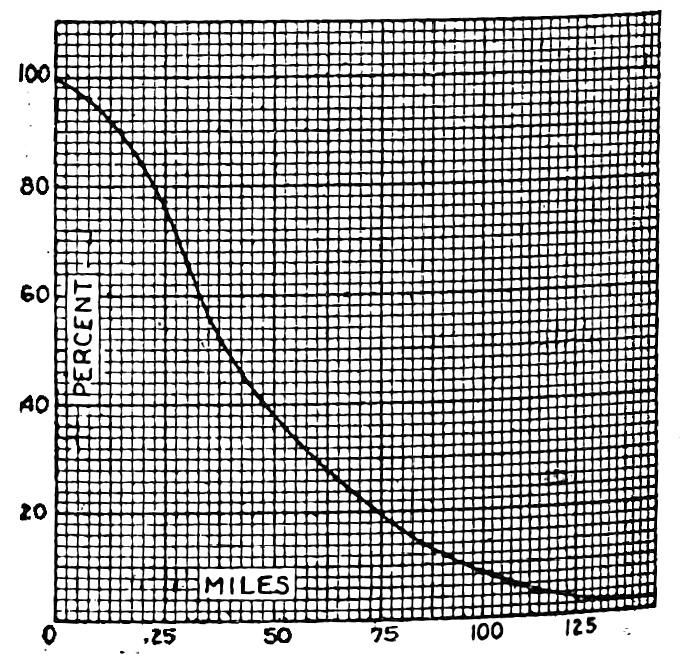
If the reader has good eyesight he can see this very plainly in the diagram shown below. The curve is drawn for a station which sends a certain number of amperes up into its antenna. Right at the station, if we had a receiving set there, we would receive a pretty strong signal. Let us call that signal strength 100 per cent. As we move our receiving station away from the transmitting station, it is obvious that the received signals would diminish in strength, and how much it diminishes is shown by the way in which the curve drops downward. Kindly note that the signal strength is only 2 per cent. at the small distance of 120 miles.
But even this does not nearly tell the whole story. By the expression "signal strength," as used above, we mean the current in the receiving antenna. This, by no means, is the power, for the power is determined by both the current and the voltage, among other things. The voltage in the transmitting antenna may be way up in the thousands, whereas, in the receiving antenna, it is way down in the micros. Consequently, we may reasonably expect the watts to be also down in the micros.
Now, when we consider that the power used in the transmitter may be a thousand, or even a hundred watts, it becomes apparent that we can expect to receive, at the small distance of 120 miles, less than an amount of power that would have to be reckoned in microwatts or, perhaps, micro-microwatts.
And even with all this we have not considered such problems as fading, etc.
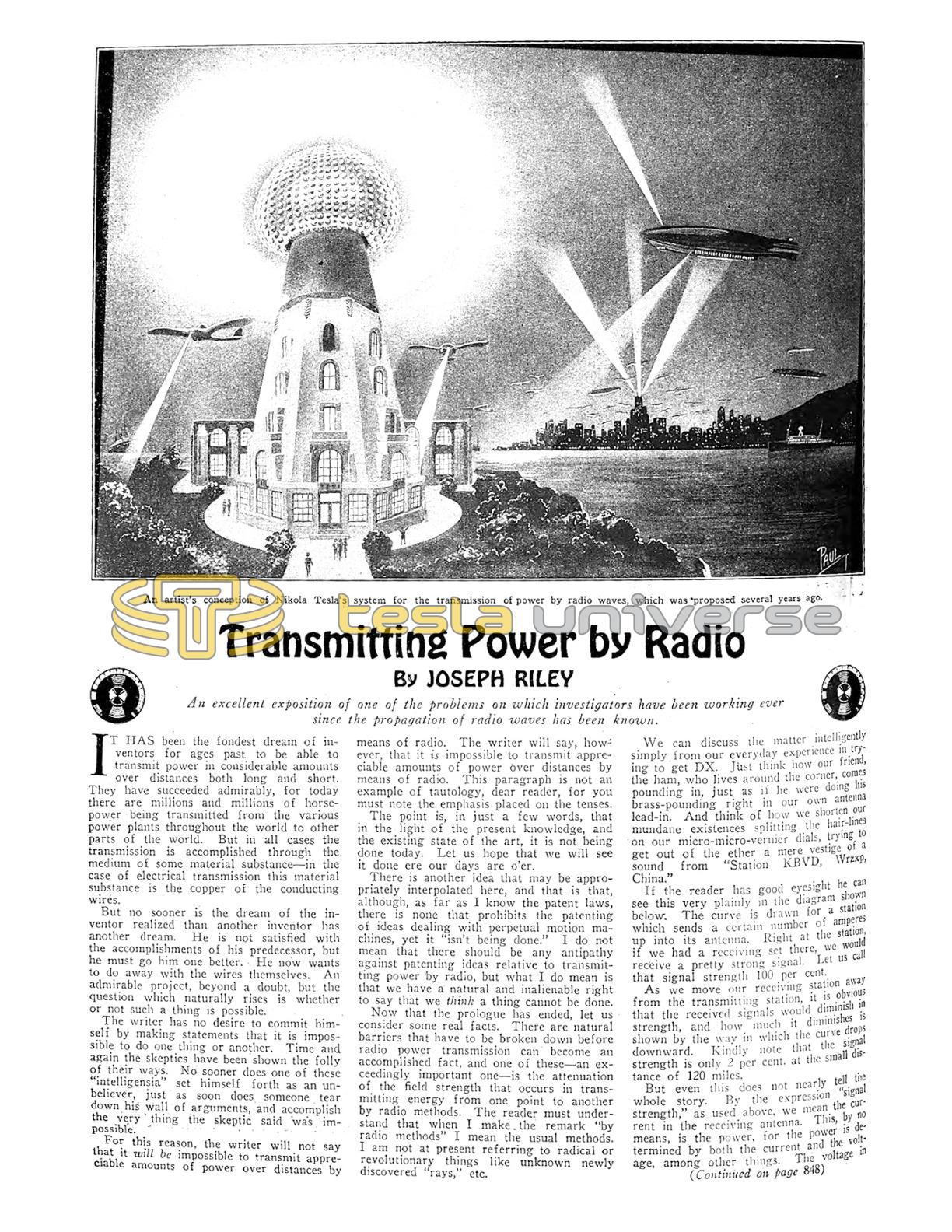
There have been attempts made in the past, some of them by notable scientists, to transmit electrical power over distances by means other than what we call in this article "ordinary radio." For instance, we show, in the illustration, a plan of Nikola Tesla's, which was started years ago, but was never carried to the point of actual experimentation. This plan was told to the readers of the Electrical Experimenter back in March, 1916. The idea was to utilize only the ground waves, the power being generated in a tower, at the top of which was a large dome to be charged to an inordi- nately high potential, say 4,000,000 volts. Another tower, located at a distance, was to do the receiving, and was similarly built.
Although some preliminary experiments employing this principle were carried through to what might be called a successful experimental conclusion, the application never reached what might be classified as a commercially promising result.
Those who have followed the advances in the radio field for the last decade will remember the experiment carried out on the plains of Colorado, in which Tesla success- fully heated the filament of an ordinary electric lamp on a small loop of wire from power generated several miles away and transmitted from the generating plant to the light through space without intervening conductors of any kind.
Another plan which was not so long ago given considerable publicity in the press, was that of Grindell-Matthews — the so-called "death ray."
It was claimed by the inventor that he had discovered a new kind of ray which he could control and project at will, and that the interception of this ray with any material body in its its path would immediately re- sult in the demolition of the obstacle. The whole thing was taboo in the minds of most of the great scientists of the world, and, as for that, the thing seems to have passed into oblivion, for we do not hear of it any longer.
Another idea which, I believe, had its inception in France (I have forgotten the inventor's name) employed two extremely powerful beams of ultra-violet rays. These were to be shot up through the air until they came to the Heaviside layer. A powerful transmitter was to be located so as to discharge into one of these beams and the receiver was to be located in the other beam. It was thought, then, that a continuous electrical circuit would be furnished by one of the beams, the Heaviside layer, the other beam and the ground, all in series with the transmitter and the receiver. Oh, Oliver Heaviside! What deeds are committed in thy name!
However, to end the effusion, and to tell the whole truth and nothing but the truth, it must be confessed that some power has been transmitted by radio. Further, it must be said that even as much as a few watts of power have been transmitted by means of radio (ordinary radio), but I must not omit to tell that this was done over wires; in other words, it was wired radio.
Far be it from me, however, to disparage the efforts of those altruistic souls who will spend their lives and fortunes in the search. Let us hope for their success, and may that success be not at the same distance as the point to which they wish to transmit power by radio.