Nikola Tesla Articles
The Electrical Experimenter
"Long live the amateur, long live wireless!" shouted the opening article of a new publication, "The Electrical Experimenter," which had long been pondered but finally was born with the issue of May, 1913. Gernsback had terminated a campaign on the part of the American amateur in Modern Electrics, but he plunged at once into the affairs of hamdom in the Electrical Experimenter by publishing a lengthy but easy-to-read piece on "Building Large Spark Coils." He would not accept or print advertising matter, an announcement said. The periodical — which at 5 cents a copy was said to have been produced at a loss — would be strictly a service to subscribers and customers of the Electro Importing Co.
The assistant editor was Harry Winfield Secor, who had been with Gernsback on Modern Electrics, and who was destined to be a member of the organization — with brief interruptions — to the present day.
Lee de Forest in the June, 1913, Electrical Experimenter told of "Recent Developments at the Federal Telegraph Co." which he said "enjoyed the distinction of having no press agents."
In the February, 1914, issue, Gernsback reported on his "Radioson" detector, which was made by fusing a .0002-inch diameter platinum wire into a tube of special glass so that only the most minute tip of the metal was presented to the electrolytic solution. It was said to have been some 1,246 times smaller than the best bare-point Wollaston wire of the day. The wireless wavemeter, one of the fundamental tools of the art, made its appearance in the Electrical Experimenter of August.
In the spring and summer of 1915, with Europe at war, radio and electronics began to move faster. On May 7 an SOS from the Lusitania revealed that the vessel had been sunk by a German U-boat. Wireless dramatically had proven again its usefulness.
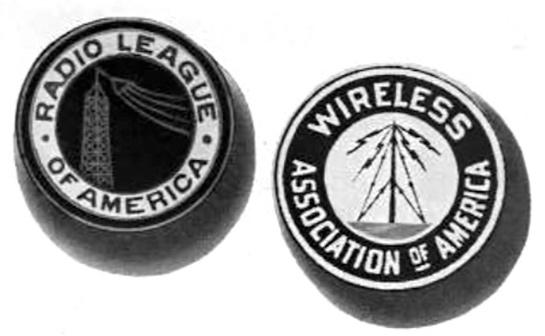
In the winter of 1915-16, under the aegis of the Electrical Experimenter, radio leaders in this country formed the Radio League of America. Its purpose was to "promote the art of amateur wireless telegraphy and telephony in the US . . . to make available to the Government a complete list of US amateur stations . . . pledged to serve the country in time of national danger or need . . . ."
There was plenty of opportunity for the magazine to take part in the country's service, and it carried on a campaign to educate the public — and the Government — to the dangers posed to the country's neutrality by the large German stations at Sayville, N. Y., and Tuckerton, N. J. The cover of the August, 1915, issue showed "Sayville Wireless Receiving German War Report," and the editorial pointed out, with examples, how simple it would be to send coded messages which would assist German U-boats to sink enemy (and neutral) shipping.
In the very next issue of Electrical Experimenter came the news that the Government had closed the station at Sayville, later reopening it with a full Government staff. Charles E. Apgar, wireless amateur of Westfield, N. J., had recorded Sayville's messages on wax records and turned them over to Federal authorities for decoding. These, when played back, furnished sufficient evidence to cause the Government to close the station.
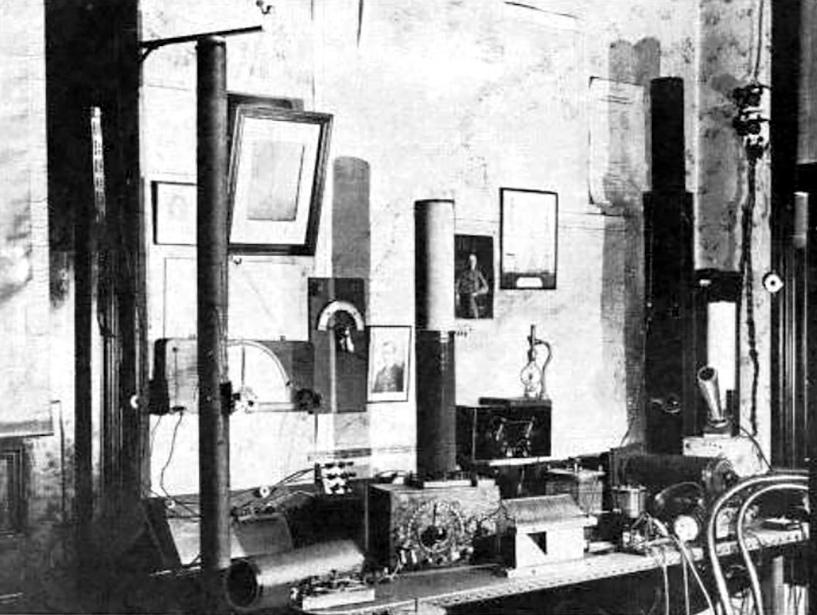
Meanwhile, the part played by the magazine aroused sharp resentment from the old Sayville officials. Dr. K. G. Frank, head of the station, wrote a bitter letter to the editor, the point of which was a little blunted by the fact that by the time it was printed, the Government had already closed Sayville. Dr. Frank, incidentally, was later convicted as a German Intelligence agent.
By this time Electrical Experimenter (it was in the spring of 1917) was carrying a few ads — the de Forest "Oscillion" for $60. Pacific Laboratories displayed and described double-end vacuum-tube detectors. Crystal detec- tors were still in the literature of the day, but many realized they were on the way out. An editorial on "War and the Radio Amateur," stated that the huge backlog of amateur operators could be inducted into the country's service at a moment's notice. "What other country could provide such a vast army of well-trained and intelligent men as this, whose very multitude is a priceless protection?"
Then on April 6 the US entered the war and President Wilson signed the order silencing the amateurs for the duration. Many, forthwith, went into the armed forces as an outlet for their activities. Gernsback promptly gave vent to his imagination in an editorial on the possibilities of "Shooting with Electricity," or magnetism, to be more exact. Thereafter, Electrical Experimenter explored many facets of the expanding use of electronics in warfare.
But for the Electrical Experimenter and its merchandising associate, the Electro Importing Co., a crisis was at hand. Its business — and inventory — has been increasing since 1908. Now President Wilson clamped down on the sale of radio equipment. There was a war on. With a fortune in parts on hand, there was no one to sell them to. One of Gernsback's first acts was to assemble simple telegraph outfits. He sold thousands, but this did not take care of the great bulk of apparatus on hand.
Then one night he stayed in the factory till 2 am, "rummaging over all the parts in the shop." Suddenly came the solution to the dilemma. He would assemble sets of lamps, batteries, keys, phones and other electrical compo- nents into a neat little box called "The Boy's Electric Toys." Sitting up late several nights, he compiled a 32-page profusely illustrated booklet of "100 Electrical Experiments" that could be performed with the outfit. This little publication may well have been the most important one the organization ever printed. With its aid the shelves were cleared and the day saved for the E.I.Co. and, of course, Electrical Experimenter.
The editorial of January, 1919, was entitled "Electric Music." It predicted telephone receivers covering every audible tone, with almost any required amount of loudness. Thus was anticipated the current world of high fidelity, the loudspeaker without a horn and the high-power amplifier to drive it. Even electronic or "concrete" music was predicted.
In the February, 1919, issue, Electrical Experimenter began a series of articles entitled "My Inventions" by Nikola Tesla. To persuade the great Tesla to write his own autobiography was no mean feat, and the editor still looks back on it as his greatest journalistic beat. The series ended in the May issue, with the author stating confidently that his proposed system of wireless transmission of power, temporarily defeated, would finally become a "triumphal success."
With the war over, the question of "regulating the amateur" came up again. The 65th Congress proposed to amend the Alexander Wireless Bill, but the proposed amend- ments forbade so many things essential to the amateur that the editor was moved to lampoon the bill in a bitter cartoon in the February Electrical Experimenter. The bill was
killed. The hated demon had been effectively exorcised by the power of the cartoonist's pen and of the printed word.
The Acting Secretary of the Navy announced that, effective April 15, 1919, all restrictions were removed on radio receiving stations other than those used for reception of commercial traffic.