From the enemy U-boats of World War II to the enemy insects attacking man and crops today, Philip Callahan tells the fascinating tale of how an understanding of electromagnetic radiation can lead one to victory.
by Philip S. Callahan.
The night sky is filled with waves of electromagnetic radiation. Sometimes it is bright with light from the Moon, sometimes dimly streaked with the early light of false dawn; sometimes low clouds cause darkness to shroud the lands.
Strangely enough the night sky is also filled with vivid colors. Red, blue, orange, and green colors bathe the Earth from the thousands of suns (stars) that irradiate our atmosphere. Infrared colors (wavelengths) and ultraviolet are emitted by constellations and are reflected from our own Sun to the surface of the Moon and back to Earth. At various times during the night, the gaseous molecules that compose our many atmospheric layers are stimulated to glow, at very low intensities in beautiful hues of red, green, near-infrared, or ultraviolet. We cannot see these low-intensity colors with our eyes. The cones of our retina, which work so well in bright daylight, cut out at low intensities of light. Our eye cannot see ultraviolet or infrared light during daylight or night light.
The human eye is completely restricted to the narrow, visible portion of the electromagnetic spectrum. The fact that we cannot see these many night radiations does not mean that they have no effect on our lives or on nature around us. I was witness to the effect of such low-intensity night light on earthly life many years ago.
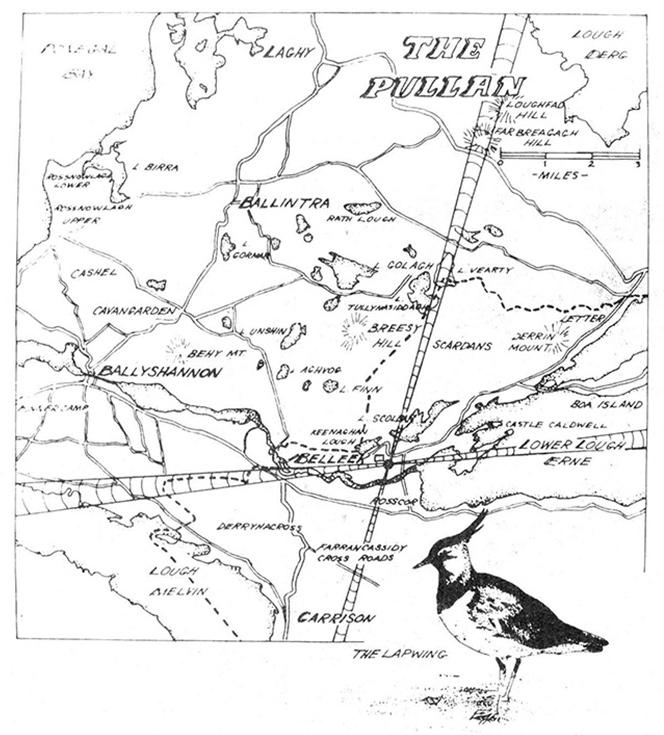
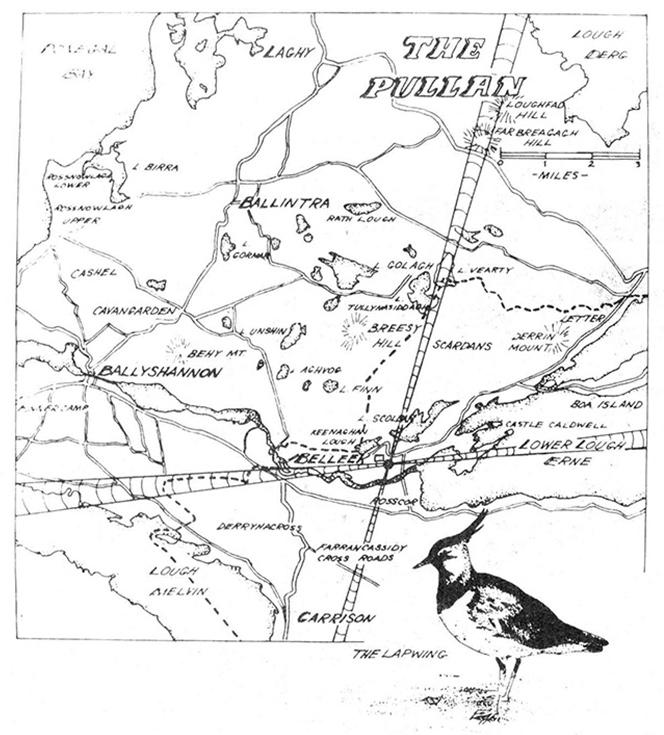
I had set out on a hike across the wild, uninhabitable moorlands of southwest Donegal, Ireland. I began my hike at the little crossroad village of Ballintra and cut southeastward cross country toward Lough Erne in County Fermanagh. This area of Donegal is called the Pullan (Figure 1). It is a stretch of moorland 8 to 10 miles across and far more desolate than the Dartmoor of England. The Pullan is dotted with bogs and small lakes or loughs. Pullan means puddle in Gaelic. Red grouse, merlin, corncrakes, and lapwings inhabit its marshes, moors, and lush vegetation.
As evening fell, the persistent "crek-crek" of the corncrake filled the darkening sky. Halfway between Ballintra and Lough Erne a mountain called Breezy Hill rises 2,500 feet above sea level. I used Breezy Hill as a central landmark to guide myself across the bogs and heather-covered highlands.
The ‘Hour of the Wolf'
During summer at 55° N latitude (New York City is 42°) there are still streaks of light at midnight. It was almost midnight when I stopped to camp in a sheltered spot between the great rocks on the side of Breezy Hill. As the last glimmer of light faded away I spread my bedroll between the huge gray-colored boulders. Suddenly the heather-filled crevice between the boulders was filled with dancing moths. They seemed to fly out from the nearby rock-face.
It is too long ago to be certain, but they may have been the gray mountain carpet moth (Entephria caesiata). E.B. Ford in his book Moths says that the gray mountain carpet will take to the wing if the collector throws a handful of small stones against a moorland rock-face. The larvae of the gray mountain carpet feed on heather.
What I am certain of is that as "the hour of the wolf" approached, the moth creatures of the night behaved as if possessed. Just before dawn — the Moon hung low in the west — I awoke to see them flitting between the boulders in a frenzy of activity. It was almost as if they were afraid the rising Sun might catch them before they found a suitable hiding place among the rocks. We have all heard the old folk belief that it is darkest just before dawn. Urban dwellers take no notice of such things, but hikers, campers, or rural dwellers, who spend much of their time out of doors, are apt to experience a mysterious uneasy feeling at that hour of the darkening. That is why in folklore it is recorded as the "hour of the wolf."
Astronomers avoid taking photographic plates of the stars during this period of nighttime because they wish to avoid fogging their plates by the ultraviolet light that floods the predawn sky. This phenomenon usually occurs at least an hour before any trace of dawn. The ultraviolet concerned is close to the visible light portion of the spectrum and is called black light. The human eye cannot detect such black light, but moths can see in that region of the spectrum in addition to being sensitive to visible light. This has been demonstrated numerous times by detecting nerve impulses from the retina, when it is radiated with visible and near-ultraviolet light.
Professor Lewis Epstein, a physicist at Louisiana State University in New Orleans, has what is for me a good explanation for the haunting sensation of the hour of the wolf. He reasoned that this black light ultraviolet disturbs the night adaptation of the human eye and thus induces the sensation of darkening. The effect can be experienced by looking at a commercial black light bulb and then looking away at another object. Black lights are used in discoteques to create the same uneasy manifestation in the customers. The moth, of course, would be at the peak of its visual power in predawn black light since the moth eye works as well or better in that portion of the spectrum as in the visible.
Figure 1 - MAP OF THE COUNTRYSIDE AROUND BELLEEK COUNTY.
Belleek Country in Northern Ireland lies at the far west point of the northern six counties. The border is the dotted line. To the left of the border is County Donegal, Southern Ireland (Eire). Lower Lough Erne lies wholly in Northern Ireland, but the River Erne flows to Donegal Bay (far left, top). Belleek Radio Range was as close to Donegal Bay and the ocean as it could be and still be in Northern Ireland. The flying boats followed the west beam in over Belleek station and let down on Lough Erne just past Boa Island. If they missed in a fog, they crashed in the Pullan, but were not interned. If they were off course to the south, they crashed against Margo Cliffs in Northern Ireland, about where the lapwing drawing is.
The ‘Ultra Station'
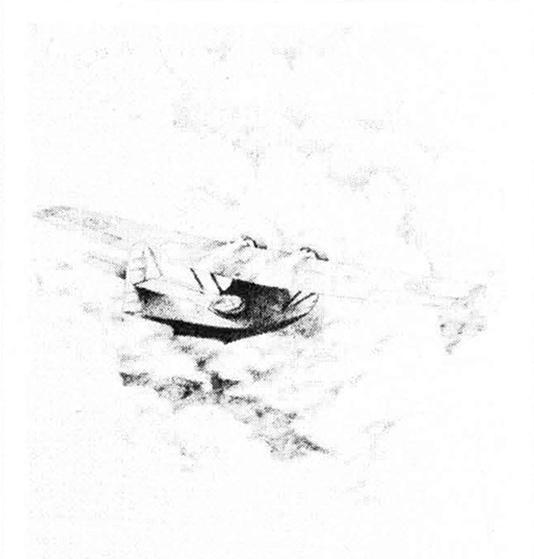
Figure 2 - THE RAF FLYING BOAT.
My hike across the Pullan took place during World War Il when I was attached to an U.S. Army Air Force Unit that maintained a radio beacon for antisubmarine patrol aircraft.
The land south of the Pullan where I was hiking rises to a low plateau before dropping to the River Erne. At the south end of this highland sat the ghostly remains of Magheramena Castle. The rocky masonry of the square keep has broken away now and is piled in heaps on the lush grazingland below. What is now cow pasture was, during World War II, a broad, well-kept lawn that swept to the banks of the river Erne.
During the war, on overcast days the elegant crested lapwings flew in from the west, wheeling and circling below darkening skies. Even through the misty air the black and white of their graceful wings flashed against the sky to signal their landing approach. Like a squadron of Spitfires with lowered gears, they dropped as a single compact group into a corner of the grassy landing strip. About the time the lapwings had settled down to feed on the broad lawn, the distant drone of Royal Air Force Sunderland and Catalina flying boats would fill the still morning air (Figure 2).
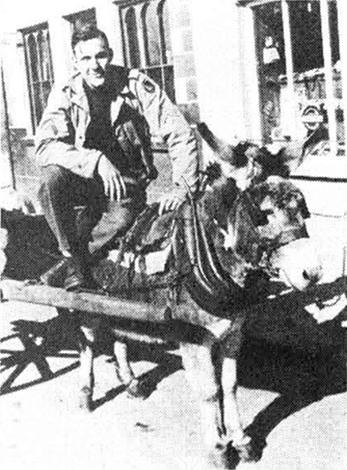
The author and friend, Belleek, 1944.
They broke out in the west below the stormy clouds at dawn, and like lumbering albatrosses followed the river across the 10 miles of land that lie between the Atlantic and the safety of Lough Erne. It was a dangerous 10-mile stretch of land, for most of the aircraft had pushed their fuel to the limits. They were armed for submarine hunting across the North Atlantic. Overloaded with depth charges and bombs, there was no second chance if they missed the calm surface of their sheltered lough. Once in a while one missed, and the bodies of the crew were carried across the Irish Free State border by an honor guard. However, most of them made it back to Lough Erne.
Even today we do not understand how the lapwings can navigate for hundreds of miles back and forth between their feeding grounds, but we know how the Catalinas and Sunderland flying boats did it, for the pilots were tuned to the radio beam of the "Ultra Station" on Magheramena Castle grounds. Ultra Station was not the real name. That's what I call it today after reading The Ultra Secret, F.W. Winterbotham's intriguing book about the brilliant way in which British Intelligence decoded Germany's "Enigma" code. Once they broke the code, the RAF Coastal Command knew where every German submarine was located and could sink them from the air at will. The Ultra Station was really Belleek Radio Range and was maintained by an Air Force group called AACS. The letters stood for the Army Airway Communication System, and AACS operated a worldwide network of our navigational aids.
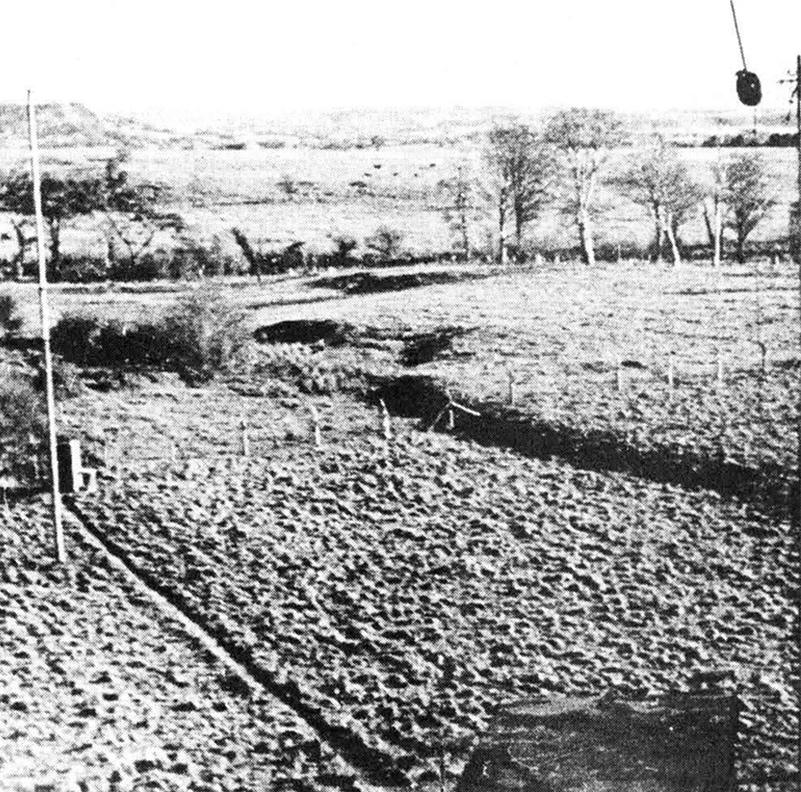
The Belleek radio-range beam antenna in a photo taken by the author while working at the top of one of the antenna poles. To the right (top) are the Margo cliffs, which overlook the south bank of Lower Lough Erne, where the RAF Coastal Command flying boats landed. The installation was very inconspicuous. The low-frequency transmitters were in the flat-roofed building (bottom of photo).
Belleek Radio Range Station was a very low frequency homing beacon. It sent a narrow beam of 330-kilocycle waves out over the North Atlantic and was a part of what Churchill called the "battle of the beams." It was a resonant system based on a fundamental principle of radio wave generation called a "tuned" or resonant circuit. The tuned circuit was invented by the great electrical genius Nikola Tesla in 1889. In 1890, Tesla built a low-frequency station similar to the Belleek Ultra Station and sent a low-frequency radio wave around the world. Technically speaking, the Belleek radio range and moth pheromones (sex scents) have much in common. We may understand these similarities if we look back into the history of World War II.
Radio Warfare
Few persons today realize that during World War II there existed, concealed beneath the surface of the more visible war, a totally separate and secret electronic war. The electronic war was fought in the minds of a few communications wizards on both the German and Allied sides. Late in the war, after radar was perfected, it was fought with high-frequency radar systems designed by the secret groups. Early in the war, however, and, in fact, during major portions of the famous "Battle of Britain," right up to the bombing of Coventry, it was fought with homing beams similar to the one utilized in Belleek, Ireland, by Coastal Command, only at higher frequencies.
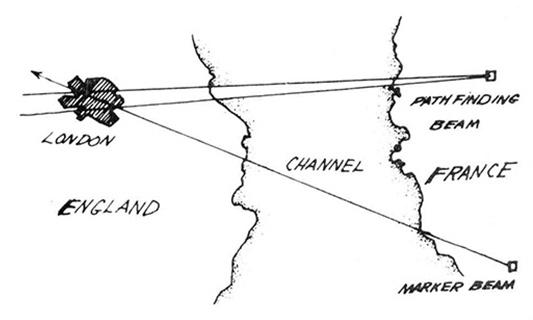
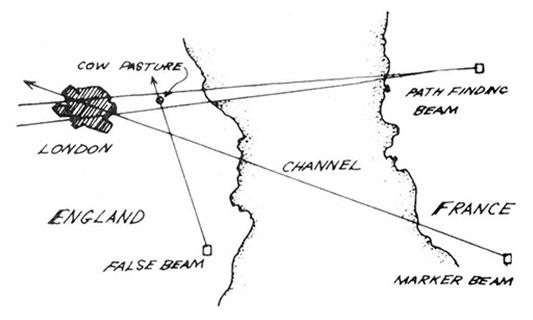
In the early 1940s, the Germans developed electronic systems that emitted 50-megacycle (50 million cycles) narrow radio beams. They directed these beams out over the major cities of England so that the Luftwaffe could fly straight to their targets. The German bombers did not have navigators on their crews as did the American and British bombers. The German pilot would fly the beam until he hit another radio signal that intersected the main "pathfinding" beam (Figure 3). He would then automatically release the bombs. Because the bombing took place at night, and often through overcast skies, the German pilots never actually saw the target. The English countered the German pathfinding beam in the sky in a very ingenious manner. They generated a beam on the same frequency as the second beam but directed it across the pathfinding beam over the wide open country south of London (Figure 4). When the German pilot hit the false marker, he thought he was over London and dropped his bombs. The London blackout was very rigidly enforced so that it took a long time before the Luftwaffe caught on. The English also very obligingly lit fires in the open fields so the Germans would believe they had hit their target. (A very clever people these English!) The fascinating electronic war of World War II is documented by Winston Churchill in Volume 2 of his series on World War II, Their Finest Hour.
Figure 3 - THE BEAM SYSTEM THAT GUIDED THE LUFTWAFFE.
Figure 4 - ENGLAND'S FALSE BEAM SYSTEM.
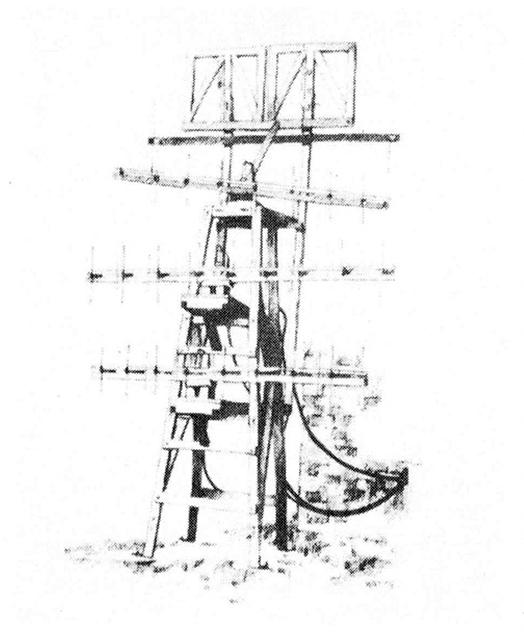
A draw of one of the 50-megacycle antennae used to produce the false beam is shown in Figure 5. Its resemblance to certain moth antennae is obvious to any entomologist! Since the antenna (Figure 5) looks like a moth antenna with sensilla, we should try to understand how the antenna and tuned circuit works. It might be that the moth antenna really is an antenna!
The Tuned Circuit and Antenna
Just as a lens collects light and focuses it on a detector system, an antenna collects and focuses the longer radio waves on a receiver detector. Radio and optics have much in common, including a law called the "reciprocal law." The reciprocal law states that any antenna that makes a good transmitting system (putting out waves) also makes a good receiving antenna (collecting waves); the same goes for a lens.
We will discuss the antenna as a transmitting system, but the same principle holds for all receivers of radio waves.
Figure 5 - RAF FALSE BEAM ANTENNA.
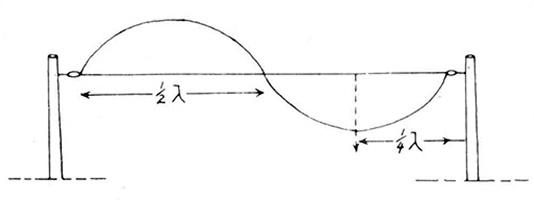
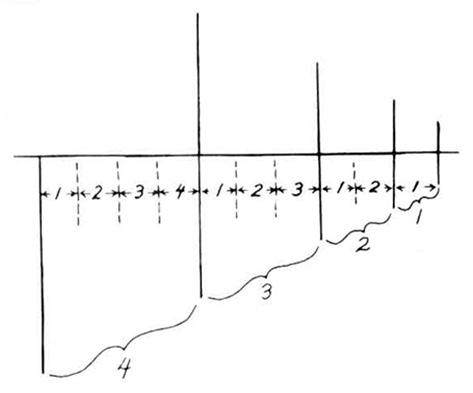
An antenna is cut to equal the same length as the frequency being emitted. Such an antenna is called a full wave antenna. Antennas can also be cut to 1/2 or 1/4 wavelength and still work (Figure 6). Since the Belleek radio range was a low-frequency beam, the Belleek Radio Range station operated at 330 kilocycles, emitting waves 9.09 kilometers long. A 9-kilometer-long wire antenna would be a little awkward; it would stretch from Belleek to Garrison and back again (see Figure 1). A 1/4 antenna would still be 2.27 kilometers long. Since a low-frequency radio range beam required four antennas placed in a square to produce four right-angle beams, that would equal four times the wire of 2.27 kilometers — or 9.09 kilometers of strung antenna.
Figure 6 - EXAMPLE OF A FULL WAVE ANTENNA CUT TO 1/2 and 1/4.
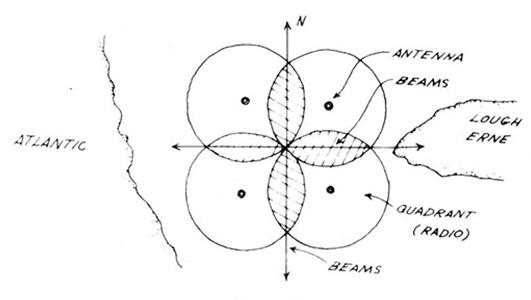
Figure 7 - SCHEMATIC OF RADIO BEAM FORMATION.
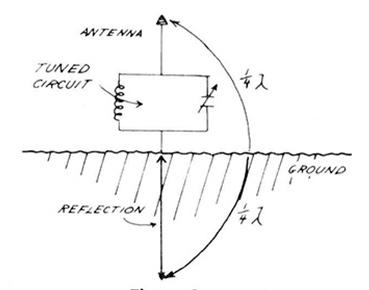
Figure 8 - ANTENNA SYSTEM WITH TESLA TUNED CIRCUIT.
We will not go into the details of forming a radio beam but, simply put, each 1/4 antenna transmits a circular radio wave. Where each radio wave overlaps the other, the 330kilocycle radio beam is formed (Figure 7). Thus, there are four radio legs emitted by such a station. At Belleek, the west leg led out over the Atlantic where the flying boats could intersect and fly the leg straight in. The east leg lay lengthwise along Lough Erne in order to guide the planes to a safe landing on the lough (see map).
To practically construct such a long wavelength system so that one doesn't have to use 9 miles of wire, the antennae are electrically shortened or lengthened by utilizing a Tesla "tuned" circuit in the line that feeds each antenna. The circuit consists of a coil and a condenser in parallel. The bottom part of the coil and condenser is grounded and the top connected to the antenna (Figure 8).
One-fourth of the wire is represented by the antenna and the tuned circuit, and the other 1/4 by radio reflection from the ground, so the whole system represents a 1/2 wavelength antenna system. The ground can be compared to a mirror in the visible in that it reflects the other 1/4 of the half-wave being emitted. The tuned circuit can be likened to your fingers on a violin string, and the antenna to the instrument's resonant sound box. When resonance is reached, by adjusting the condenser, the radio waves oscillate back and forth in the circuit similar to sound waves in a resonant box. The tuned circuit in effect electrically lengthens or shortens the wire antenna depending on frequency, the same way as your fingers do the vibrating violin string.
You reach resonance on the violin by shortening or lengthening the particular vibrating string with the fingers. At the right resonance points, all the sound waves go out in "tune." The same is true of the electrical resonant circuit. When the condenser is set right, all the radio waves go out together at 330 kilocycles from the Belleek Station.
On the violin, the vibrating string is the oscillator, the fingers the tuned circuit, and the wooden box the antenna for "focusing" the sound. In the radio circuit we must still have an oscillator (vibrator) before the system is complete. The vibrating electric oscillator is connected to the tuned circuit of the antenna by a second tuned circuit.
The Crystal Oscillator
Instead of a cat gut string, which vibrates to emit sound waves, the Belleek station had a quartz crystal oscillator (vibrator). Such a crystal is known as a piezoelectric substance. When the crystal is placed between two plates with an electric voltage across the plates, it is electrically stimulated to oscillate and emit radio waves. In other words, a piezoelectric crystal converts mechanical vibrations into electromagnetic vibrations. The frequency of vibrations depends on the temperature and the thickness of the crystal. The 330-kilocycle crystal is cut to a definite thickness just as the violin string is cut to a definite length.
If the temperature of the quartz crystal is kept constant, so that it does not expand or contract, then it keeps vibrating at the fixed 330-kilocycle frequency and the 9.09-kilometer-long waves are constantly emitted from the tuned wire antenna of the radio range station. Such a transmitter, in its basic form, consists of the antenna and tuned circuit coupled to the oscillator by a second tuned circuit. There is a vacuum tube to control the system. When the condenser in the antenna tuned circuit is adjusted right for 330 kilocycles, the antenna is electrically 9.09 kilometers long and all the waves go out from the antenna current, which is now oscillating along the length of the wires strung from telephone poles. In this manner, the small quartz crystal sends its message hundreds of miles out to sea and across the surface of the lake. The low-frequency beam guides the pilots of RAF Coastal Command safely home.
History records the Battle of Britain as being won by radar. During most of the battle, radar was not even perfected to the point of reliability. Winston Churchill called the real battle the "Battle of the Beams." Churchill ought to know, for he stated the following in Their Finest Hour (p. 338):
Of course, there would in any case have been much inaccuracy, but the whole German system of bombing was so much disturbed by our counter-measure, added to the normal percentage of error, that not more than one-fifth of their bombs fell within the target areas. We must regard this as the equivalent of a considerable victory, because the fifth part of the German bombing, which we got, was quite enough for our comfort and occupation.
Regarding the U-boat menace, he states (p. 608):
At the same time, however, we gave orders to the RAF Coastal Command to dominate the outlets from the Mersey and Clyde and around Northern Ireland. Nothing must be spared from this task. It had supreme priority. The bombing of Germany took second place. All suitable machines, pilots, and material must be concentrated upon our counter-offensive, by fighters against the enemy bombers, and surface craft assisted by bombers against the U-boats in these narrow vital waters [emphasis added].
It was not radar that saved Britain from bombers over its cities or from U-boats cutting it off from its American allies. Instead, Britain, as history truly records from the mouth of Winston Churchill, was saved by the Battle of the Beams!
Magheramena Castle "Ultra Station" was such an important part of that battle of the beams that after the war the Belleek transmitter was mentioned by Churchill himself. The irrefutable fact is that he considered the U-boat war of the North Atlantic far more important than the bombing war.
Tap Dancing on Molecules
The "battle of the beams" is important for another reason. It is a quirk of fate (or God) that the very same battle led me to a concept that I today call "tap dancing on molecules"!
The battle of the beams has been over for 40 years, but in a very true sense I am still in a battle of beams. My battle today does not involve German subs and RAF flying boats, nor does it depend on low-frequency radio beams. It is an agricultural battle of the beams and it is directed at an adversary whose ability to outwit man is far more subtle and elegant than that of our German adversaries in World War II. For the last 20 years I have been busy decoding the "Enigma" code and navigation beam from insects that fly to and attack man and his crops. Today it is an entomological battle of the beams. To understand what I am talking about, we need to understand one more important concept of electromagnetic radiation, the concept of modulation.
The Belleek Ultra Station sent its beam of electromagnetic energy out over the Atlantic as pure radio frequency, or RF as it is called in communications jargon. Such a wave is known as a carrier wave and can be tuned to by a tuned circuit and antenna. It is useless of itself, however, for it carries no information. It tells the Catalina pilot nothing. In order for him to get information he must be able to see or hear the beam. It must be translated into a system that his biological sensors can detect. It is translated by the process of modulation.
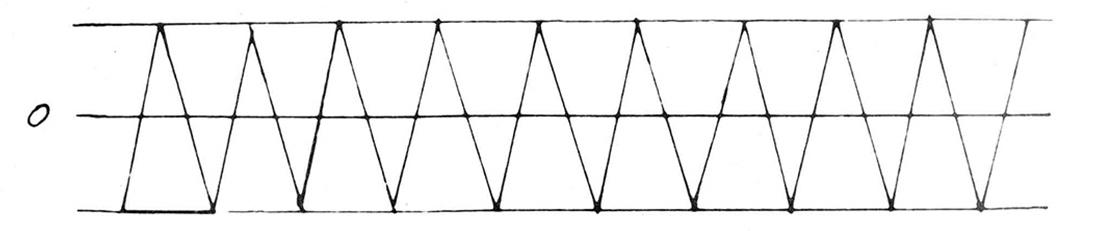
Figure 9 - NMODULATED CARRIER WAVE.
Figure 10 - LOW-FREQUENCY AUDIO WAVE.
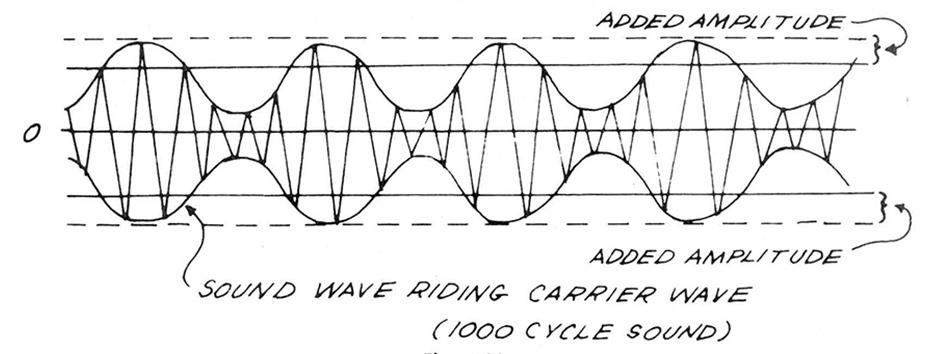
Figure 11 - SOUND WAVE RIDING THE CARRIER WAVE.
For the pilot to hear the radio-range beam from Belleek, we must superimpose a sound wave on the pure carrier wave. Put simply, we must vibrate the carrier wave with another vibrating wave of sound. The sound wave will ride the radio carrier wave — piggyback so to speak. In radio broadcasts this is accomplished by a microphone connected to vacuum tubes, or transistors that cut on and off with vibrations of the diaphragm in the microphone. The pressure waves in the air from the voice cause the diaphragm to vibrate according to the strength, called amplitude of the voice pressure wave. If the vibration is strong, then the amplitude of the signal on the grid of the vacuum tube goes up high and is added to the carrier wave emitted from the antenna. If the sound is weak, then the amplitude drops accordingly. The unmodulated carrier wave is a straight electromagnetic vibrating wave (Figure 9). The sound is a low-frequency pressure wave (Figure 10). When the two are added on the grid of a vacuum tube, it looks like the drawing in Figure 11. We see then that the pressure wave from the sound has been converted to a strong or weak (+ or -) electrical signal on the grid of the vacuum tube, or inside the transistor. The audio wave adds to, or subtracts from, the carrier wave. Thus, the audio wave not only adds an audio signal to the transmitter system, but also amplifies the electromagnetic wave.
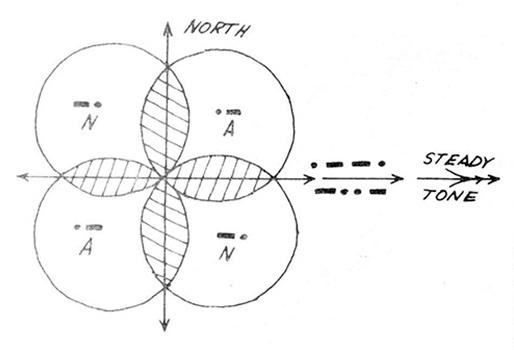
In order for the pilot to hear the Belleek radio range, we modulated each of the four towers with a 1,000-cycle audio tone. Two of the opposite towers sent out an A (. -), and the other two opposite ones transmitted an N (- .) Morse code tone signal (Figure 12).
Figure 12 - BELLEEK'S MODULATED RADIO RANGE.
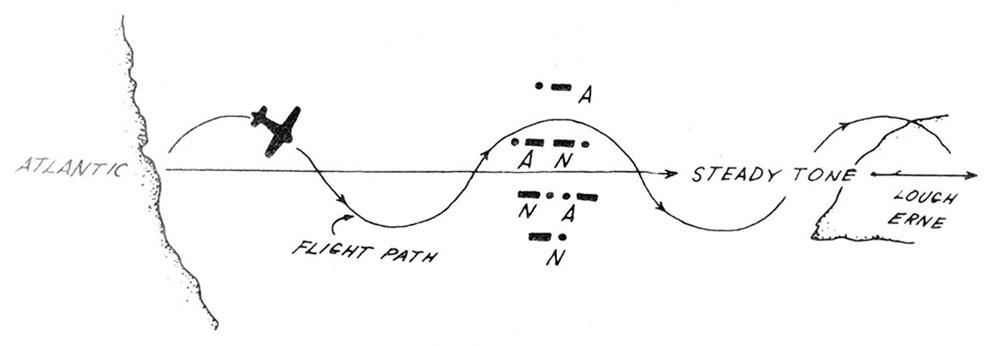
Since each tower sent out a circular pattern, the pilot heard an N (- .) if he were in one quadrant and an A (. -) if he were in another. He would turn at an angle until, as he approached the area where the two patterns overlapped, the A and N would begin to blend together into a steady tone in his headset. He then turned and flew along the steady tone beam to Lough Erne. If the pilot drifted to an A or N quadrant, he would turn back into the steady tone; thus, his flight course was a gentle undulating pattern (Figure 13).
Figure 13 - THE FLIGHT COURSE TO LOUGH ERNE.
The entire system then depended on four fundamentals of electromagnetic navigation:
a stable electromagnetic carrier wave being transmitted;
an audio modulation system;
a resonant circuit and antenna to collect or focus on the carrier wave;
tracking in and out of the system to fly it.
The German bombing beam operated in exactly the same way, except that the two overlapping patterns were 50 megacycles instead of 330 kilocycles. Keep these four requirements of a good navigation system in mind as I explain why I call my work "tap dancing" on molecules.
The Molecular ‘Radio Range'
After the war, I left the Army Air Force and took a job as civilian chief of maintenance for navigational aids in the Far Pacific Air Force in Japan. I was responsible there for installing and maintaining 16 or more such systems scattered around Japan and the Far Pacific. American aircraft flew the system until it was replaced by more modern systems years later. I spent literally hundreds of hours in the air flying in and out of such beams to check their courses and keep them in tune. I was a biologist at heart, however, so after a few years I left to return to college, where I trained as a field biologist in ornithology and entomology.
Figure 14 - SCHEMATIC OF THE CORN EARWORM MOTH ANTENNA.
Forty years of watching moths fly to lights and candles, and watching the gyrations the male executed in finding his mate (Callahan 1957; 1958), convinced me that insects fly a molecular beam of scent in exactly the same way that I flew the radio range beam when I was installing them.
I spent hundreds of nights in the field and lab watching the corn earworm moth, Heliothis zea (Boddie), fly to its mate using the same tracking system as an aircraft. I also knew that visible light had to be very important to the system, so I wrote my PhD thesis on the effect of light on the mating and egg-laying of the corn earworm moth.
There was another even more important indication that insect scent (olfaction) had to operate as an electromagnetic system, and that is the shape of the moth antenna. As pointed out above, the moth antennae resembled in every way the shape of the antennae used by the RAF to fool the Luftwaffe (Figure 5). The moth antenna, in fact, looks very much like a TV antenna — long bars (spines) at the base for long waves, and short bars (spines) at the tip for shorter waves.
By the time I finished the morphology of the corn earworm moth antenna, I realized it was designed to operate as what today is called a log-periodic antenna. Without discussing the mathematics of logarithmic spacings, essentially the bars or spines get closer and closer together from the base to the tip (Figure 14).
The shape indicated that any plant or sex scent that blows through the air must emit electromagnetic wavelengths and that the length and diameter of the spines could tell me where the wavelengths lay in the electromagnetic spectrum. A few simple mathematical calculations told me that I should be exploring the infrared spectrum.
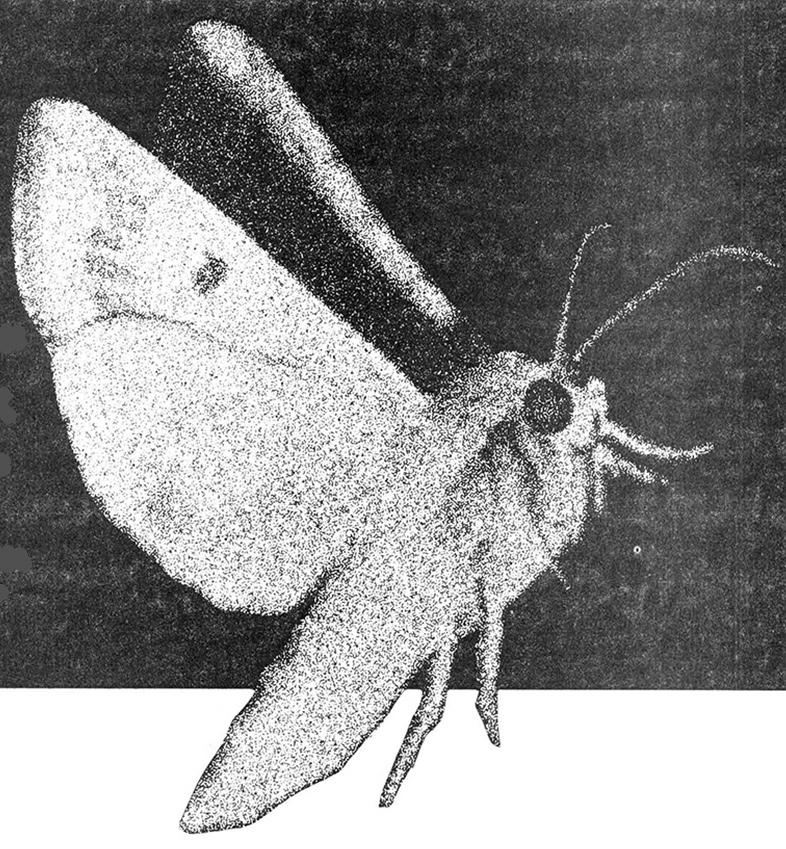
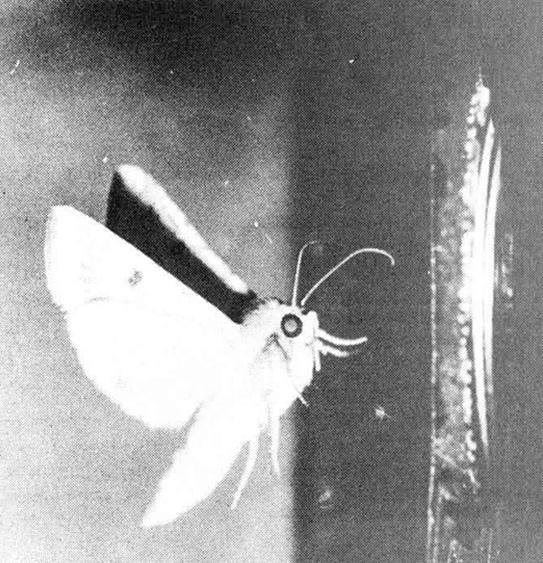
The corn earworm moth, Heliothis zea, flying to a window lit with low-intensity blue light. The low intensity blue "pumps" the corn scent in the chamber causing it to emit coherent (maser-like) lines just in front of the window. The insect is not going to the light because of its eyes, as is commonly believed, but to the pumped infrared lines in the airspace in front of the light. These infrared lines are detected by the insect's log periodic antenna spines, called sensilla.
Because the spines on the moth antenna average between 8 and 80 microns long, I knew the wavelength would lie in that region. Remember, the antenna must match or be a multiple of the length of the wave to be transmitted or collected by the antenna. In the case of the corn earworm and cabbage looper moths, the wavelength fit was perfect for the 15-micron to 30-micron region of the infrared spectrum. From my experience working with the low-frequency radio-range system, I had another excellent clue as to how an insect sex scent might work as it drifted like a plume of smoke through the air.
An oscillator, whether it be a small molecule or a large crystal, can be stimulated to give off electromagnetic waves. In the case of the molecule, and the short visible and infrared waves, high-energy radiation from the short end of the spectrum "pumps" the system by raising (absorbing) the electrons of the molecule to a higher energy level. As they drop back down, they emit wavelengths in a longer wave portion of the spectrum. We call this phenomenon fluorescence or in the case of molecules colliding with a surface, scattering. In the case of radio, the crystal in the oscillator is stimulated by electricity (voltage across the plates) to emit radio waves.
At Belleek we had to constantly check the temperature of the crystal oscillator. The temperature of the crystal is controlled very closely because the frequency of emission shifts with temperature. If the crystal heated up, it expanded, and because wavelength depends on thickness, the frequency would shift higher or lower depending on the cut (shape) of the crystal. The change in an X- or Y- cut crystal, as they are known to radio engineers, is not a straight line but jumps around. In other words, it is nonlinear, just as in the case of oscillating molecules in a laser system. I reasoned that if a quartz crystal oscillator can change in frequency according to its temperature, then surely the same holds for a molecular oscillator.
Later on, work by laser scientists told me that I was right and that any nonlinear, narrow-band wavelength from a scent molecule should shift both with the concentration of the molecular oscillator in the air and with the air temperature. Since organic dye lasers emit longer waves at higher concentrations and higher temperatures, so also should the free-floating emitting molecule.
We have now come full circle back to my own "hour of the wolf" on the Pullan in Ireland. Consider the following in the light of what I have presented about good communications systems:
The blue and near-ultraviolet light floods the night sky, and the moths that see with their eyes in that ultra violet-visible region fly out into the night light.
The females release an organic sex scent, called a pheromone by entomologists, into the night air.
At the female body, the scent is at high concentration and warm, and at a distance it is at lower concentration and cooler, depending on how far it is blown by a gentle breeze.
The scent is radiated by the ultraviolet and blue sky as it is pumped to a high energy level.
The sex scent (pheromone) drifts through the water molecules in the air and they knock against one another; thus the system is modulated by air pressure movement in the same manner as voice pressure waves knock against a microphone diaphragm. This is called gasdynamic modulation by laser physicists. As the scent flows, it collides with the insect antenna and scatter out coherent Cabannes infrared wavelengths to which the spines resonate.
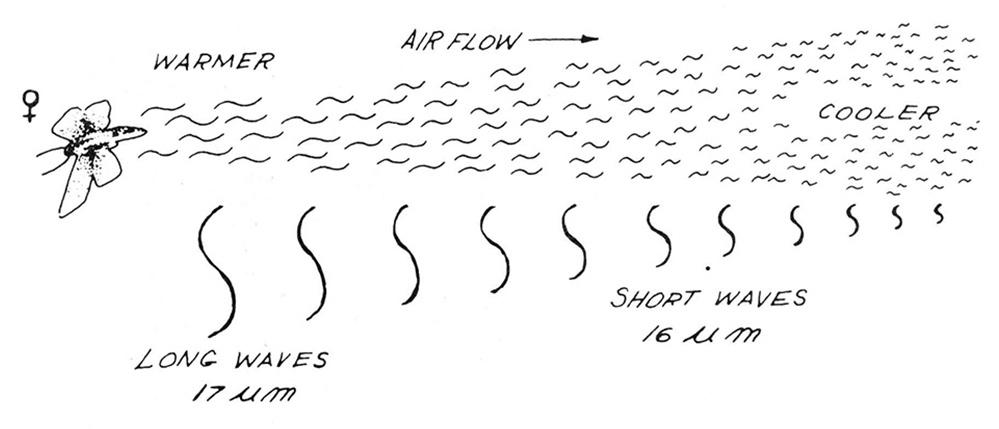
As sex scent (pheromones) float through the air, each one is primed like a free-floating maser (a maser is a microwave laser), but is also cooling (thermodynamically) according to distance and concentration (Figure 15).
At a distance from the female the sex scent is cooler and less concentrated, so shorter wavelengths are emitted. Close by, at the tip of the female abdomen where the sex gland is located, longer wavelengths are emitted.
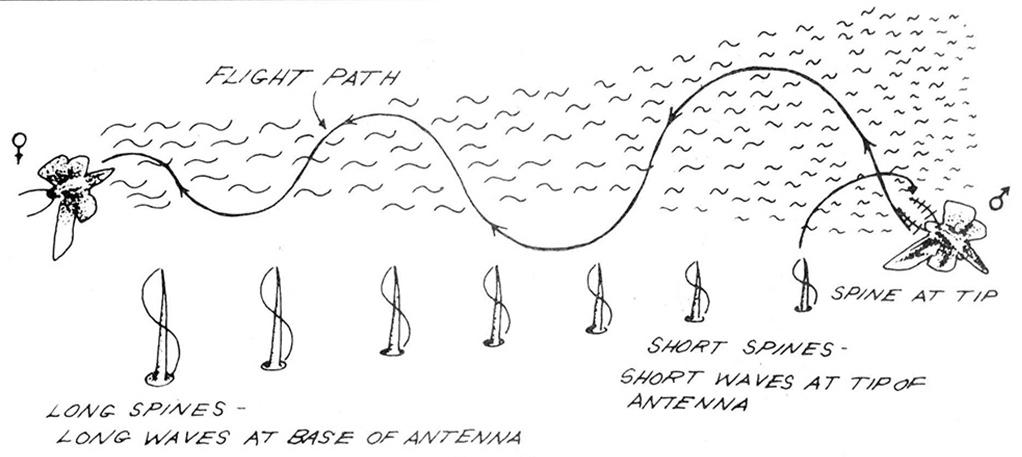
The male flies into the scent and the molecules flow past and collide with the short spines on his antenna, which are the proper length to resonate to the short wavelengths. If he strays too far from the floating infrared scent, the system cuts off because the concentration of sex molecules in the water vapor of the air is too dilute. He turns back into the plume of the sex scent. As he gets closer and frequencies shift to longer waves, the longer spines take over (Figure 16).
The male flying the sex scent has an additional powerful means of modulating the free-floating infrared scent besides the gasdynamic principle. He vibrates his own antenna at audio frequencies. All insects vibrate when they fly, and different species vibrate at different frequencies.
The reader can appreciate by now that the only difference between the RAF flying the Belleek radio range beam and a moth flying a sex scent beam is that the radio beam is emitted from one point — the radio station — whereas the molecular beam is formed by millions of little free-floating oscillators (radio stations) whose wavelength and frequency depend on concentration and the temperature in the night air. The beauty of this God-made infrared "radio range" is that it not only tells the male moth direction, but also, depending on temperature and concentration, distance from the female. It is an elegant navigation system that contains both direction and distance information and is modulated by the vibrating flying insect and also the night breeze.
Of course, the system is not limited to sex scents alone; the same system will work to lead a cabbage looper moth to the scent from a cabbage field, or a corn earworm moth to a corn field, and even a house fly to the scent from a rotting carcass.
Figure 15 - SCHEMATIC OF PHEROMONE WAVE EMISSION.
The Proof of the Pudding
How would one prove that the cabbage looper pheromone emits infrared radiation of the proper resonant frequencies and that such emitted frequencies shift with temperature and concentration?
For many years I could not prove it, for we did not have any instruments with high enough resolution to "see" these narrow maser radiations from scent molecules. In 1969, however, an instrument called a Fourier Transform Spectrometer was invented. When I tuned to the cabbage looper sex scent with this instrument, I found the nonlinear maser emissions exactly where I predicted. Furthermore, they shifted with concentration and temperature just as I predicted (Callahan 1967, 1969, 1975, 1977 abc; Callahan and Hamilton 1977).
I have since experimented with many different insect attractants, and in every case I have found nonlinear maser radiation that matches the insects' antenna spines. Fire ants, for instance, follow their trail by vibrating their antenna and modulating the chemical trail at 15 cycles per second. They also tap the thin layers of molecules on each other's bodies and cause these "body identification" molecules to emit maser radiation. Because these antenna vibrations and tappings modulate small concentrations of identification molecules, whether in the air or as thin layers on plants or other insects' bodies, I call such insect modulation techniques "tap dancing on molecules."
If you do not believe that insects tap dance on molecules, then the next time you are in a fruit market watch closely a little fruit fly walking over the plums and strawberries. His feet have spines or antennae on them and every once and a while the fly will stop and drum them against the skin of the fruit. House flies are constantly vibrating their antennae and feet, and if we listen closely, we can hear the hum from almost any vibrating flying insect. Insects are vibratory creatures and entomologists must measure the frequency of these vibrations in studying insect attractants!
The implications of this system are revolutionary for control of those unwelcome insects that feast on our agricultural crops as though man had set a vast table for their dinner. We can electronically duplicate the frequency to which the insect is attracted, thereby bringing them to a central spot where they then can be killed. Or, we can come up with a beat frequency, a jamming frequency, that would mask the insect attractant of the crop, keeping the insects away from the crops and sending them back to feed on the weeds from which they evolved.
The advantage of this elegant and useful system is that unlike pesticides, these frequencies can be switched on and off. If a particular frequency were to resonate to something that could cause damage — which is highly unlikely, since these are weak infrared frequencies — it could be switched on only at night or according to need. What more useful way to revitalize the Silicon Valley computer recession than giving the industry the task of devising the small diode lasers required to emit the frequencies that will prevent insect and pest damage.
From what I have written about insects, the reader may understand that I am the first person in the world to decode the insect molecular communication system. I did it by exploring the spectrum, and it all began in World War II with the battle of the beams.
Philip S. Callahan is an entomologist at the Insect Attractants, Behavior, and Basic Biology Research Laboratory of the U.S. Department of Agriculture, Gainesville, Fla. In addition to his many technical articles, he has written several popular books, including Tuning in to Nature.
References
Callahan, P.S. 1958a. "Serial Morphology As a Technique for Determination of Reproductive Patterns in the Corn Earworm, Heliothis zea (Boddie)." Annals of the Entomology Society of America51: 413-28.
_____1958b. "Behavior of the Imago of the Corn Earworm, Heliothis zea (Boddie), with Special Reference to Emergence and Reproduction." Annals of the Entomology Society of America51: 271-83.
_____1967. "Insect Molecular Bioelectronics: A Theoretical and Experimental Study of Insect Sensilla As Tubular Waveguides, with Particular Emphasis on Their Dielectric and Thermoelectric Properties." Miscellaneous Publications of the Entomology Society of America 5 (7): 315-47.
_____1969. "The Exoskeleton of the Corn Earworm Moth, Heliothis zea, Lepidoptera: Noctuidae, with Special Reference to the Sensilla As Polytubular Dielectric Arrays." University of Georgia Agricultural Experimental Station Research Bulletin 54: 5-105.
_____1975. "The Insect Antenna As a Dielectric Array for the Detection of Infrared Radiation from Molecules." International Conference on Biomedical Transducers 1: 133-38.
_____1977a. "Solid State (Pheromone-Beeswax) Far Infrared Maser." Applied Optics 16: 1557-61.
_____1977b. "Moth and Candle: The Candle Flame As a Sexual Mimic of the Coded Infrared Wavelengths from a Moth Sex Scent (Pheromone)." Applied Optics16: 3089-97.
_____1977c. "Tapping Modulation of the Far Infrared (17 um region) Emission from the Cabbage Looper Pheromone (Sex Scent). Applied Optics16: 3098-3102.
Callahan, P.S. and Eugene Hamilton. 1977. "Pumping Frequency for the 17 μm IR Emission from Cabbage Looper Moth Sex Scent (Pheromone). Applied Optics16: 1476-77.
Fabre, J.H. 1913. "The Great Peacock Moth." In The Insect World of J. Henry Fabre, ed. E. W. Teale (1964).
Ford, E.B. 1947. Moths (London: Collins).
Figure 16 - SCHEMATIC OF MALE INSECT ‘RADIO RANGE'.
Downloads
Downloads for this article are available to members. Log in or join today to access all content.
Downloads
Downloads for this article are available to members. Log in or join today to access all content.