Nikola Tesla Articles
Mr. Tesla Before The New York Academy of Sciences
On April 6, Mr. Nikola Tesla delivered before the New York Academy of Sciences an address "On the Streams of Lenard and Röntgen, with Novel Apparatus for Their Production." The lecturer began by stating that in 1894, in experimenting to determine the actinic action of phosphorescent light emanating from vacuum tubes, he had found that the actinic power of Crookes tubes varied greatly, and in the most anomalous manner. Thus some tubes emitting a strong light had very little action on photographic plates, while some showing a feeble light acted very strongly on such plates. A large number of these plates, made by Tonnele for the Century Magazine, were stored in Mr. Tesla's laboratory when it was destroyed by fire, and thus he was unable now to examine them for the Röntgen effects. He believed that he had just missed the discovery which made Röntgen famous and though he was thoroughly familiar with Lenard's work, he did not see far enough.
Mr. Tesla then reviewed his work in the direction of obtaining a reliable apparatus for generating high frequency currents, which he recognized as the keynote to the production of vacuum tube lighting. He told how he had met with difficulties at every point; how a small bubble of air would destroy the value of the coil, or how one-quarter of an inch of wire too much or too little would throw a coil out of balance; how one day a coil would run cold and on another day hot, etc. By finally calling to his aid the condenser, Mr. Tesla stated, he had succeeded in obtaining the desired action and now nothing stood in the way of securing millions of vibrations from ordinary circuits. The lecturer then briefly explained the principle of the condenser discharge as applied to high frequency currents, and pointed to various types of apparatus on the lecture table designed to utilize the principle.
In order to demonstrate the action of the high frequency currents Mr. Tesla attached a circular loop of heavy copper wire to the terminals of a high frequency generator and brought to brilliant incandescence a small lamp connected diametrically across the heavy loop; the illumination of the lamp could be varied by connecting it to various points on the diameter of the loop. Mr. Tesla also lit the lamp by the current induced in a second loop brought in proximity to the first. He explained that the coil accomplishing this work had a resistance of 600 ohms and an inductance of 6 henrys; the coil was connected to the circuit one-half the time and took from the primary circuit only 5 watts.
Mr. Tesla next showed a vacuum tube lit from the terminals of another high frequency machine. He also showed a coil consisting of a single turn of heavy wire which formed the core, as it were, of a small coil of a few turns wound on a paper cylinder surrounding the heavy wire. When connected to a high frequency generator, this apparatus gave a 4-inch spark with an expenditure of energy equal to that taken by one lamp. Mr. Tesla stated that his high frequency generators were so constructed that they could be connected to any existing circuits, direct or alternating.
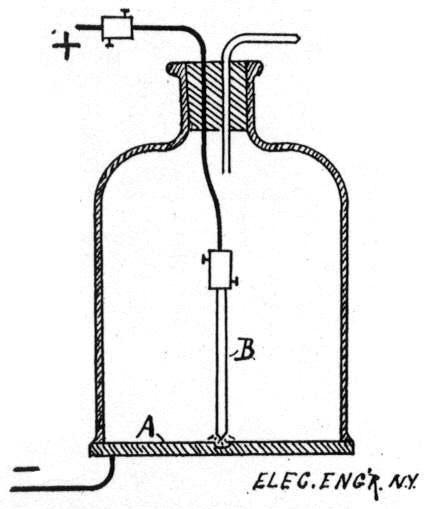
Returning to the Röntgen rays, the lecturer stated that he had succeeded in discovering a new source of these rays, far more powerful than any heretofore available, though the difficulty of maintaining it was very great. This new source is the electric arc; not the ordinary arc, however. The arc required for the purpose is that maintained between a platinum terminal and an aluminum plate, as illustrated in the accompanying diagram, where A represents the aluminum plate and B the platinum, enclosed in a glass jar.
Mr. Tesla stated that he had also succeeded in deflecting the Röntgen rays by a magnet. He had proved this by deflecting the rays into a condenser placed a long distance from the source of the rays, and which in 5 seconds was charged sufficiently to throw a galvanometer needle off the scale.