Nikola Tesla Articles
Mr. Tesla's Science
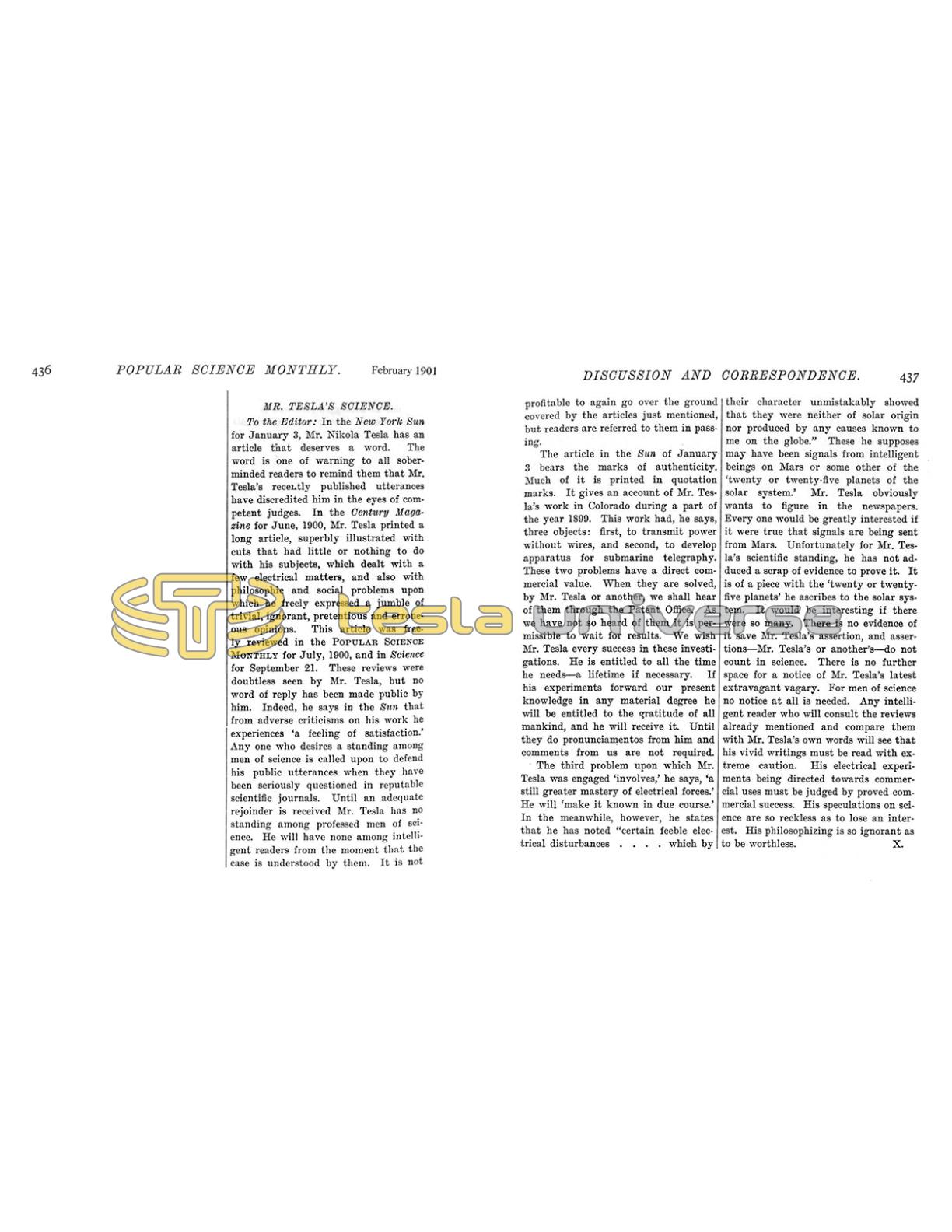
To the Editor: In the New York Sun for January 3, Mr. Nikola Tesla has an article that deserves a word. The word is one of warning to all sober-minded readers to remind them that Mr. Tesla's recently published utterances have discredited him in the eyes of competent judges. In the Century Magazine for June, 1900, Mr. Tesla printed a long article, superbly illustrated with cuts that had little or nothing to do with his subjects, which dealt with a few electrical matters, and also with philosophic and social problems upon which he freely expressed a jumble of trivial, ignorant, pretentious and erroneous opinions. This article was freely reviewed in the Popular Science Monthly for July, 1900, and in Science for September 21. These reviews were doubtless seen by Mr. Tesla, but no word of reply has been made public by him. Indeed, he says in the Sun that from adverse criticisms on his work he experiences 'a feeling of satisfaction.' Any one who desires a standing among men of science is called upon to defend his public utterances when they have been seriously questioned in reputable scientific journals. Until an adequate rejoinder is received Mr. Tesla has no standing among professed men of science. He will have none among intelligent readers from the moment that the case is understood by them. It is not profitable to again go over the ground covered by the articles just mentioned, but readers are referred to them in passing.
The article in the Sun of January 3 bears the marks of authenticity. Much of it is printed in quotation marks. It gives an account of Mr. Tesla's work in Colorado during a part of the year 1899. This work had, he says, three objects: first, to transmit power without wires, and second, to develop apparatus for submarine telegraphy. These two problems have a direct commercial value. When they are solved, by Mr. Tesla or another, we shall hear of them through the Patent Office. As we have not so heard of them it is permissible to wait for results. We wish Mr. Tesla every success in these investigations. He is entitled to all the time he needs — a lifetime if necessary. If his experiments forward our present knowledge in any material degree he will be entitled to the gratitude of all mankind, and he will receive it. Until they do pronunciamentos from him and comments from us are not required.
The third problem upon which Mr. Tesla was engaged 'involves,' he says, 'a still greater mastery of electrical forces." He will 'make it known in due course.' In the meanwhile, however, he states that he has noted "certain feeble electrical disturbances .... which by their character unmistakably showed that they were neither of solar origin nor produced by any causes known to me on the globe." These he supposes may have been signals from intelligent beings on Mars or some other of the 'twenty or twenty-five planets of the solar system. Mr. Tesla obviously wants to figure in the newspapers. Every one would be greatly interested if it were true that signals are being sent from Mars. Unfortunately for Mr. Tesla's scientific standing, he has not adduced a scrap of evidence to prove it. It is of a piece with the 'twenty or twenty-five planets' he ascribes to the solar system. It would be interesting if there were so many. There is no evidence of it save Mr. Tesla's assertion, and assertions — Mr. Tesla's or another's — do not count in science. There is no further space for a notice of Mr. Tesla's latest extravagant vagary. For men of science no notice at all is needed. Any intelligent reader who will consult the reviews already mentioned and compare them with Mr. Tesla's own words will see that his vivid writings must be read with extreme caution. His electrical experiments being directed towards commercial uses must be judged by proved commercial success. His speculations on science are so reckless as to lose an interest. His philosophizing is so ignorant as to be worthless.