Nikola Tesla Articles
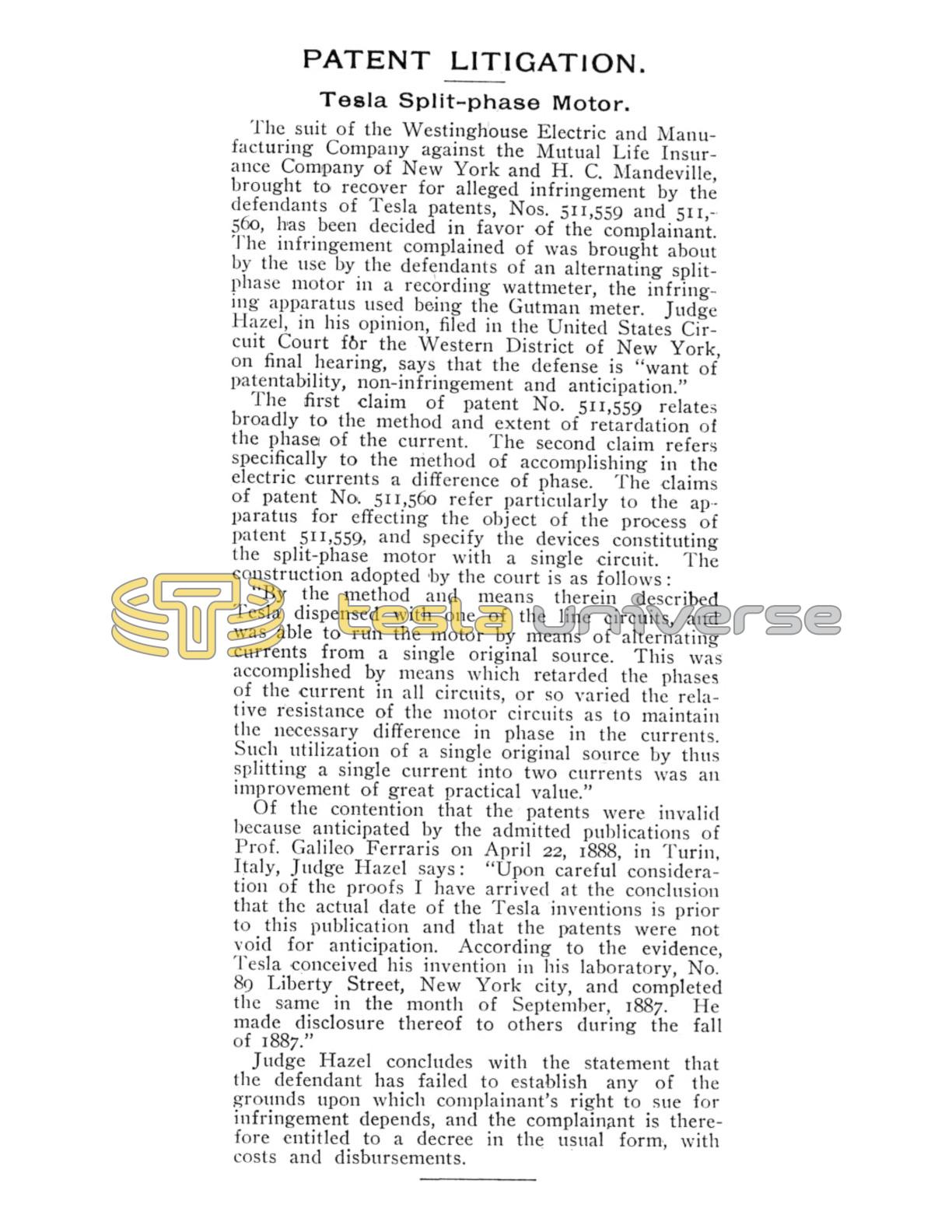
Patent Litigation - Tesla Split-phase Motor
The suit of the Westinghouse Electric and Manufacturing Company against the Mutual Life Insurance Company of New York and H. C. Mandeville, brought to recover for alleged infringement by the defendants of Tesla patents, Nos. 511,559 and 511,560, has been decided in favor of the complainant. The infringement complained of was brought about by the use by the defendants of an alternating split-phase motor in a recording wattmeter, the infringing apparatus used being the Gutman meter. Judge Hazel, in his opinion, filed in the United States Circuit Court for the Western District of New York, on final hearing, says that the defense is "want of patentability, non-infringement and anticipation."
The first claim of patent No. 511,559 relates broadly to the method and extent of retardation of the phase of the current. The second claim refers specifically to the method of accomplishing in the electric currents a difference of phase. The claims of patent No. 511,560 refer particularly to the apparatus for effecting the object of the process of patent 511,559, and specify the devices constituting the split-phase motor with a single circuit. The construction adopted by the court is as follows:
"By the method and means therein described Tesla dispensed with one of the line circuits, and was able to run the motor by means of alternating currents from a single original source. This was accomplished by means which retarded the phases of the current in all circuits, or so varied the relative resistance of the motor circuits as to maintain the necessary difference in phase in the currents. Such utilization of a single original source by thus splitting a single current into two currents was an improvement of great practical value."
Of the contention that the patents were invalid because anticipated by the admitted publications of Prof. Galileo Ferraris on April 22, 1888, in Turin, Italy, Judge Hazel says: "Upon careful consideration of the proofs I have arrived at the conclusion that the actual date of the Tesla inventions is prior to this publication and that the patents were not void for anticipation. According to the evidence, Tesla conceived his invention in his laboratory, No. 89 Liberty Street, New York city, and completed the same in the month of September, 1887. He made disclosure thereof to others during the fall of 1887."
Judge Hazel concludes with the statement that the defendant has failed to establish any of the grounds upon which complainant's right to sue for infringement depends, and the complainant is therefore entitled to a decree in the usual form, with costs and disbursements.