Nikola Tesla Articles
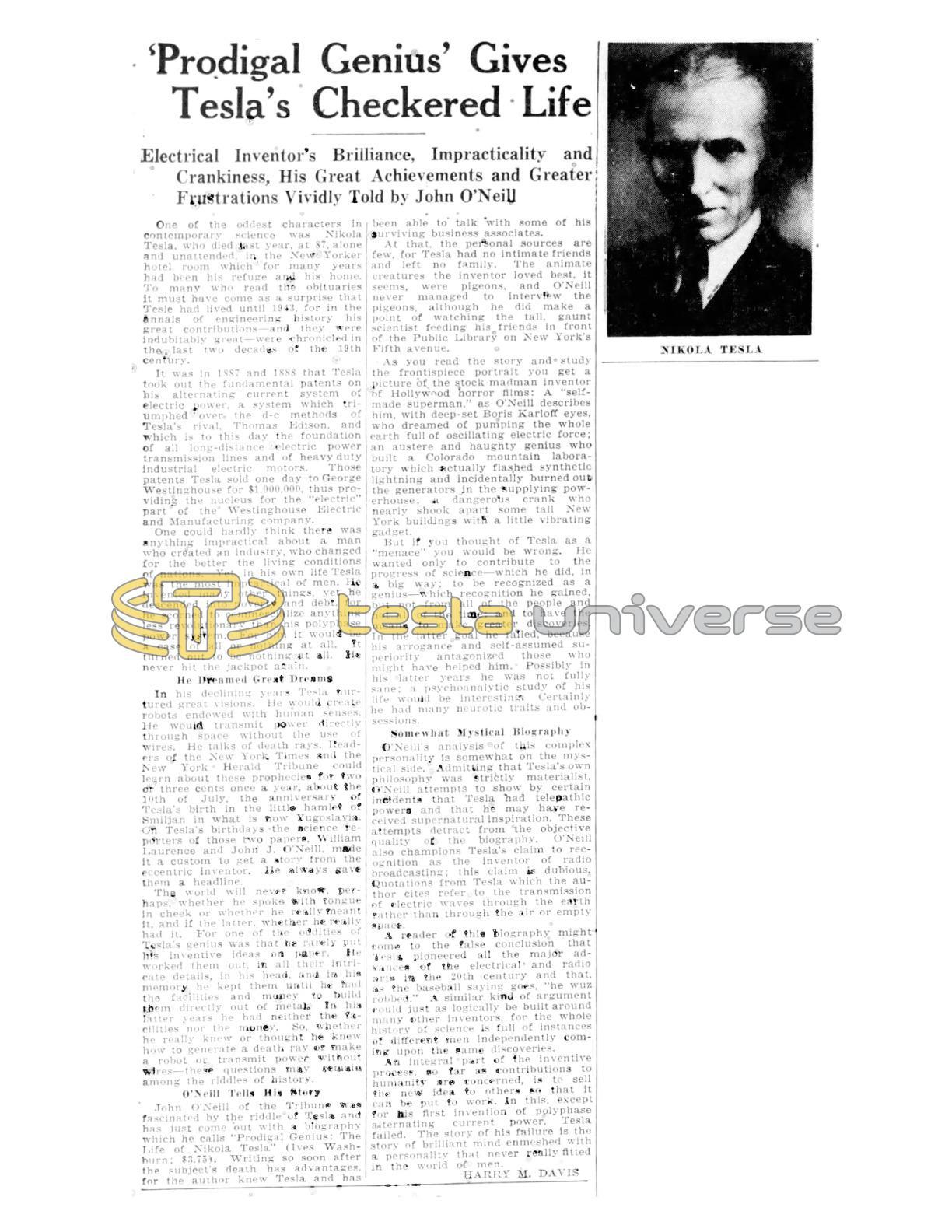
"Prodigal Genius" Gives Tesla's Checkered Life
Electrical Inventor's Brilliance, Impracticality and Crankiness, His Great Achievements and Greater Frustrations Vividly Told by John O'Neill
One of the oddest characters in contemporary science was Nikola Tesla, who died last year, at 87, alone and unattended, in the New Yorker hotel room which for many years had been his refuge and his home. To many who read the obituaries it must have come as a surprise that Tesla had lived until 1943, for in the Annals of engineering history his great contributions — and they were indubitably great — were chronicled in the last two decades of the 19th century.
It was in 1887 and 1888 that Tesla took out the fundamental patents on his alternating current system of electric power, a system which triumphed over the d-c methods of Tesla's rival, Thomas Edison, and which is to this day the foundation of all long-distance electric power transmission lines and of heavy duty industrial electric motors. Those patents Tesla sold one day to George Westinghouse for $1,000,000, thus providing the nucleus for the "electric" part of the Westinghouse Electric and Manufacturing company.
One could hardly think there was anything impractical about a man who created an industry, who changed for the better the living conditions of nations. Yet, in his own life Tesla was the most impractical of men. He invented many other things, yet he descended into poverty and debt, for he scorned to commercialize anything less revolutionary than his polyphase power system. For him it would be a case of all or nothing at all. It turned out to be nothing at all. He never hit the jackpot again.
He Dreamed Great Dreams
In his declining years Tesla murmured great visions. He would create robots endowed with human senses. He would transmit power directly through space without the use of wires. He talks of death rays. Readers of The New York Times and the New York Herald Tribune could learn about these prophecies for two or three cents once a year, about the 10th of July, the anniversary of Tesla's birth in the little hamlet of Smiljan in what is now Yugoslavia. On Tesla's birthdays the science reporters of those two papers, William Laurence and John J. O'Neill, made it a custom to get a story from the eccentric inventor. He always gave them a headline.
The world will never know, perhaps, whether he spoke with tongue in cheek or whether he really meant it, and if the latter, whether he really had it. For one of the oddities of Tesla's genius was that he rarely put his inventive ideas on paper. He worked them out, in all their intricate details, in his head, and in his memory he kept them until he had the facilities and money to build them directly out of metal. In his latter years he had neither the facilities nor the money. So, whether he really knew or thought he knew how to generate a death ray or make a robot or transmit power without wires—these questions may remain among the riddles of history.
O'Neill Tells His Story
John O'Neill of the Tribune was fascinated by the riddle of Tesla and has just come out with a biography which he calls "Prodigal Genius: The Life of Nikola Tesla" (Ives Washburn: $3.75). Writing so soon after the subject's death has advantages, for the author knew Tesla and has been able to talk with some of his surviving business associates.
At that, the personal sources are few, for Tesla had no intimate friends and left no family. The animate creatures the inventor loved best, it seems, were pigeons, and O'Neill never managed to interview the pigeons, although he did make a point of watching the tall, gaunt scientist feeding his friends in front of the Public Library on New York's Fifth avenue.
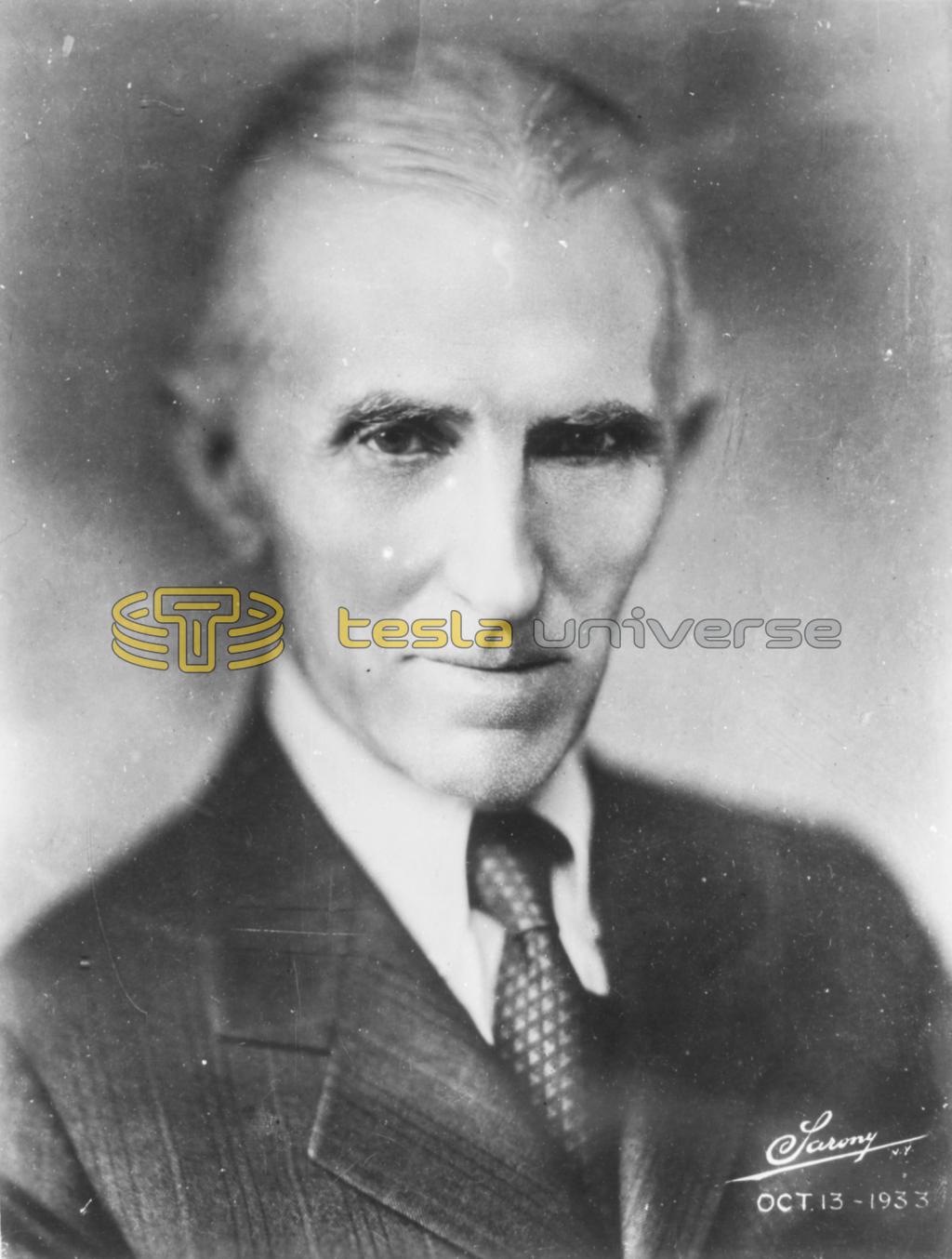
As you read the story and study the frontispiece portrait you get a picture of the stock madman inventor of Hollywood horror films: A "self-made superman," as O'Neill describes him, with deep-set Boris Karloff eyes, who dreamed of pumping the whole earth full of oscillating electric force; an austere and haughty genius who built a Colorado mountain laboratory which actually flashed synthetic lightning and incidentally burned out the generators in the supplying powerhouse; a dangerous crank who nearly shook apart some tall New York buildings with a little vibrating gadget.
But if you thought of Tesla as a "menace" you would be wrong. He wanted only to contribute to the progress of science—which he did, in a big way; to be recognized as a genius—which recognition he gained, but not from all of the people and not all of the time; and to have the means to make greater discoveries. In the latter goal he failed, because his arrogance and self-assumed superiority antagonized those who might have helped him. Possibly in his latter years he was not fully sane; a psychoanalytic study of his life would be interesting. Certainly he had many neurotic traits and obsessions.
Somewhat Mystical Biography
O'Neill's analysis of this complex personality is somewhat on the mystical side. Admitting that Tesla's own philosophy was strictly materialist, O'Neill attempts to show by certain incidents that Tesla had telepathic powers and that he may have received supernatural inspiration. These attempts detract from the objective quality of the biography. O'Neill also champions Tesla's claim to recognition as the inventor of radio broadcasting; this claim is dubious. Quotations from Tesla which the author cites refer to the transmission of electric waves through the earth rather than through the air or empty space.
A reader of this biography might come to the false conclusion that Tesla pioneered all the major advances of the electrical and radio arts in the 20th century and that, as the baseball saying goes, "he wuz robbed." A similar kind of argument could just as logically be built around many other inventors, for the whole history of science is full of instances of different men independently coming upon the same discoveries.
An integral part of the inventive process, so far as contributions to humanity are concerned, is to sell the new idea to others so that it can be put to work. In this, except for his first invention of polyphase alternating current power, Tesla failed. The story of his failure is the story of brilliant mind enmeshed with a personality that never really fitted in the world of men.
HARRY M. DAVIS