Nikola Tesla Articles
Radio Waves Heard from Jupiter and Venus
By O. P. FERRELL
Radio waves spanning interplanetary space are now a certainty. The dreams of science fiction writers and the predictions of Nikola Tesla are closer to reality. Positive identification of radio waves generated by means unknown on both Jupiter and Venus has been established. Work is progressing rapidly in this field by teams of scientists in Europe, Australia and the United States, where giant radio telescopes are now in use.
Radio signals from beyond the earth have been known for about twenty years. But these came mostly from turbulent areas of outer space, where intense electrical activity accompanies the formation of new stars and the gigantic eruptions of distant suns beyond the reach of even the largest telescopes. Only lately have radio star-gazers been hearing odd noises from our relatively quiet and astronomically "dead" next-door neighbors, the planets.

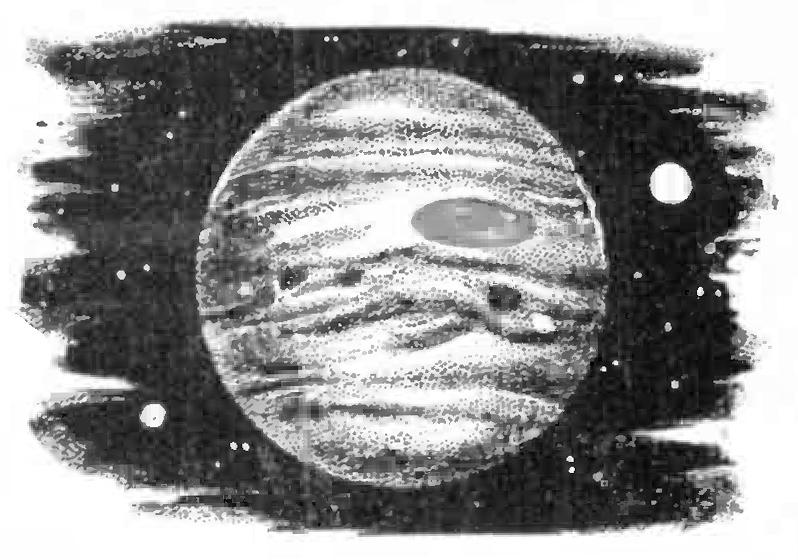
Thundering Jupiter. Electromagnetic waves picked up from Jupiter lack a clearly defined frequency, yet are best heard around 22 megacycles. With their frequency distribution being random throughout a wide band, the signals sound just like static caused by storms. Since Jupiter, like Earth, is surrounded by a gaseous atmosphere, it is quite possible that the radiation it sends out is a sign of turbulent weather.
Lending probability to this theory is the electrical behavior of the weather-bearing layers in our own terrestrial atmosphere. About 50,000 thunderstorms per day pass over the face of the earth. About 2000 are going strong at any one moment, giving off about 100 lightning flashes every second. Each lightning flash is a 3-millisecond burst of 2000-3000 amperes, reaching peaks around 10,000 amperes. That's a lot of electrical popping for our small planet. To radios on Jupiter, it would probably sound the same way that the waves from Jupiter sound to us.

Hot Venus. Until a few months ago, it seemed that Jupiter was the only planet to radiate electromagnetic waves. Yet earlier this year, Dr. John Kraus of Ohio State University also caught signals from Venus, the planet which is prominent in the sky as the Evening and Morning Star. The Naval Research Laboratory in Washington independently made the same discovery.
Signals from Venus reported by the Navy differ from those of Jupiter. They are not generated by electric disturbances of the atmosphere, but by the molecular activity of heat. The wavelength of the Venus signals stays fairly constant at 3 cm., which corresponds to a temperature of more than 212° F — the boiling point of water. Any water existing on Venus would therefore be in the form of steam. This makes it unlikely that living organisms as we know them could exist on that planet.
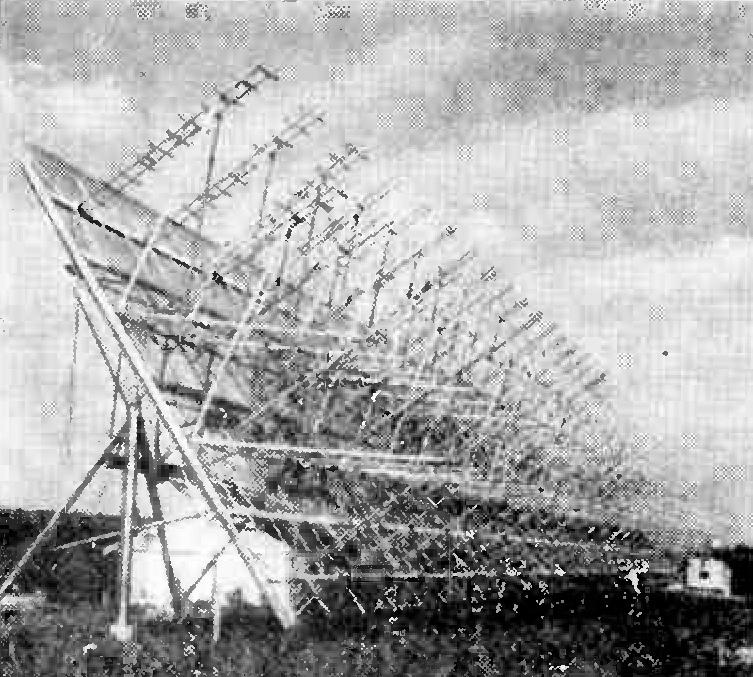
Giant Antennas. No ordinary antenna will catch these faint signals from the stars. Instead, radio astronomers employ huge parabolas or dipole arrays to concentrate the dim stellar mutterings at the receiver input.
For instance, the giant parabola atop the Naval Research Laboratory Building in Washington acts like the mirror in an ordinary optical reflector telescope. All the energy is focused in a single point at the tip of the central pole, from whence it is funneled to the receiver. The antenna is automatically rotated so as to keep pointing at the same target in space, regardless of the motion of the earth. Signal gain attainable with this antenna is over one million.

The optical refracting telescope, exemplified by ordinary field glasses, also has its electronic equivalent. Helical antennas, looking like vast coil-spring mattresses, bend the incoming radio waves as a deflection coil bends the beam in a TV tube. In this manner, they concentrate the incident energy at the pickup point. By stringing a large number of coil-shaped structures in an array, the gain is multiplied in proportion to the total antenna size. On this principle, Ohio State University built the 96-coil unit, which success- fully eavesdropped on Venus.
Whether similar waves will be heard from Mars is still an open question. As Mars draws closer to Earth this year than it has at any time within the past 20 years, the chances of intercepting its radio waves, if any, are greatly increased. Experiments continue as the massive antennas seek out our brother and sister planets in the solar system.