Nikola Tesla Articles
Recognition, At Last - Nikola Tesla Achievements Finally Get Their Due
By William J. Broad
The New York Times
The world of science is belatedly recognizing the genius of centric and enigmatic inventors, Nikola Tesla.
A century after he arrived penniless on the docks of New York City, Tesla is receiving credit for brilliant achievements that outdid those of his contemporaries, Edison and Marconi. And more than 40 years after the recluse died in a Manhattan hotel room, in the company of the pigeons who were his favorite companions in the final years of his life, he is at last being elevated to the pantheon of the world's great inventors.
It was Nikola Tesla, not Marconi, who invented the first radio; it was Tesla, not Edison, who devised the system of electric power distribution now used throughout the world. Working in small laboratories in midtown Manhattan and Greenwich Village, Tesla invented the polyphase electric motor, the bladeless steam turbine and the radio-guided torpedo. Some scientists say it was Tesla who first conceived ideas for a "Star Wars" type of military shield in space.
To help analyze and publicize the accomplishments of the enigmatic genius, a group of scientists and engineers have formed the Tesla Centennial Committee and recently held a symposium and organized a museum exhibition.
'Spawned a revolution'
"He helped spawn the industrial revolution," said Toby Grotz, chairman of the Tesla Centennial Committee and an engineer at Martin Marietta Aerospace in Denver. "It couldn't have happened without him. He came from a period when a single individual could still change the course of history."
The centennial events have largely taken place in Colorado, where the inventor had built a laboratory to create huge bolts of artificial lightning.
"We're trying to bring his name to its rightful prominence," said William H. Terbo, who is Tesla's great-nephew and honorary chairman of the Tesla Memorial Society.
The proceedings of the symposium will be published by the New York-based Institute of Electrical and Electronics Engineers, the world's largest such society.
The committee says conventional histories all too often dismiss Tesla in a few paragraphs. Indeed, the usual story is quite short.
Early talents displayed
Tesla was born in 1856 in Croatia, then part of the Austro-Hungarian Empire, and soon showed a talent for invention and tinkering. In 1884, he took a ship to New York and immediately went to work for Thomas Alva Edison. But the two quickly parted ways after a dispute over an invention.
Going into business for himself, Tesla soon developed the basis for the alternating-current system in worldwide use today. He realized that direct current can be transported over wires for only a few miles, whereas high-voltage alternating current can go on almost forever without sustaining great losses of power. To make the new system practical, he invented and patented a variety of alternating-current generators, transformers and motors.
Edison supported direct current as the perfect electrical source of the future, and the two men fought a heated battle over the best system. It went down in science history as the "war of the currents" — a contest Tesla won.
So much for Tesla's conventional history. The Centennial Committee says he went on to do much more than just spark the age of electricity — envisioning and inventing a dazzling array of futuristic devices.
"All the literature says Marconi invented the radio," Grotz said in an interview. "But long before Marconi had a patent, Tesla was demonstrating a radio-controlled model boat and talking about transmitting electrical power across the Atlantic. Compare that to Marconi's S-O-S."
Indeed, in 1943 the Supreme Court overturned Marconi's patent because the justices found it had been preceded by Tesla's practical achievements in radio transmission.
Another example is radar, which employs short wavelength radio signals that can be reflected from solid objects. As early as 1900, members of the centennial committee note, Tesla suggested that these wavelengths could be used for locating ships at sea.
Spectacular experiment
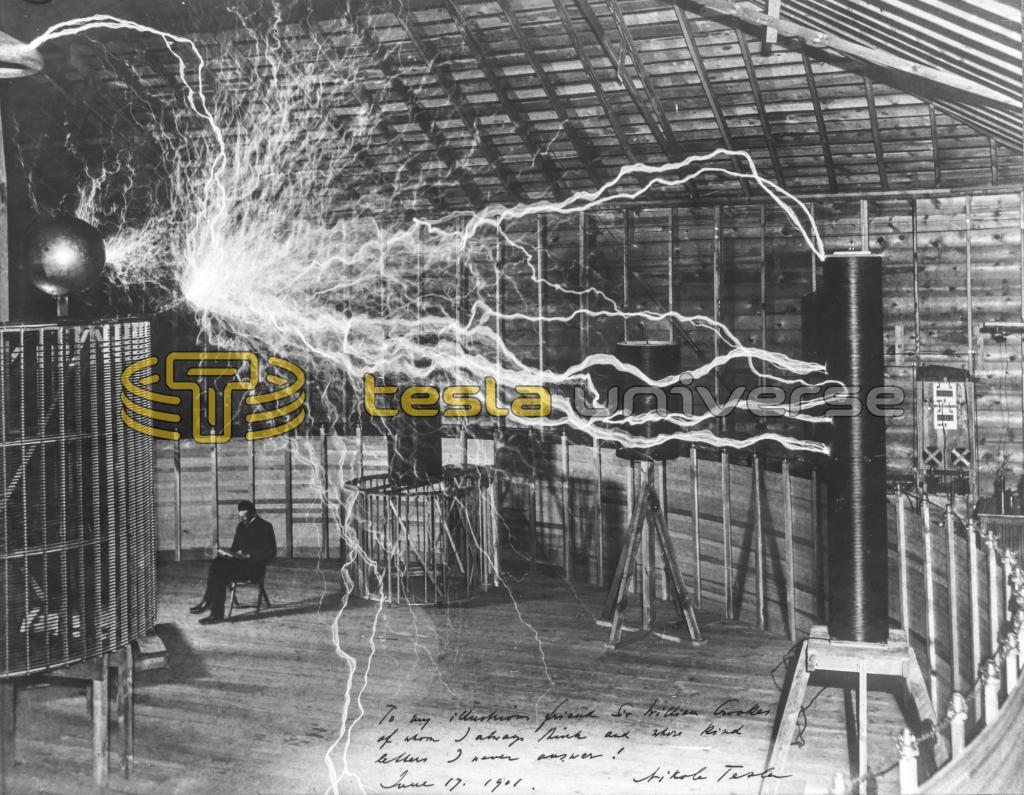
Many of the 27 speakers at the Tesla symposium, held recently at The Colorado College in Colorado Springs, put their emphasis on Tesla's most spectacular experiments of all, which occurred at a laboratory not far from the symposium site. There, at the turn of the century, Tesla built enormous coils that generated 10 million to 12 million volts of electricity and sent bolts of artificial lightning flashing 135 feet through the air, a feat that has never been equaled.
To this day, scientists debate what Tesla accomplished in Colorado, for much of the work was shrouded in mystery. Dr. Robert W. Bass, an electrical engineer with Litton Industries, said at the symposium that one of Tesla's more controversial claims that he had created ball lightning was probably true and he cited contemporary theories of physics to explain how Tesla could reproduce such a rare natural phenomenon.
Tesla was indeed something of a character, according to Margaret Cheney, whose book, Tesla, Man Out of Time, details some of the eccentricities. At the height of his fame, while eating dinner in the Palm Room of the Waldorf-Astoria Hotel, he would polish the already sparkling sliver and crystal using exactly 18 napkins. He had a phobia about germs and a love of numbers divisible by three.
The New York Times reported in a front-page article in 1915 that Tesla was to share that year's Nobel Prize in physics with Edison. But he never got the award. One biographer said that Tesla had refused to share it with his old rival. Another version has it that Tesla rejected the prize because it had been given in 1909 to Marconi.
After the death of his mother, Tesla became increasingly eccentric and withdrawn. He vigorously disagreed with theories put forward by great scientists of his day including James Clerk Maxwell and Albert Einstein. He never married. Nearly every day he would go to Bryant Park behind the New York Public Library and feed his friends, the pigeons. Late in life he announced that he had received signals from distant planets, a claim that was greeted with no little skepticism.
Although Tesla is only belatedly being recognized for the wide-ranging brilliance of his achievements, one testimonial to his genius did come in 1917 from B.A. Behrend, an engineer who had an inkling of the mark Tesla would make on Western civilization.
TESLA'S ACCOMPLISHMENTS
Here is a digest of some of Nikola Tesla's most important work:
ALTERNATING ELECTRICAL CURRENT: Tesla developed the basis for the alternating-current system in worldwide use today. He realized that direct current can be transported over wires for only a few miles, whereas high-voltage alternating current can go on almost forever without sustaining great losses of power. He invented and patented a variety of alternating-current generators, transformers and motors. Thomas Edison supported direct current as the perfect electrical source of the future, and the two men argued fiercely over which was the best system. It went down in science history as the "war of the currents." Tesla won the war.
RADIO: Long before Marconi had a patent for his radio device, Tesla had demonstrated a radio-controlled model boat and was talking about transmitting electrical power across the Atlantic Ocean. In 1943 the Supreme Court overturned Marconi's patent because jurists found it had been preceded by Tesla's practical achievements in radio transmission.
RADAR: What we call radar employs short wavelength radio signals that can be reflected from solid objects. As early as 1900, Tesla suggested that such wavelengths could be used for locating ships at sea.
"Were we to eliminate from our industrial world the results of his work," he told a banquet in Tesla's honor, "the wheels of industry would cease to turn, our electric cars and trains would stop, our towns would be dark, our mills would be dead and idle. His name marks an epoch in the advance of electrical science. From his work has sprung a revolution."
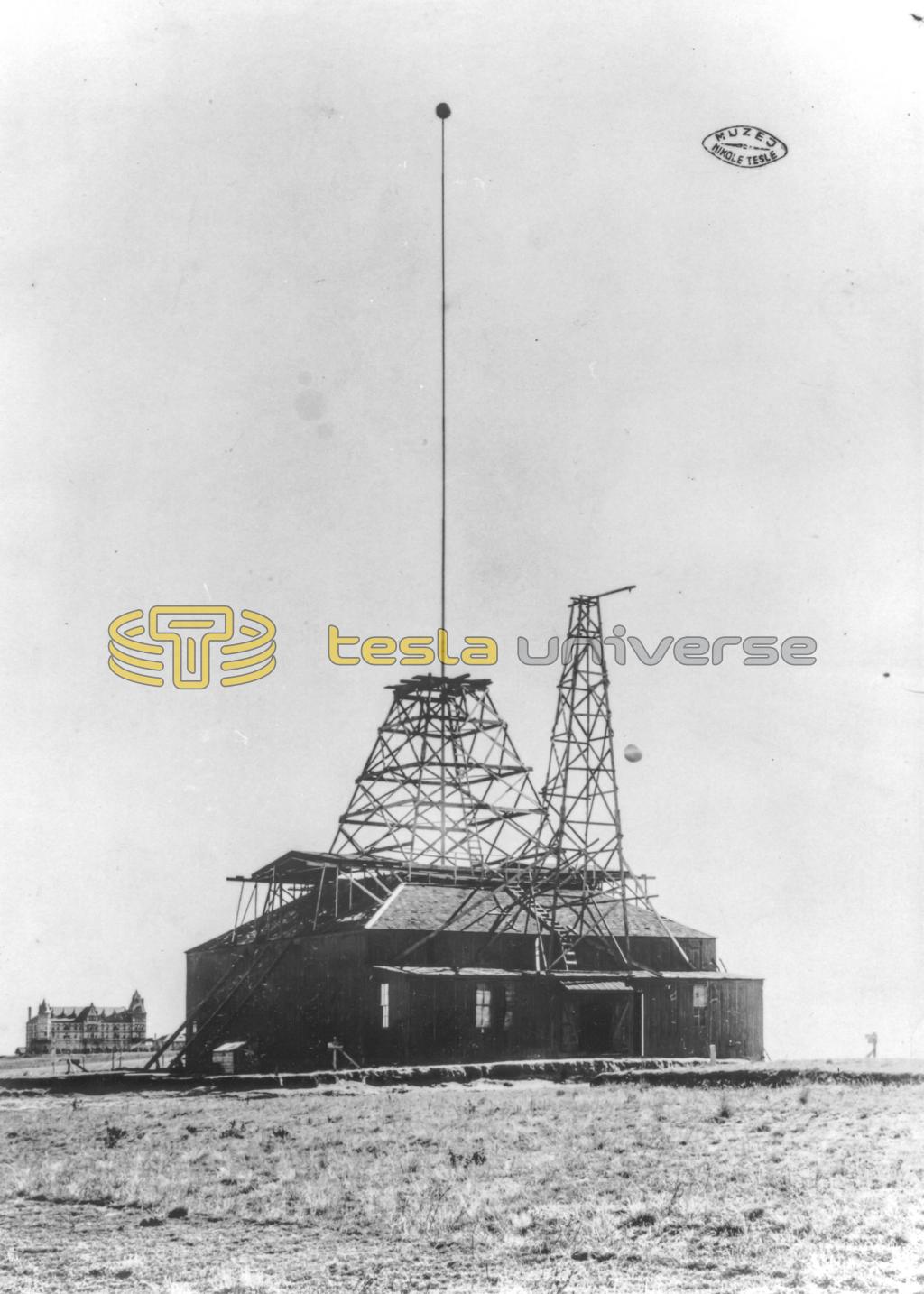
Tesla's laboratory in Colorado Springs was a barn-like structure that sat atop a hill on the prairie and was crowned by an 80-foot tower and beyond that a 122-foot mast. The tall fence surrounding it carried signs reading: "Keep Out - Great Danger." The claps of thunder from his bolts of artificial lightning could be heard for miles.
In Colorado, Tesla hit upon what he thought was a revolutionary way to send electricity through the air. "Not only was it practicable to send telegraphic messages to any distance without wires," he wrote of the insight, "but also to impress upon the entire globe the faint modulations of the human voice, more still, to transmit power, in unlimited amounts, to any terrestrial distance and almost without any loss."
At the symposium some of Tesla's advocates seemed to try to outdo the master's knack for hyperbole as far they conjured visions of death rays and futuristic weapons.
'Star Wars' precursor?
In a paper entitled "Star Wars Now!" Thomas E. Bearden, a retired nuclear engineer and Army war games analyst, noted what he said were a number of designs for making weapons based on Tesla's more exotic ideas. The hypothetical devices included what he termed a Tesla howitzer and a Tesla shield that could allegedly stop Soviet missiles.
Tesla suggested in 1940 that the United States military could build a system of death rays that would melt enemy airplanes at a distance of 250 miles. The War Department looked into the idea and said, politely, no thanks.
"With Tesla you're always going to get the fringe," said Robert K. Golka, a physicist.
Waldemar B. Kaempffert, a science editor of The New York Times in the first half of the century, once described Tesla as "an intellectual boa constrictor" and a "medieval practitioner of black arts."
Tesla's great-nephew and closest living relative, Terbo, says that four basic types of people are attracted to Tesla-serious scientists, Yugoslavs proud of his achievements, pseudoscientists who pursue some of his wackier ideas and cultists who worship him as an extraterrestrial.
"There are religious fanatics in Pasadena who say he came down on a space ship from Venus," said Terbo, adding, "It's no small group."
