
Nikola Tesla Articles
Rotary Spark Gaps
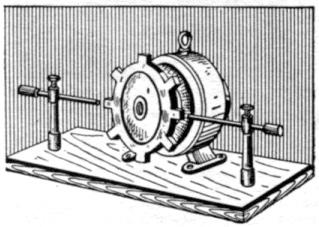
In these days of radio telegraphy, the use of rotary spark gaps has become very extended. There are a great number of different type gaps on the market, some of them very efficient, and some of them inefficient. It is the purpose of this article to point out the advantages and disadvantages of a few of these rotary gaps, as shown by actual experiments.
TYPE 1.
This is the simplest form of rotary gap, and is more or less crude in design. It is operated by a small battery motor on four or more dry cells. As the principle of design is wrong, the results obtained with this gap are never very satisfactory. The spark obtained is very ragged and almost impossible to read, while the tone is low and unsteady. Fast and accurate transmission with it is an impossibility. By overloading the motor with batteries and thus running it at an excessive speed, the tone and spark are improved, but of course the excess current is liable to damage the motor. The trouble with the design is simply that the sparking points are too far apart for the revolutions of the motor.
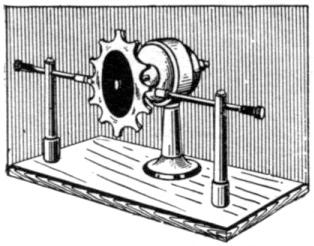
TYPE 2.
This is similar in design to Type 1, but of better design and more efficient. The sparking points are more numerous and the scallop effect in design gives a less abrupt break and consequently a steadier spark. The increased number of sparking points also gives a higher tone than Type 1. A well-designed motor runs this rotary gap and it will operate on 110 volts d.c. or a.c. The gap can be used with good results up to about 1 k.w. While not recommended for long distance work, this gap is efficient and satisfactory for ordinary use.
TYPE 3.
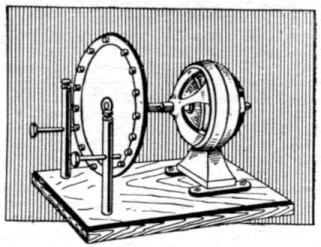
This is a very good type of rotary gap, well designed and very efficient. In method of operation it is very similar to Type 2, but is of improved design. It permits of very close adjusting of the electrodes to produce a clear spark, and the high speed a.c. motor gives a very clear tone. It is very efficient for long distance work and operates successfully on powers up to 1 k.w.
TYPE 4.
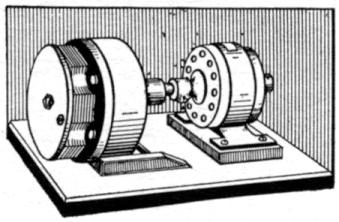
This is without question the most efficient and satisfactory rotary spark gap in use in modern radio telegraphy. The motor is of exceptional design and is furnished for 60 cycles or any other frequency at any voltage. The gap consists of two rotary quenched spark gaps in series, formed by two semi-circular stationary electrodes placed in front of the circular rotating electrodes, the spark occurring between one stationary and one rotating electrode, and thence to the remaining stationary electrode. The faces of the electrodes have slots milled in their surfaces, leaving radial projections from which sparking ensues, at the rate of 25,000 condenser discharges per second. The radial projections are used simply to break these discharges into groups corresponding to the tone desired from the set, as the discharge rate is so high that it approaches the limits of audibility. It will be seen that by varying the speed of rotation and thus the rate at which the sectors pass, any desired tone is produced. The efficiency of a transmitting set with a rotary gap of this design is from 60 to 70 per cent., which is very good. The tone produced is very high and piercing, resembling a clear whistle, easily read through static or interference, and is readily distinguished when used for long distance work.
