Nikola Tesla Articles
On the Source of the Roentgen Ray
A series of experiments extending over the past six weeks has at length yielded conclusive evidence and enabled the source and distribution of the ray to be mapped out around the entire tube with great clearness. Penumbral shadows were repeatedly plotted back to the tube and invariably pointed to the area of the bulb opposite the cathode as the source of the distribution. These observations have already been published.¹
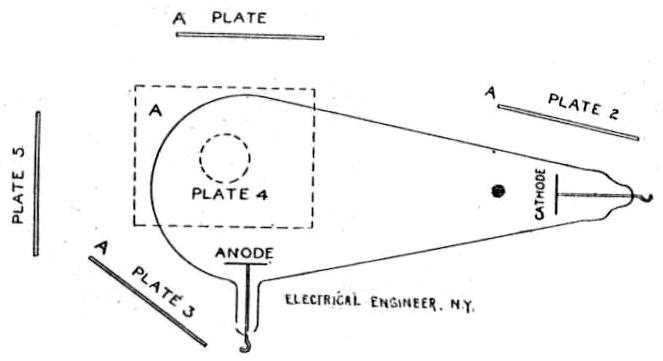
It occurred to the writer that the best means to trace the ray distribution would be shadows cast by short metallic tubes. Half-inch lengths were cut from No. 18 gauge brass tubing, varying in diameter from 1/2 inch to 3 inches. In the first experiment, these were placed concentrically on a dry plate and placed parallel with the bulb in position marked 5 in Fig. 1, the distance of the plate from the bulb being 4 inches. The sciagraph is reproduced in Fig. 2.
Two separate effects are to be noted in all the sciagraphs of the tubes used. Both the length and direction of the shadow are clearly indicated and the vertical shadow of the metal itself. It will be noted that the latter seems to indicate the presence of rays which are more or less vertical. Plotting the shadows in Fig. 2 and noting that the vertical shadow does not appear beyond the third ring, we find that the source of the rays was on the surface of the bulb, and the area of the source was nearly or quite circular, and not much in excess of the diameter of the third ring, which was 1 1/2 inches.
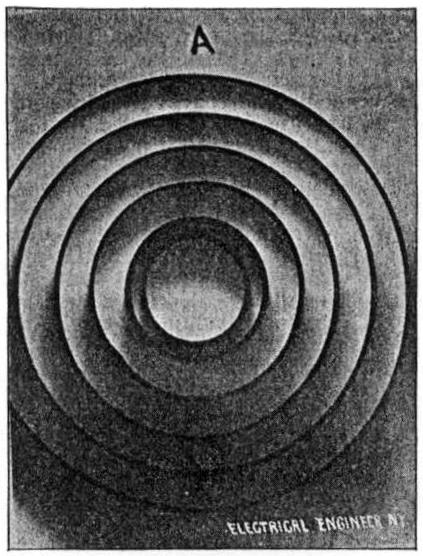
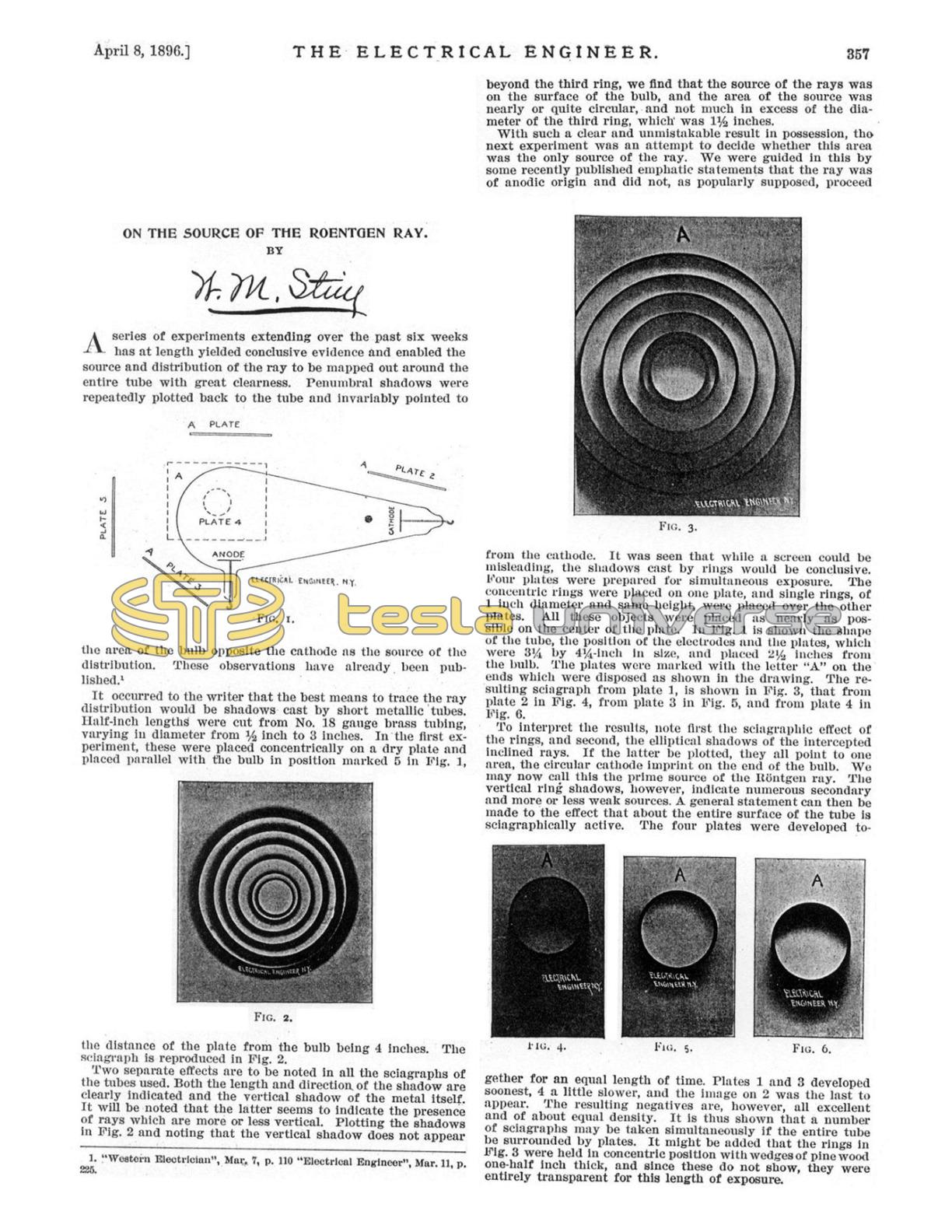
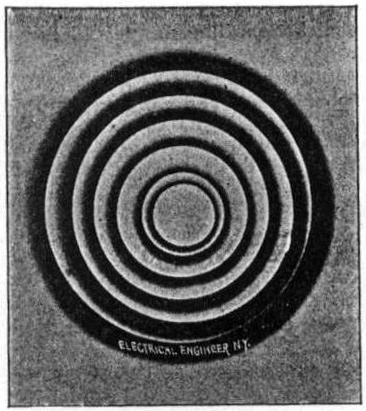
With such a clear and unmistakable result in possession, the next experiment was an attempt to decide whether this area was the only source of the ray. We were guided in this by some recently published emphatic statements that the ray was of anodic origin and did not, as popularly supposed, proceed from the cathode. It was seen that while a screen could be misleading, the shadows cast by rings would be conclusive. Four plates were prepared for simultaneous exposure. The concentric rings were placed on one plate, and single rings, of 1 inch diameter and same height, were placed over the other plates. All these objects were placed as nearly as possible on the center of the plate. In Fig. 1 is shown the shape of the tube, the position of the electrodes and the plates, which were 3 1/4 by 4 1/4-inch in size, and placed 2 1/2 inches from the bulb. The plates were marked with the letter "A" on the ends which were disposed as shown in the drawing. The resulting sciagraph from plate 1, is shown in Fig. 3, that from plate 2 in Fig. 4, from plate 3 in Fig. 5, and from plate 4 in Fig. 6.
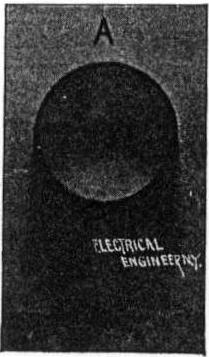
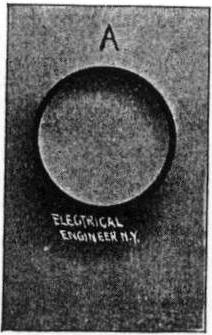
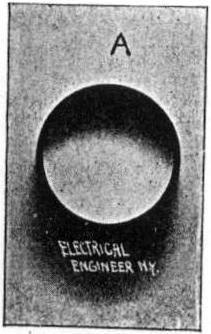
To interpret the results, note first the sciagraphic effect of the rings, and second, the elliptical shadows of the intercepted inclined rays. If the latter be plotted, they all point to one area, the circular cathode imprint on the end of the bulb. We may now call this the prime source of the Röntgen ray. The vertical ring shadows, however, indicate numerous secondary and more or less weak sources. A general statement can then be made to the effect that about the entire surface of the tube is sciagraphically active. The four plates were developed together for an equal length of time. Plates 1 and 3 developed soonest, 4 a little slower, and the image on 2 was the last to appear. The resulting negatives are, however, all excellent and of about equal density. It is thus shown that a number of sciagraphs may be taken simultaneously if the entire tube be surrounded by plates. It might be added that the rings in Fig. 3 were held in concentric position with wedges of pine wood one-half inch thick, and since these do not show, they were entirely transparent for this length of exposure.
1. "Western Electrician", Mar, 7, p. 110 "Electrical Engineer", Mar. 11, p. 225.