Nikola Tesla Articles
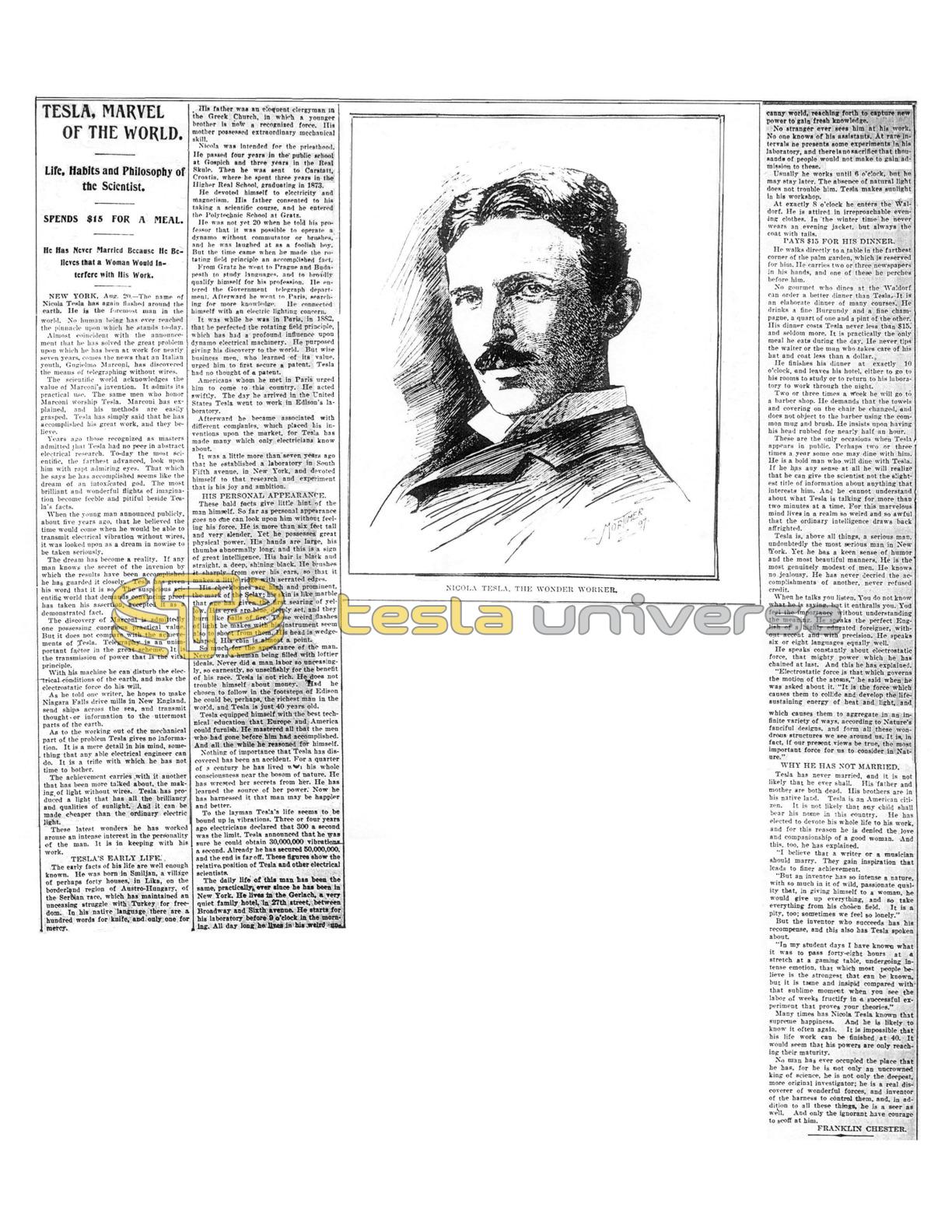
Tesla, Marvel of the World
Life, Habits and Philosophy of the Scientist.
SPENDS $15 FOR A MEAL.
He Has Never Married Because He Believes that a Woman Would Interfere with His Work.
NEW YORK, Aug. 20 — The name of Nikola Tesla has again flashed around the earth. He is the foremost man in the world. No human being has ever reached the pinnacle upon which he stands to-day.
Almost coincident with the announcement that he has solved the great problem upon which he has been at work for nearly seven years, comes the news that an Italian youth, Gugielmo Marconi, has discovered the means of telegraphing without wires.
The scientific world acknowledges the value of Marconi's invention. It admits its practical use. The same men who honor Marconi worship Tesla. Marconi has explained, and his methods are easily grasped. Tesla has simply said that he has accomplished his great work, and they believe.
Years ago those recognized as masters admitted that Tesla had no peer in abstract electrical research. To-day the most scientific, the farthest advanced, look upon him with rapt admiring eyes. That which he says he has accomplished seems like the dream of an intoxicated god. The most brilliant and wonderful flights of imagination become feeble and pitiful beside Tesla's facts.
When the young man announced publicly, about five years ago, that he believed the time would come when he would be able to transmit electrical vibration without wires, it was looked upon as a dream in nowise to be taken seriously.
The dream has become a reality. If any man knows the secret of the invention by which the results have been accomplished. he has guarded it closely. Tesla has given his word that it is so. The suspicious scientific world that demands convincing proof has taken his assertion, accepted it as a demonstrated fact.
The discovery of Marconi is admittedly one possessing enormous practical value. But it does not compare with the achievements of Tesla. Telegraphy is an unimportant factor in the great scheme. It is the transmission of power that is the vital principle.
With his machine he can disturb the electrical conditions of the earth, and make the electrostatic force do his will.
As he told one writer, he hopes to make Niagara Falls drive mills in New England, send ships across the sea, and transmit thought or information to the uttermost parts of the earth.
As to the working out of the mechanical part of the problem Tesla gives no information. It is a mere detail in his mind, something that any able electrical engineer can do. It is a trifle with which he has not time to bother.
The achievement carries with it another. that has been more talked about, the making, of light without wires. Tesla has produced a light that has all the brilliancy and qualities of sunlight. And it can be made cheaper than the ordinary electric light.
These latest wonders he has worked arouse an intense interest in the personality of the man. It is in keeping with his work.
TESLA'S EARLY LIFE.
The early facts of his life are well enough known. He was born in Smiljan, a village of perhaps forty houses, in Lika, on the borderland region of Austro-Hungary, of the Serbian race, which has maintained an unceasing struggle with Turkey for freedom. In his native language there are a hundred words for knife, and only one for mercy.
His father was an eloquent clergyman in the Greek Church, in which a younger brother is not a recognized force. His mother possessed extraordinary mechanical skill.
Nikola was intended for the priesthood. He passed four years in the public school at Gospich and three years in the Real Skule. Then he was sent to Carlstadt, Croatia, where he spent three years in the Higher Real School, graduating in 1873.
He devoted himself to electricity and magnetism. His father consented to his taking a scientific course, and he entered the Polytechnic School at Gratz.
He was not yet 20 when he told his professor that it was possible to operate a dynamo without commutator or brushes, and he was laughed at as a foolish boy. But the time came when he made the rotating field principle an accomplished fact.
From Gratz he went to Prague and Budapest to study languages, and to broadly qualify himself for his profession. He entered the Government telegraph department. Afterward be went to Paris, searching for more knowledge. He connected himself with an electric lighting concern.
It was while he was in Paris, in 1882, that he perfected the rotating field principle, which has had a profound influence upon dynamo electrical machinery. He purposed giving his discovery to the world. But wise business men, who learned of its value, urged him to first secure a patent. Tesla had no thought of a patent.
Americans whom he met in Paris urged him to come to this country. He acted swiftly. The day he arrived in the United States Tesla went to work in Edison's laboratory.
Afterward he became associated with different companies, which placed his inventions upon the market, for Tesla has made many which only electricians know about.
It was a little more than seven years ago that he established a laboratory in South Fifth avenue, in New York, and devoted himself to that research and experiment that is his joy and ambition.
HIS PERSONAL APPEARANCE.
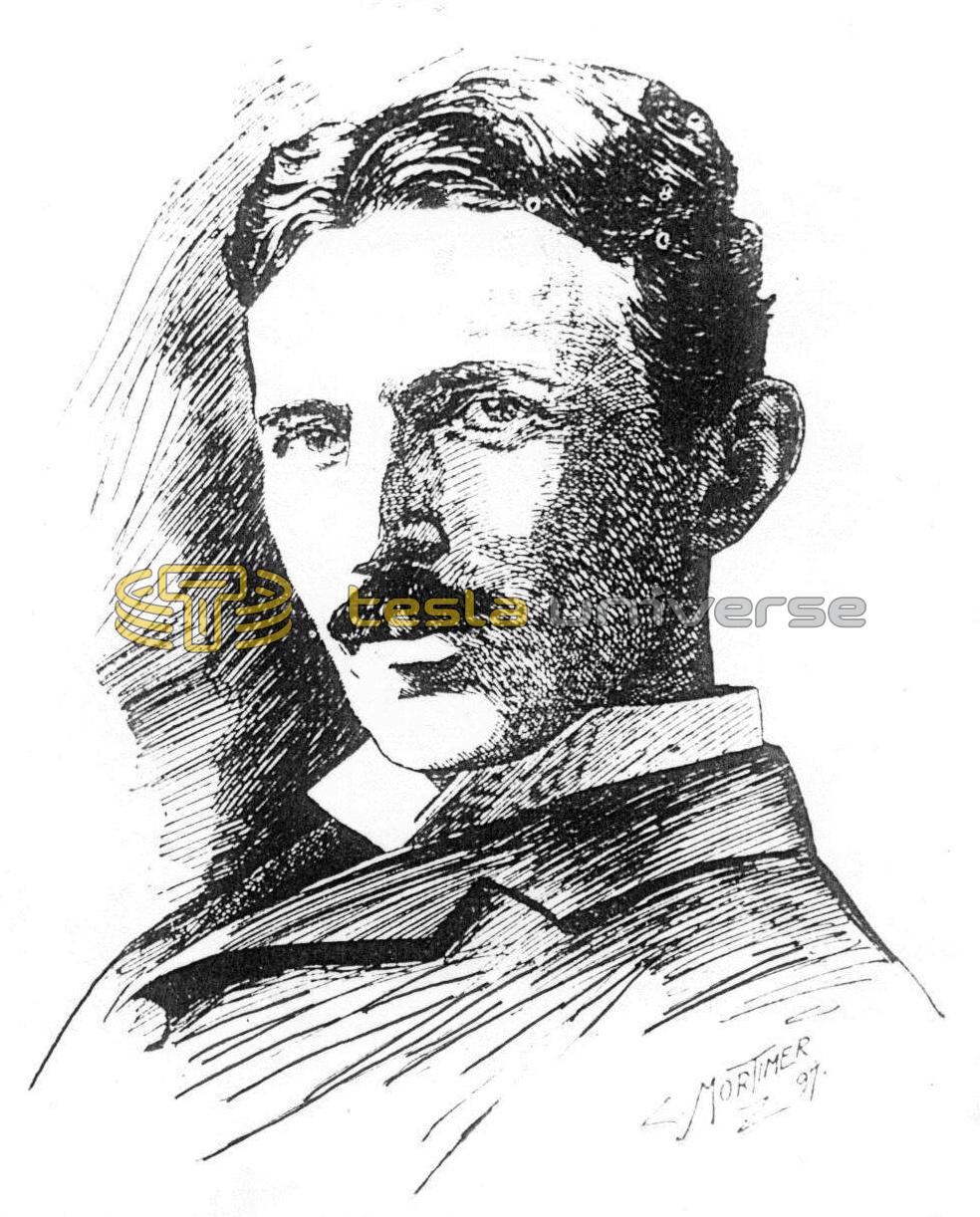
These bald facts give little hint of the man himself. So far as personal appearance goes no one can look upon him without feeling his force. He is, more than six feet tall and very slender. Yet he possesses great physical power. His hands are large, his thumbs abnormally long, and this is a sign of great intelligence. His hair is black and straight, a deep, shining black. He brushes it sharply from over his ears, so that it makes a little ridge with serrated edges.
His cheekbones are high and prominent, the mark of the Sclav; his skin is like marble that age has given the first searing of yellow. His eyes are blue, deeply set, and they burn like balls of fire. Those weird flashes of light he makes with his instrument seem also to shoot from them. His head is wedge-shaped. His chin is almost a point.
So much for the appearance of the man. Never was a human being filled with loftier ideals. Never did a man labor so unceasingly, so earnestly, so unselfishly for the benefit he of his race. Tesla is not rich. He does not trouble himself about money. Had chosen to follow in the footsteps of Edison he could be, perhaps, the richest man in the world, and Tesla is just 40 years old.
Tesla equipped himself with the best technical education that Europe and America could furnish. He mastered all that the men who had gone before him had accomplished. And all the while he reasoned for himself.
Nothing of importance that Tesla has discovered has been an accident. For a quarter of century he has lived his whole consciousness near the bosom of nature. He has wrested her secrets from her. He has learned the source of her power. Now he has harnessed it that man may be happier and better.
To the layman Tesla's life seems to be bound up in vibrations. Three or four years ago electricians declared that 300 a second Iwas the limit. Tesla announced that he was sure he could obtain 30,000,000 vibrations a second. Already he has secured 50,000,000, and the end is far off. These figures show the relative position of Tesla and other electrical scientists.
The daily life of this man has been the same, practically, ever since he has been in New York. He lives in the Gerlach, a very quiet family hotel, in 27th street, between Broadway and Sixth avenue. He starts for his laboratory before 9 o'clock in the morning. All day long he lives in his weird no canny world, reaching forth to capture new power to gain fresh knowledge.
No stranger ever sees him at his work. No one knows of his assistants. At rare intervals he presents some experiments in his laboratory, and there is no sacrifice that thousands of people would not make to gain admission to these.
Usually he works until 6 o'clock, but he may stay later. The absence of natural light does not trouble him. Tesla makes sunlight in his workshop.
At exactly 8 o'clock he enters the Waldorf. He is attired in irreproachable evening clothes. In the winter time he never one wears an evening jacket, but always the coat with tails.
PAYS $15 FOR HIS DINNER.
He walks directly to a table in the farthest corner of the palm garden, which is reserved for him. He carries two or three newspapers in his hands, and one of these he perches and before him.
No gourmet who dines at the Waldorf can order a better dinner than Tesla, It is an elaborate dinner of many courses. He drinks a fine Burgundy and a fine champagne, a quart of one and a pint of the other. His dinner costs Tesla never less than $15, and seldom more. It is practically the only meal he eats during the day. He never tips the waiter or the man who takes care of his hat and coat less than a dollar.
He finishes his dinner at exactly 10 o'clock, and leaves his hotel, either to go to his rooms to study or to return to his laboratory to work through the night.
Two or three times a week he will go to a barber shop. He demands that the towels and covering on the chair be changed, and does not object to the barber using the common mug and brush. He insists upon having his head rubbed for nearly half an hour.
These are the only occasions when Tesla, appears in public. Perhaps two or three times a year some one may dine with him. He is a bold man who will dine with Tesla. If he has any sense at all he will realize that he can give the scientist not the slightest title of information about anything that interests him. And he cannot understand about what Tesla is talking for more than two minutes at a time. For this marvelous mind lives in a realm so weird and so awful that the ordinary intelligence draws back affrighted.
Tesla is, above all things, a serious man, undoubtedly the most serious man in New York. Yet he has a keen sense of humor and the most beautiful manners. He is the most genuinely modest of men. He knows no jealousy. He has never decried the accomplishments of another, never refused credit.
When he talks you listen. You do not know what he is saying, but it enthralls you. You feel the importance without understanding the meaning. He speaks the perfect English of a highly educated foreigner, without accent and with precision. He speaks six or eight languages equally well.
He speaks constantly about electrostatic force, that mighty power which he has chained at last. And this he has explained.
"Electrostatic force is that which governs the motion of the atoms," he said when he was asked about it. "It is the force which causes them to collide and develop the life-sustaining energy of heat and light, and which causes them to aggregate in an infinite variety of ways, according to Nature's fanciful designs, and form all these wondrous structures we see around us. It is, in fact, if our present views be true, the most important force for us to consider in Nature."
WHY HE HAS NOT MARRIED.
Tesla has never married, and it is not likely that he ever shall. His father and mother are both dead. His brothers are in his native land. Tesla is an American citizen. It is not likely that any child shall bear his name in this country. He has elected to devote his whole life to his work, and for this reason he is denied the love and companionship of a good woman. this, too, he has explained.
"I believe that a writer or a musician should marry. They gain inspiration that leads to finer achievement.
"But an inventor has so intense a nature, with so much in it of wild, passionate quality that, in giving himself to a woman, he would give up everything, and so take everything from his chosen field. It is a pity, too; sometimes we feel so lonely."
But the inventor who succeeds has his recompense, and this also has Tesla spoken about. And at a
"In my student days I have known what it was to pass forty-eight hours stretch at a gaming table, undergoing intense emotion, that which most people believe is the strongest that can be known, but it is tame and insipid compared with that sublime moment when you see the labor of weeks fructify in a successful experiment that proves your theories."
Many times has Nicola Tesla known that supreme happiness. And he is likely to know it often again. It is impossible that his life work can be finished at 40. It would seem that his powers are only reaching their maturity.
No man has ever occupied the place that he has, for he is not only an uncrowned king of science, he is not only the deepest, more original investigator; he is a real discoverer of wonderful forces, and inventor of the harness to control them, and, in addition to all these things, he is a seer as well. And only the ignorant have courage to scoff at him.
FRANKLIN CHESTER.