Nikola Tesla Articles
Tesla's Work in Radiography
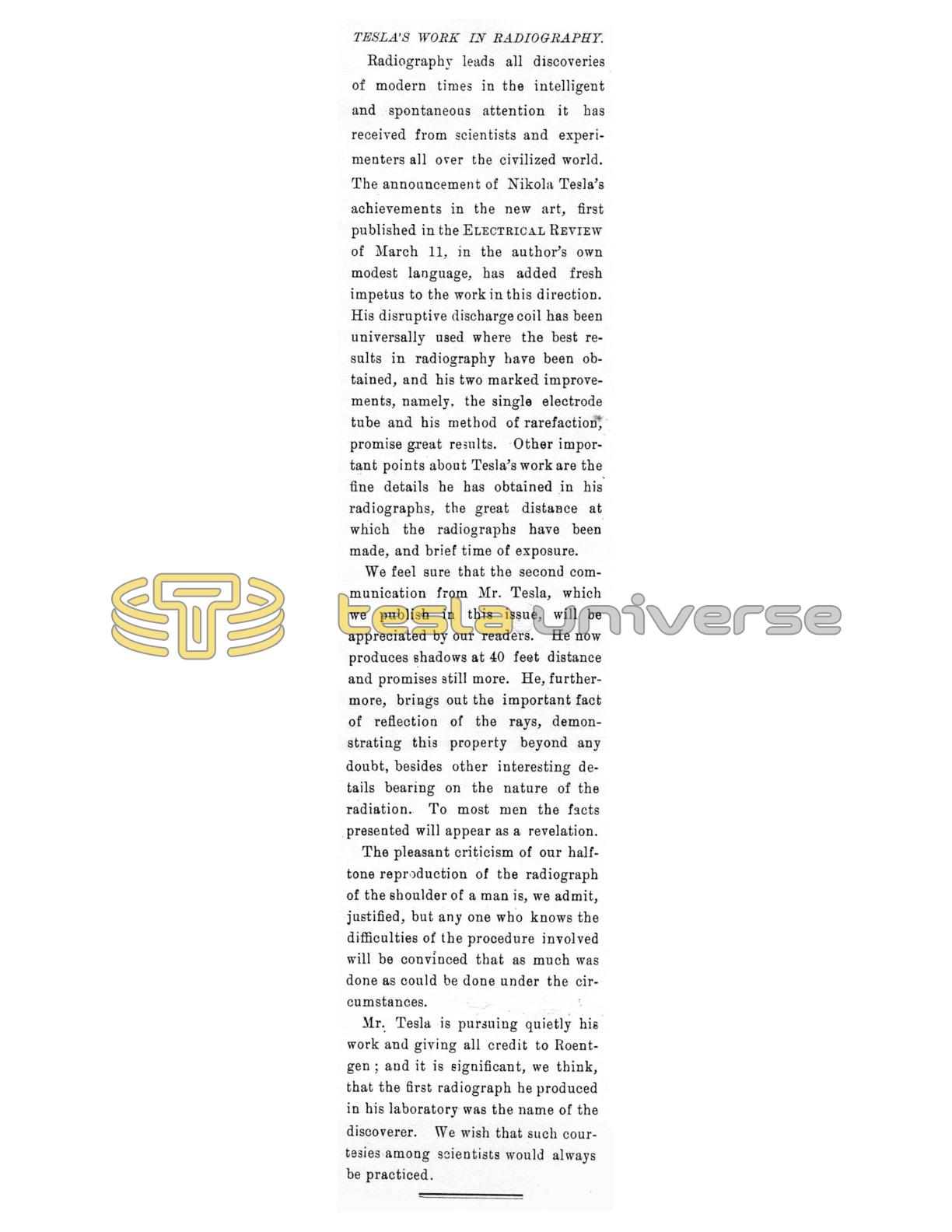
Radiography leads all discoveries of modern times in the intelligent and spontaneous attention it has received from scientists and experimenters all over the civilized world. The announcement of Nikola Tesla's achievements in the new art, first published in the Electrical Review of March 11, in the author's own modest language, has added fresh impetus to the work in this direction. His disruptive discharge coil has been universally used where the best results in radiography have been obtained, and his two marked improvements, namely, the single electrode tube and his method of rarefaction, promise great results. Other important points about Tesla's work are the fine details he has obtained in his radiographs, the great distance at which the radiographs have been made, and brief time of exposure.
We feel sure that the second communication from Mr. Tesla, which we publish in this issue, will be appreciated by our readers. He now produces shadows at 40 feet distance and promises still more. He, furthermore, brings out the important fact of reflection of the rays, demonstrating this property beyond any doubt, besides other interesting details bearing on the nature of the radiation. To most men the facts presented will appear as a revelation.
The pleasant criticism of our halftone reproduction of the radiograph of the shoulder of a man is, we admit, justified, but any one who knows the difficulties of the procedure involved will be convinced that as much was done as could be done under the circumstances.
Mr. Tesla is pursuing quietly his work and giving all credit to Roentgen; and it is significant, we think, that the first radiograph he produced in his laboratory was the name of the discoverer. We wish that such courtesies among scientists would always be practiced.