Nikola Tesla Articles
The Tesla Electrical Condenser - Editorial
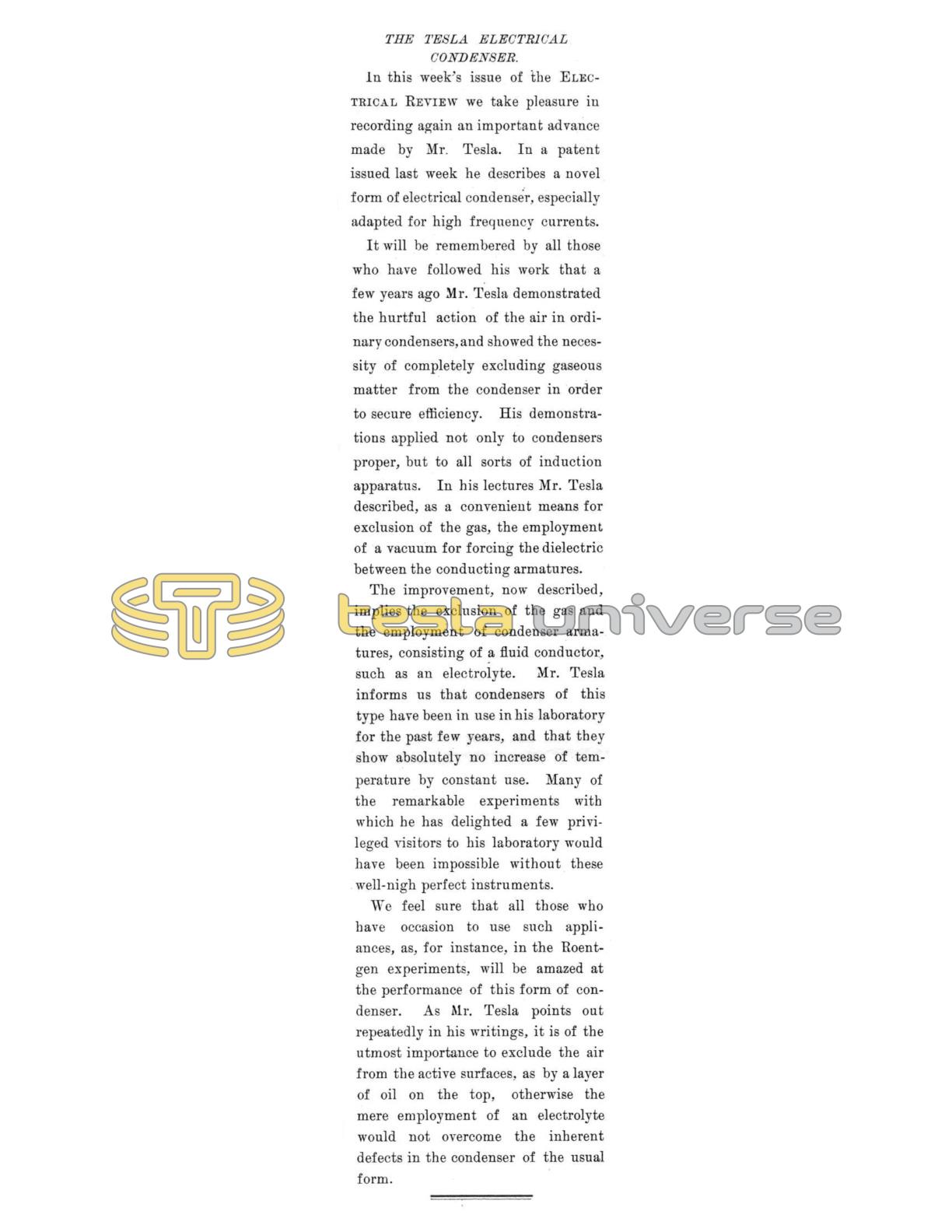
In this week's issue of the ELECTRICAL REVIEW we take pleasure in recording again an important advance made by Mr. Tesla. In a patent issued last week he describes a novel form of electrical condenser, especially adapted for high frequency currents.
It will be remembered by all those who have followed his work that a few years ago Mr. Tesla demonstrated the hurtful action of the air in ordinary condensers, and showed the necessity of completely excluding gaseous matter from the condenser in order to secure efficiency. His demonstrations applied not only to condensers proper, but to all sorts of induction apparatus. In his lectures Mr. Tesla described, as a convenient means for exclusion of the gas, the employment of a vacuum for forcing the dielectric between the conducting armatures.
The improvement, now described, implies the exclusion of the gas and the employment of condenser armatures, consisting of a fluid conductor, such as an electrolyte. Mr. Tesla informs us that condensers of this type have been in use in his laboratory for the past few years, and that they show absolutely no increase of temperature by constant use. Many of the remarkable experiments with which he has delighted a few privileged visitors to his laboratory would have been impossible without these well-nigh perfect instruments.
We feel sure that all those who have occasion to use such appliances, as, for instance, in the Roentgen experiments, will be amazed at the performance of this form of condenser.
As Mr. Tesla points out repeatedly in his writings, it is of the utmost importance to exclude the air from the active surfaces, as by a layer of oil on the top, otherwise the mere employment of an electrolyte would not overcome the inherent defects in the condenser of the usual form.