Nikola Tesla Articles
The Tesla Two-Phase System - Part 1
Extensive Use at the Westinghouse Works, Brinton.
The New Plant Fully Equipped with Alternating-Current Apparatus—The Most Important Installation Thus Far Attempted.
BY NELSON W. PERRY, E. M.
For many years it was a matter of reproach to the electrical industry that the manufacturers of electrical apparatus who zealously urged its adoption in all other industries failed to use it in their own. While recommending their wares to others they used them not themselves, except in a few isolated cases where small electrical apparatus was erected in the works to show to prospective purchasers that it would run under favorable circumstances. On the conservative business man the claims of superior economy, efficiency and convenience made for electrical methods produced rather the opposite effect to that intended when he saw in these great establishments the same methods in vogue which their proprietors were urging him to discard in his own.
Gradually, however, things changed, and the electrical manufacturer began himself to follow the advice which he had so long been giving to others.
Direct current methods are the oldest, commercially speaking at least, and first reached a perfection leaving little to be desired; and for some years past several of our largest electrical companies have been distributing power throughout their works by electrical means instead of by long belts and shafting, and have driven almost all of their tools either directly from direct current motors or from short lines of shafting driven locally in the same way.
Next in point of time came the simple alternating current which seemed to present possibilities for the future which would relegate direct current practice to the rear. For incandescent lighting purposes and long distance transmission per se it seemed all-sufficient almost from the invention of Gaulard and Gibbs, but for motor service it proved inadequate to the demands. Early in the history of the art alternating current motors of good efficiency had been constructed, which, when once brought up to speed, would do good work, but from that day to this, notwithstanding the persistent efforts of the best talent, a simple alternating current motor that could be started and stopped and reversed while under load, and thus fulfill all the requirements of commercial practice, has not been built.
From time to time claims have been made that this has been accomplished, but the test has never verified the promise. Not until the invention of the polyphase motor by Nikola Tesla, in which two or more simple alternating currents differing in phase were employed, was the alternating current adapted to the demands of commercial power practice.
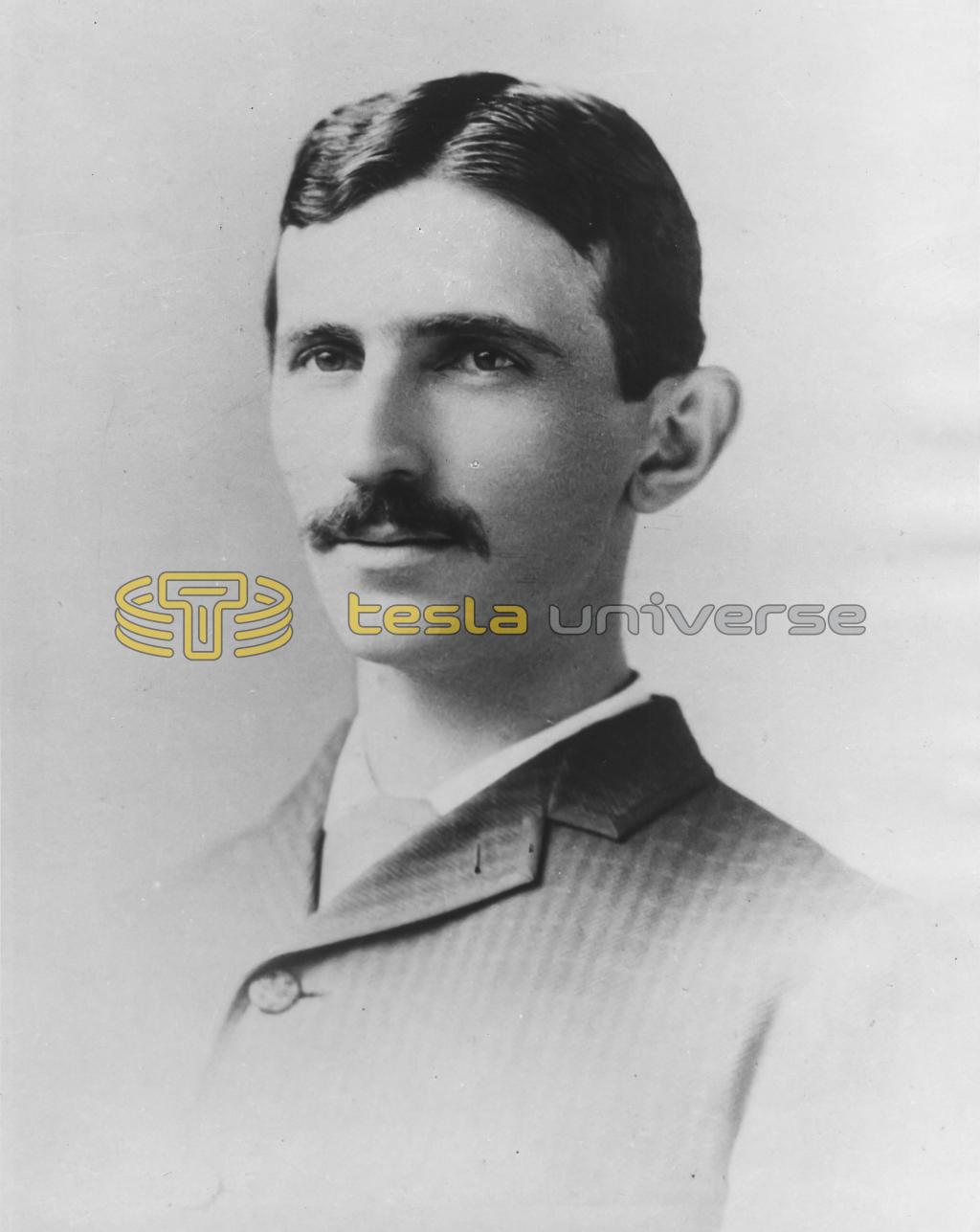
Although Tesla's seven earliest patents were issued on May 1, 1888, followed by four others during the same year, the value of the polyphase system was not generally realized until 1891, when the Frankfort-Lauffen experiment attracted world-wide attention to its merits. Both before and since that date, however, many modifications of Tesla's method had sprung into existence whose claims for utility were strongly urged by their respective promoters, and the history of the direct current method from the manufacturer's standpoint was repeated. Although extraordinary claims were advanced for these systems, and latterly numerous successful installations had been made, the manufacturer himself neglected them in the equipment of his own shop. With one or two exceptions, while the manufacturer of alternating current apparatus equipped his factory with electrical power apparatus, it was of the direct current type, which his own wares were professedly intended to supplant by reason of their superiority.
There were often more or less valid reasons for this seeming inconsistency, but the public knew them not, and from this circumstance, perhaps, more than any other has looked upon polyphase systems with lack of confidence, if not suspicion.
The greatest difficulty that the manufacturer has had to contend with in replacing an established system by a new one, has been to adapt the speeds of the new motors to the old pulley relations — either this had to be done or the pulley relations had to be adapted to the new motor speeds, either of which would involve an expense scarcely warranted by the results.
But when the Westinghouse Electric and Manufacturing Company began equipping their magnificent new works at East Pittsburg they were hampered by neither of these considerations, and were left entirely free to choose that system which they thought promised the best results. This company being the owners of all the Tesla polyphase patents, had for years been recommending the system to their patrons as universally applicable for general power distribution; and they have given evidence of their faith in the system by equipping their new works throughout with it.
This plant, which is now described for the first time, though not yet complete, forms the most interesting installation of polyphase apparatus thus far made, for several reasons. In the first place, the same type of apparatus, the same method of distribution and the same frequency of alternation of current (3,000 per minute) are employed as are to be used at Niagara. Its sufficiency for all the multifarious demands of these large works is therefore a demonstration of its sufficiency for all the demands that can be made upon it at Niagara. Furthermore, it is the first practical demonstration of this on a sufficiently extended scale to settle the matter beyond question. In the second place it is the first demonstration on a practical scale of the system to machinery and work of the greatest heterogeneity and severity of exactions and as a forerunner of the Niagara project will serve as an object lesson of the greatest value and do more to rapidly advance the great industrial progress in and around Niagara, which has to depend upon this very system, than almost any other agency.
Although anticipating a little, it may be well, in order to convey an idea of the variety of service that this system is supplying in the Westinghouse works, to catalogue the apparatus it is now driving.
PRESENT INSTALLATION.
Main Machinery Building, 754 feet long by 235 feet wide.
SMALL GENERATOR DEPARTMENT — MACHINES BELOW 100 H. P.
Ground Floor —
Two 40 h. p. motors each, driving planers, drill presses, lathes, etc., to the number of about 100 machines.
Galleries —
One 30 h. p., driving about 40 screw machines of various sizes.
Two 20 h. p. each driving 40 tools of various kinds in Tool Department.
One 40 h. p. driving about 40 tools of various sizes in Commutator Department.
One 20 h. p. driving about 25 or 30 tools in Brush-holder Department.
One 30 h. p. driving about 60 tools in Controller Department.
One 20 h. p. driving about 15 tools in Converter Department,
One 20 h. p. driving 15 punches and various tools in Mica Department.
Four 20 h. p. driving 200 winding lathes.
Six 40 h. p. driving fans for heating.
Making 20 motors of an aggregate of 620 h. p. already installed in this building.
There still remain to be installed in this building the following motors:
One 30 h. p. to drive 3 Ingersoll milling machines.
Two 30 h. p. in Railway Motor Armature Department, each of which will drive some 40 tools, lathes, etc.
One 15 h. p. in Motor Armature Winding Department.
Two 30 h. p. in Motor Machinery Department, each driving some 30 heavy tools, boring mills, lathes, drills, etc.
One 30 h. p. to drive 3 boring mills, one 122 inch by 35 inch lathe, two 72 inch radial drills, two large planers.
One 30 h. p. to operate planers, boring mills and drill presses.
Three 20 h. p. to drive large planers, boring mills, drill press and lathes.
Two 500 h. p. in General Testing Room.
One 75 h. p., one 60 h. p., one 40 h. p. in the Detail Testing Room.
Some of this machinery, together with the elevator and traveling cranes, is already installed and being temporarily driven by direct current apparatus, but it is intended to supplant all these by two-phase apparatus.
WAREHOUSE, 76 FEET X 754 FEET.
Motors already installed —
Four 20 h. p., each driving some 40 tools.
Two 30 h. p., each driving some 45 tools.
Two 40 h. p., each driving fans for heating purposes.
Making 8 motors of 220 h. p.
CARPENTER AND CABINET SHOP, 192 FEET X 60 FEET.
100 h. p. in small units, all direct current at present, but to be replaced with two-phase motors.
BLACKSMITH SHOP, 242 FEET X 82.6 FEET.
Two 20 h. p., on exhaust fans.
Two 10 h. p., on pressure fans.
One 20 h. p., driving two large shears and punches and 5 smaller tools.
Total — 5 motors of 80 h. p.
POWER HOUSE, 206 FEET X 76 FEET.
At present this contains—
Two 500 h. p. direct connected alternating current (two-phase) and two 500 h. p. direct connected direct current machines.
The full complement will be 3 units of 500 h. p. each of each kind.
PUNCH SHOP, 258 FEET X 76 FEET.
Two 80 h. p., each driving 40 odd punching machines.
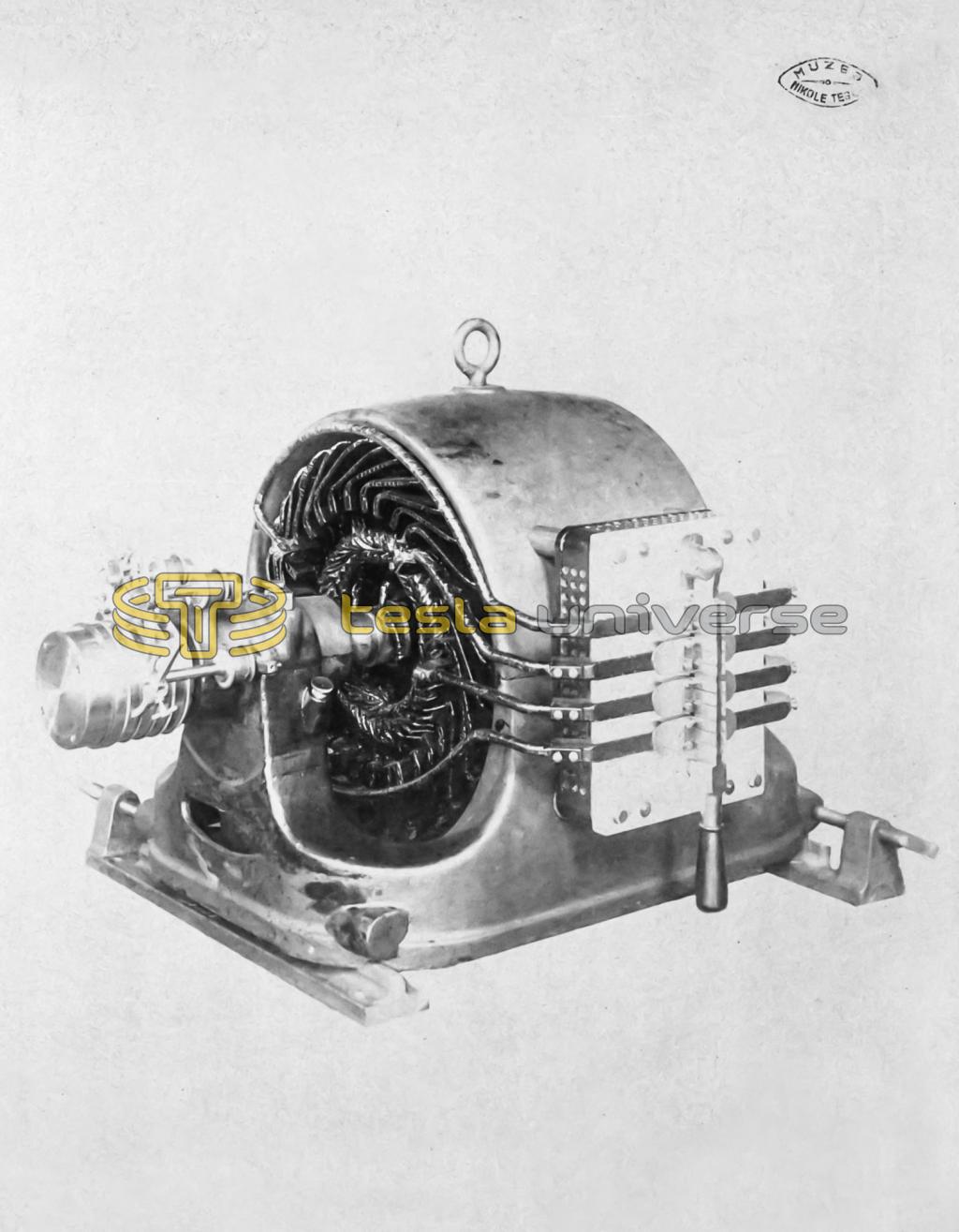
Recapitulating, we find that there are at present installed and in operation 37 alternating current motors of an aggregate capacity of 980 h. p. There are yet to be installed 16 more of a capacity of 1,390 h. p., besides several hundred horsepower direct current motors now installed to be replaced by two-phase alternate current motors.
It will be seen from this catalogue that the new plant constitutes by far the largest installation of polyphase motors that has heretofore ever been attempted and that these motors are doing almost every conceivable class of service except, electrolytic work. In addition to this, all of the lights, both arc and incandescent, for the whole establishment are supplied from the alternating current circuits, thus realizing on a most extended practical scale all the promises held out by the attractive "transmission of power" exhibit by this company at the World's Fair, and constituting this by far the most interesting plant anywhere in operation at the present time.
DESCRIPTION OF THE PLANT.
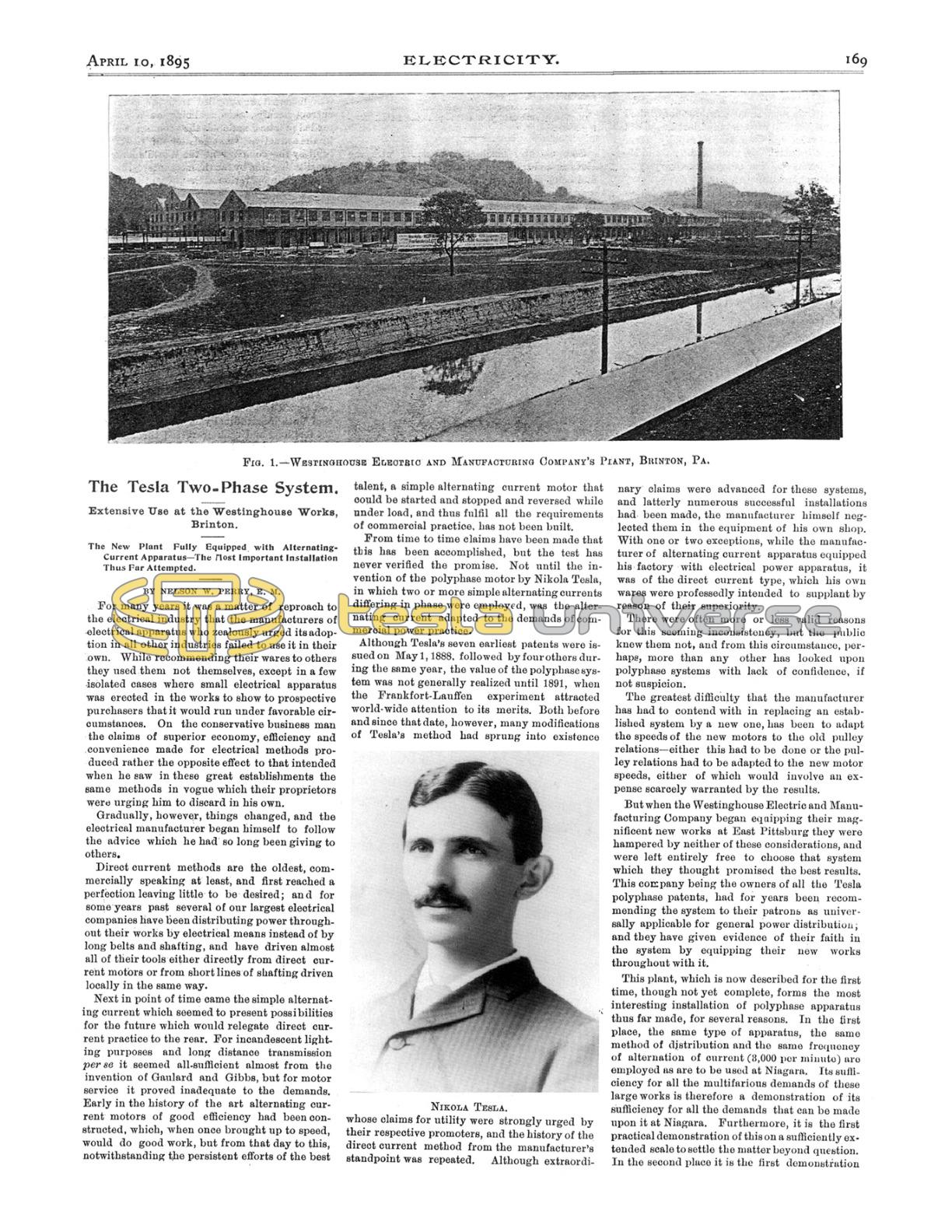
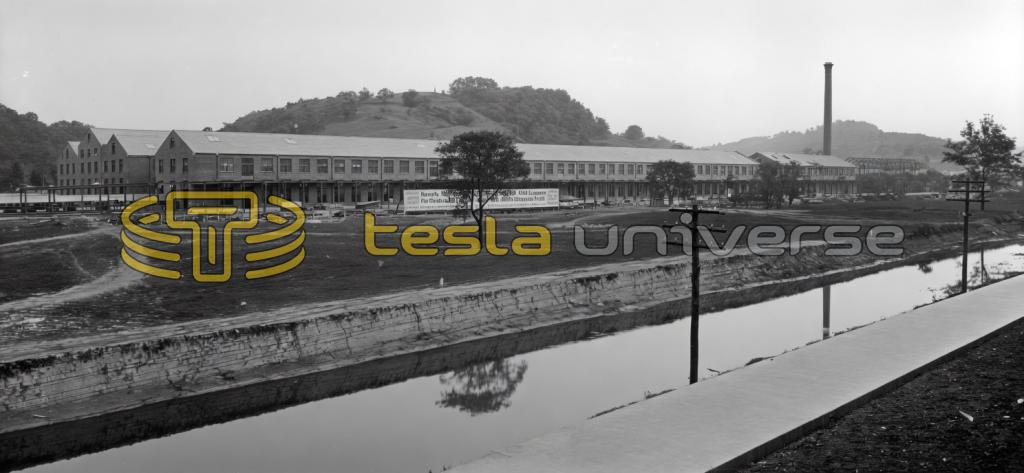
The site of the Westinghouse Electric & Manufacturing Company's new shops, which has been christened East Pittsburg, is 12 miles from Pittsburg, on the Pennsylvania Railroad. The buildings at present erected and occupied are seven in number, and in the order of size are the main machine shop, warehouse, punch shop, blacksmith shop, power house, carpenter shop, and temporary brass foundry. All of these are substantial brick buildings except the carpenter shop and the brass foundry, which are of corrugated iron.
THE MAIN MACHINE SHOP.
This, by far the largest, covers an area of 754 feet by 231 feet 6 inches, and is divided by the roof lines longitudinally into three aisles, each 754 feet long and each traversed throughout its whole length by railroad tracks connecting with the main line of the Pennsylvania Railroad. The main aisle is unbroken from floor to roof and traversed throughout its length by a 30-ton electric crane. Here all the heavy machine work and large generator erecting is carried on. The side aisles are both divided midway of their height by floors, under which in each case is a 10-ton electric crane with a 754-foot runway.
On the ground floor of the north aisle are located the motor armature winding, fitting, and assembling departments and storerooms, and in the south aisle are found the small generator department, small generator armature winding and assembling departments and more storerooms, and the entire eastern quarter of the three aisles as general testing rooms for the classes of work done in their respective western portions.
On the second floor of the north wing, beginning at the west and going east, are the screw department, tool and storeroom, brush-holder department and railway equipment rooms, and similarly situated in the south wing are the wire storeroom, winding and insulation department, mica department, detail testing room and converter department.
Each of these longitudinal sections of the building is traversed by line shafting divided into numerous sections, each of which is belted to an individual two-phase motor situated on the floor, and from which are belted the various tools and machines already enumerated. This plan of transmission from motor to tool is observed throughout the various buildings and need not be again referred to. It may also be stated here that with the exception of three small steam hammers for copper forging, in the blacksmith shop, every piece of machinery in the establishment is electrically driven.
THE WAREHOUSE.
Directly south of the machine shop is a building of equal length, but only 76 feet 2 inches broad, whose entire first floor is occupied as a warehouse, in which all finished and returned material is stored for further disposal. For the handling of this material there are two 10 ton electric cranes with runways extending the entire length of the building.
The second floor is connected by five bridges with the second floor of the south wing of the machine shop thus practically making the two one. The west end of this floor is devoted to the general offices of the administrative, engineering and draughting departments and the eastern end to the instrument department, including meter, arc lamp and switchboard equipments.
THE POWER HOUSE.
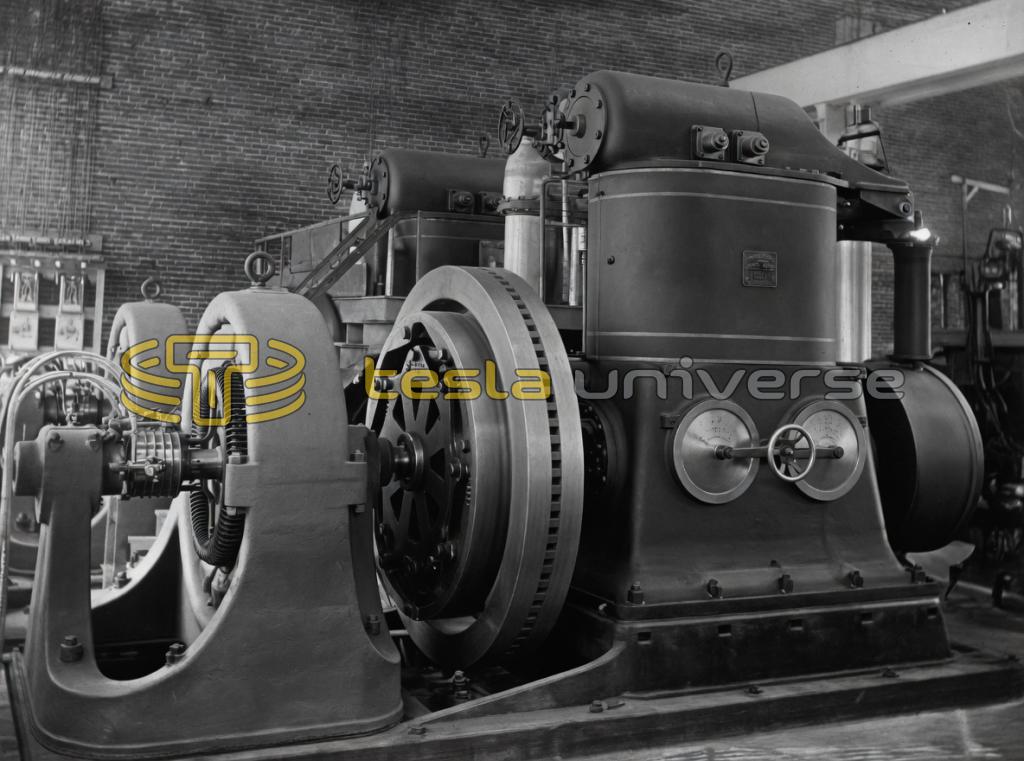
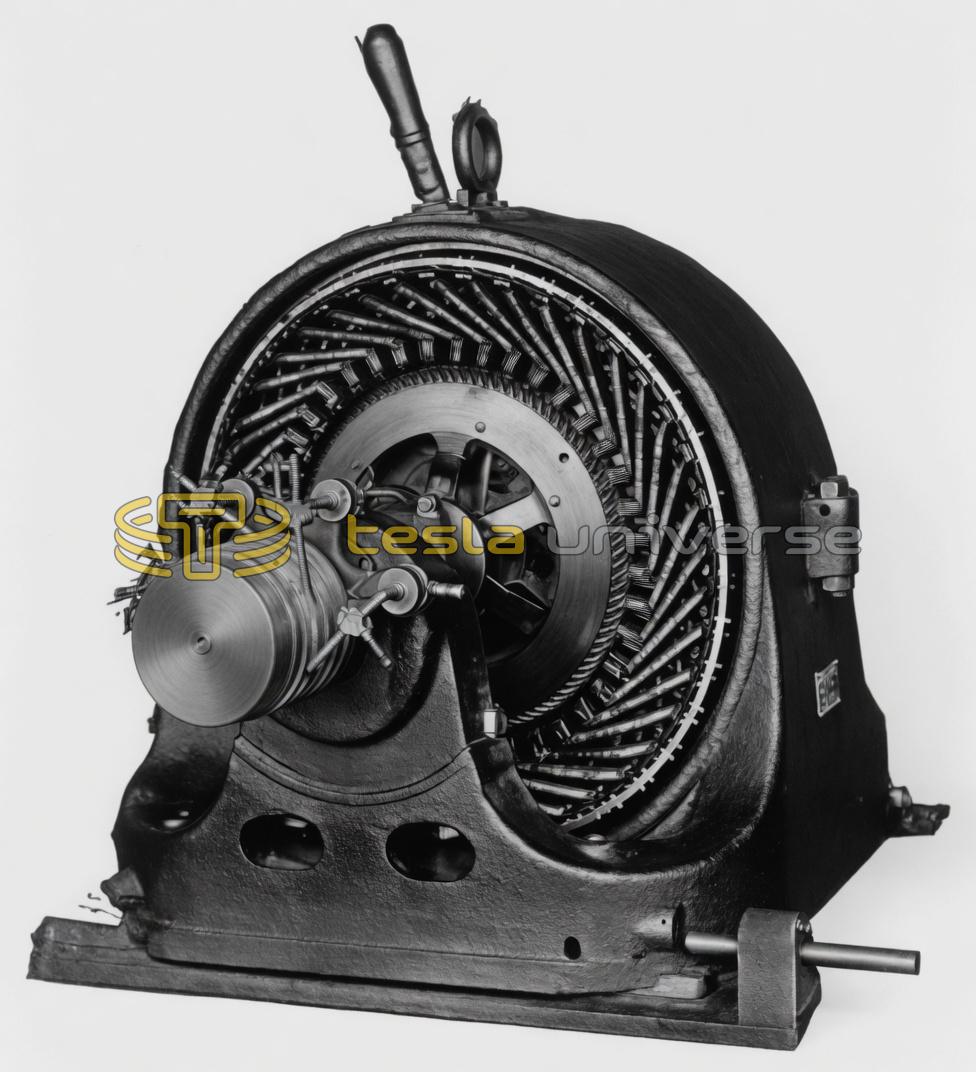
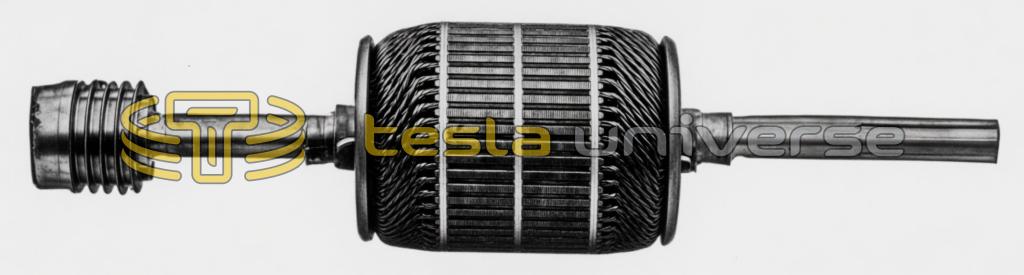
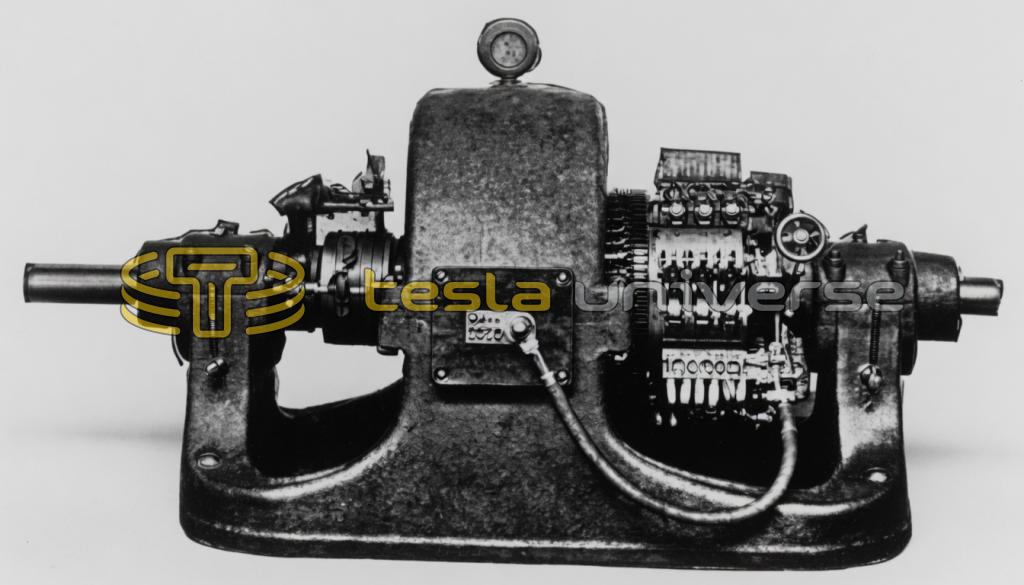
East of the warehouse, and separated from it by a passageway 52 feet wide, is the power house. This is 206 feet long by 76 feet 2 inches wide, and devoted in its western part to the engines and dynamos and two hand-operated overhead cranes and in its eastern part to the boilers. The latter are Pierpoint boilers of 2,500 h. p., and there is room for an equal number more. These boilers are equipped with the Roney mechanical stoker. The fuel is delivered from cars on an elevated track direct into large iron hoppers from which it descends as needed to the grates without manual handling of any sort. The present engine and dynamo equipment consists of two 500 h. p. Westinghouse compound engines directly connected by means of two standard Westinghouse flexible couplings to two 500 h. p. two-phase Tesla generators, and two similar engines connected in the same way to two 500 volt multipolar direct current generators. The foundations are all ready for one more 500 h. p. unit of each kind.
PUNCH SHOP.
Fifty feet to the east of the power house and on the same lines is the punch shop, 258 feet long by 76 feet 2 inches wide. Upon the ground floor are the shearing and heavy punching machines, and storage for sheet iron. In the extreme east end are the annealing ovens. The second story is devoted exclusively to the machines for punching armature disks, converter and other shapes for laminated structures.
Running along the north fronts of the warehouse, power house and punch shop is a surface railroad track connecting with the Pennsylvania Railroad's main line, and along the south walls an elevated track by which shipments to and from the second stories of the buildings are made.
TEMPORARY BRASS FOUNDRY.
Just north of the punch shop is a one-story corrugated iron building, 40 feet by 242 feet, used as a brass foundry, and north of this is the
BLACKSMITH SHOP.
This is a substantial brick building covering an area of 242 feet by 82 feet 6 inches. These last three buildings complete the extreme eastern tier of buildings, as do the machine shop and warehouse the western.
Through the center of the building runs a track for local transportation purposes. There are already erected and in operation within this building twenty-five forge fires, and there are fifteen more to be installed. The blast for these forges is supplied by two 10 h. p. two-phase motors. Over each fire is suspended a large sheet-iron hood to collect the smoke and other products of combustion, and these are connected with a system of flues in which a strong draft is created by exhaust fans operated by two 20 h. p. Tesla motors. There are also two large Allstatter combined shears and punches and some smaller tools operated by one 20 h. p. motor. Besides these there are three small steam hammers for forging copper bars of the largest size used in dynamo construction.
CARPENTER SHOP.
The carpenter shop, 60 by 192 feet, lying east of the machine shop, is a one-story corrugated iron building, fully equipped for the purpose. In the 65 feet space separating the machine shop from the warehouse is located the
COIL-BAKING AND OIL STORAGE HOUSE,
which is a small brick building, 182 feet 10 inches long by 27 feet 4 inches wide, devoted to the purposes indicated in its name. On the roof of this has been constructed a light, airy room in which the thousands of blueprints used by this great establishment are prepared.
(To be continued.)
Editor's note: See part two here.