Nikola Tesla Articles
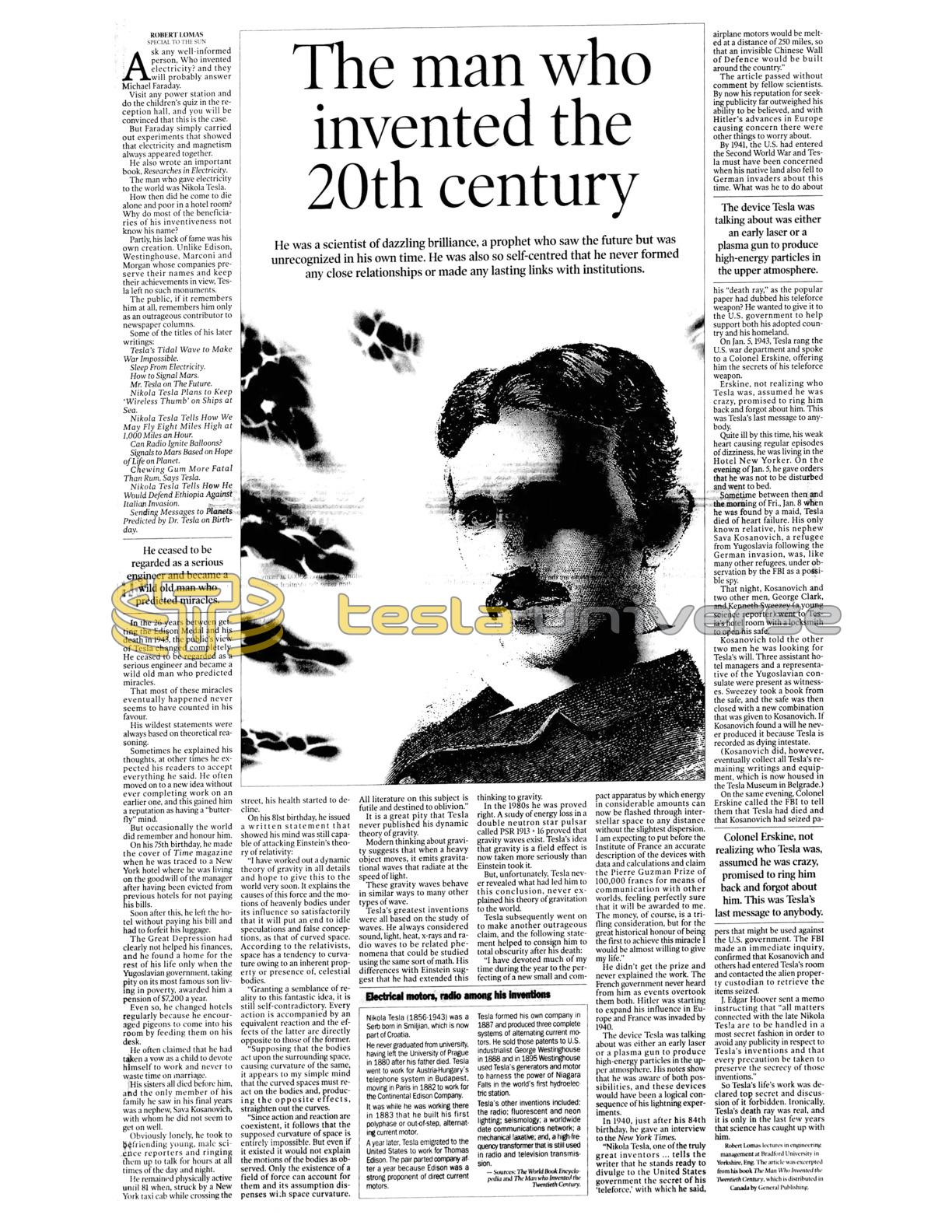
The Man Who Invented the 20th Century
ROBERT LOMAS
SPECIAL TO THE SUN
Ask any well-informed person, Who invented electricity? and they will probably answer Michael Faraday.
Visit any power station and do the children's quiz in the reception hall, and you will be convinced that this is the case.
But Faraday simply carried out experiments that showed that electricity and magnetism always appeared together.
He also wrote an important book, Researches in Electricity.
The man who gave electricity to the world was Nikola Tesla.
How then did he come to die alone and poor in a hotel room? Why do most of the beneficiaries of his inventiveness not know his name?
Partly, his lack of fame was his own creation. Unlike Edison, Westinghouse, Marconi and Morgan whose companies preserve their names and keep their achievements in view, Tesla left no such monuments.
The public, if it remembers him at all, remembers him only as an outrageous contributor to newspaper columns.
Some of the titles of his later writings:
Tesla's Tidal Wave to Make War Impossible.
Sleep From Electricity.
How to Signal Mars.
Mr. Tesla on The Future.
Nikola Tesla Plans to Keep 'Wireless Thumb' on Ships at Sea.
Nikola Tesla Tells How We May Fly Eight Miles High at 1,000 Miles an Hour.
Can Radio Ignite Balloons?
Signals to Mars Based on Hope of Life on Planet.
Chewing Gum More Fatal Than Rum, Says Tesla.
Nikola Tesla Tells How He Would Defend Ethiopia Against Italian Invasion. Sending Messages to Planets Predicted by Dr. Tesla on Birthday.
He ceased to be regarded as a serious engineer and became a wild old man who predicted miracles.
In the 26 years between getting the Edison Medal and his death in 1943, the public's view of Tesla changed completely. He ceased to be regarded as a serious engineer and became a wild old man who predicted miracles.
That most of these miracles eventually happened never seems to have counted in his favour.
His wildest statements were always based on theoretical reasoning.
Sometimes he explained his thoughts, at other times he expected his readers to accept everything he said. He often moved on to a new idea without ever completing work on an earlier one, and this gained him a reputation as having a "butterfly" mind.
But occasionally the world did remember and honour him.
On his 75th birthday, he made the cover of Time magazine when he was traced to a New York hotel where he was living on the goodwill of the manager after having been evicted from previous hotels for not paying his bills.
Soon after this, he left the hotel without paying his bill and had to forfeit his luggage.
The Great Depression had clearly not helped his finances, and he found a home for the rest of his life only when the Yugoslavian government, taking pity on its most famous son living in poverty, awarded him a pension of $7,200 a year.
Even so, he changed hotels regularly because he encouraged pigeons to come into his room by feeding them on his desk.
He often claimed that he had taken a vow as a child to devote himself to work and never to waste time on marriage.
His sisters all died before him, and the only member of his family he saw in his final years was a nephew, Sava Kosanovich, with whom he did not seem to get on well.
Obviously lonely, he took to befriending young, male science reporters and ringing them up to talk for hours at all times of the day and night.
He remained physically active until 81 when, struck by a New York taxi cab while crossing the street, his health started to decline.
On his 81st birthday, he issued a written statement that showed his mind was still capable of attacking Einstein's theory of relativity:
"I have worked out a dynamic theory of gravity in all details and hope to give this to the world very soon. It explains the causes of this force and the motions of heavenly bodies under its influence so satisfactorily that it will put an end to idle speculations and false conceptions, as that of curved space. According to the relativists, space has a tendency to curvature owing to an inherent property or presence of, celestial bodies.
"Granting a semblance of reality to this fantastic idea, it is still self-contradictory. Every action is accompanied by an equivalent reaction and the effects of the latter are directly opposite to those of the former.
"Supposing that the bodies act upon the surrounding space, causing curvature of the same, it appears to my simple mind that the curved spaces must react on the bodies and, producing the opposite effects, straighten out the curves.
"Since action and reaction are coexistent, it follows that the supposed curvature of space is entirely impossible. But even if it existed it would not explain the motions of the bodies as observed. Only the existence of a field of force can account for them and its assumption dispenses with space curvature.
All literature on this subject is futile and destined to oblivion."
It is a great pity that Tesla never published his dynamic theory of gravity.
Modern thinking about gravity suggests that when a heavy object moves, it emits gravitational waves that radiate at the speed of light.
These gravity waves behave in similar ways to many other types of wave.
Tesla's greatest inventions were all based on the study of waves. He always considered sound, light, heat, x-rays and radio waves to be related phenomena that could be studied using the same sort of math. His differences with Einstein suggest that he had extended this idea thinking to gravity.
Electrical motors, radio among his inventions
Nikola Tesla (1856-1943) was a Serb born in Smiljian, which is now part of Croatia.
He never graduated from university, having left the University of Prague in 1880 after his father died. Tesla went to work for Austria-Hungary's telephone system in Budapest, moving in Paris in 1882 to work for the Continental Edison Company.
It was while he was working there in 1883 that he built his first polyphase or out-of-step, alternating current motor.
A year later, Tesla emigrated to the United States to work for Thomas Edison. The pair parted company af- ter a year because Edison was a strong proponent of direct current motors.
Tesla formed his own company in 1887 and produced three complete systems of alternating current motors. He sold those patents to U.S. industrialist George Westinghouse in 1888 and in 1895 Westinghouse used Tesla's generators and motor to harness the power of Niagara Falls in the world's first hydroelectric station.
Tesla's other inventions included: the radio; fluorescent and neon lighting; seismology; a worldwide date communications network; a mechanical laxative; and, a high-frequency transformer that is still used in radio and television transmission.
—Sources: The World Book Encyclopedia and The Man who Invented the Twentieth Century.
In the 1980s he was proved right. A study of energy loss in a double neutron star pulsar called PSR 1913 + 16 proved that gravity waves exist. Tesla's idea that gravity is a field effect is now taken more seriously than Einstein took it.
But, unfortunately, Tesla never revealed what had led him to this conclusion, never explained his theory of gravitation to the world.
Tesla subsequently went on to make another outrageous claim, and the following statement helped to consign him to total obscurity after his death:
"I have devoted much of my time during the year to the perfecting of a new small and compact apparatus by which energy in considerable amounts can now be flashed through interstellar space to any distance without the slightest dispersion. I am expecting to put before the Institute of France an accurate description of the devices with data and calculations and claim the Pierre Guzman Prize of 100,000 francs for means of communication with other worlds, feeling perfectly sure that it will be awarded to me. The money, of course, is a trifling consideration, but for the great historical honour of being the first to achieve this miracle I would be almost willing to give my life."
He didn't get the prize and never explained the work. The French government never heard from him as events overtook them both. Hitler was starting to expand his influence in Europe and France was invaded by 1940.
The device Tesla was talking about was either an early laser or a plasma gun to produce high-energy particles in the upper atmosphere. His notes show that he was aware of both possibilities, and these devices would have been a logical consequence of his lightning experiments.
In 1940, just after his 84th birthday, he gave an interview to the New York Times.
"Nikola Tesla, one of the truly great inventors... tells the writer that he stands ready to divulge to the United States government the secret of his 'teleforce,' with which he said, airplane motors would be melted at a distance of 250 miles, so that an invisible Chinese Wall of Defence would be built around the country."
The article passed without comment by fellow scientists. By now his reputation for seeking publicity far outweighed his ability to be believed, and with Hitler's advances in Europe causing concern there were other things to worry about.
By 1941, the U.S. had entered the Second World War and Tesla must have been concerned when his native land also fell to German invaders about this time. What was he to do about
The device Tesla was talking about was either an early laser or a plasma gun to produce high-energy particles in the upper atmosphere.
his "death ray," as the popular paper had dubbed his teleforce weapon? He wanted to give it to the U.S. government to help support both his adopted country and his homeland.
On Jan. 5, 1943, Tesla rang the U.S. war department and spoke to a Colonel Erskine, offering him the secrets of his teleforce weapon.
Erskine, not realizing who Tesla was, assumed he was crazy, promised to ring him back and forgot about him. This was Tesla's last message to anybody.
Quite ill by this time, his weak heart causing regular episodes of dizziness, he was living in the Hotel New Yorker. On the evening of Jan. 5, he gave orders that he was not to be disturbed and went to bed.
Sometime between then and the morning of Fri., Jan. 8 when he was found by a maid, Tesla died of heart failure. His only known relative, his nephew Sava Kosanovich, a refugee from Yugoslavia following the German invasion, was, like many other refugees, under observation by the FBI as a possible spy.
That night, Kosanovich and two other men, George Clark, and Kenneth Sweezey (a young science reporter) went to Tesla's hotel room with a locksmith to open his safe.
Kosanovich told the other two men he was looking for Tesla's will. Three assistant hotel managers and a representative of the Yugoslavian consulate were present as witnesses. Sweezey took a book from the safe, and the safe was then closed with a new combination that was given to Kosanovich. If Kosanovich found a will he never produced it because Tesla is recorded as dying intestate.
(Kosanovich did, however, eventually collect all Tesla's remaining writings and equipment, which is now housed in the Tesla Museum in Belgrade.)
Colonel Erskine, not realizing who Tesla was, assumed he was crazy, promised to ring him back and forgot about him. This was Tesla's last message to anybody.
On the same evening, Colonel Erskine called the FBI to tell them that Tesla had died and that Kosanovich had seized papers that might be used against the U.S. government. The FBI made an immediate inquiry, confirmed that Kosanovich and others had entered Tesla's room and contacted the alien property custodian to retrieve the items seized.
J. Edgar Hoover sent a memo instructing that "all matters connected with the late Nikola Tesla are to be handled in a most secret fashion in order to avoid any publicity in respect to Tesla's inventions and that every precaution be taken to preserve the secrecy of those inventions."
So Tesla's life's work was declared top secret and discussion of it forbidden. Ironically, Tesla's death ray was real, and it is only in the last few years that science has caught up with him.
Robert Lomas lectures in engineering management at Bradford University in Yorkshire, Eng. The article was excerpted from his book The Man Who Invented the Twentieth Century, which is distributed in Canada by General Publishing.